


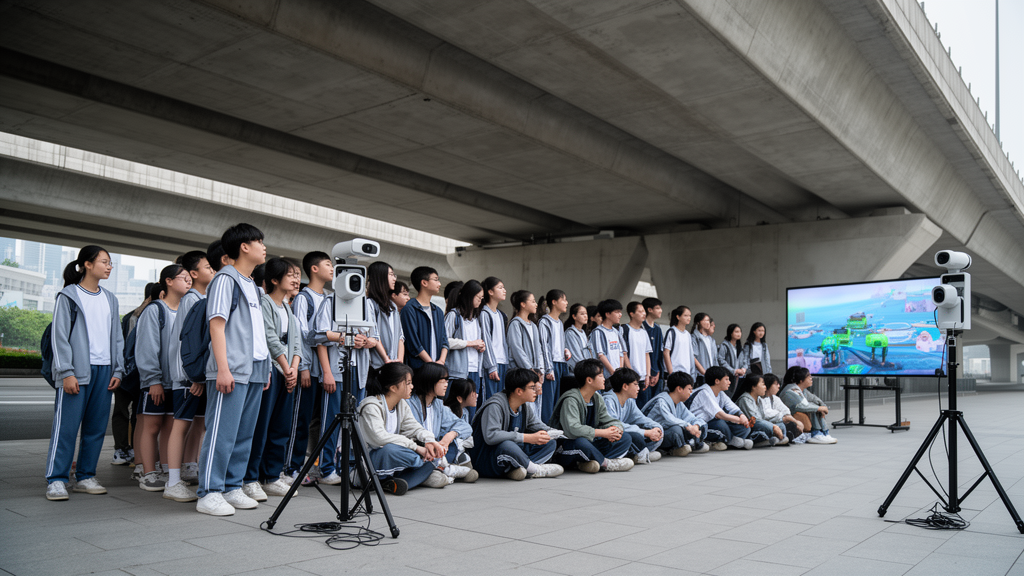
An exploratory laboratory study of 49 undergraduate students found no statistically significant scenario-level differences in any of seven relative facial-expression scores after viewing three recorded environments in a Shanghai under-viaduct park. The scenarios nevertheless contained sharply different visual and acoustic combinations, and hierarchical clustering identified six recurring audiovisual patterns. The results suggest that natural features and transport-related cues in these spaces should be evaluated together, while offering no evidence that any particular combination caused a specific emotional response.
The research took place at Jing’an Zhonghuan Park, a green space of approximately 78,000 square metres beneath the interchange of Shanghai’s Middle Ring Road and North–South Elevated Road. Vegetation-dominated recreational areas coexist there with exposed roads, moving vehicles, bridge structures and traffic facilities. The investigators selected three representative recordings from this single site: S1, a green landscape recorded during off-peak traffic; S2, a green landscape recorded during peak traffic; and S3, a transport-oriented view recorded during peak traffic. The missing combination—a transport-oriented view during off-peak traffic—was not included, so the scenarios represented observed field conditions rather than a fully crossed experimental design.
All 49 participants, including 35 women and 14 men aged 20 to 28, viewed the scenarios as one continuous stimulus in a fixed order. The analyzed material comprised 33 seconds of S1, 41 seconds of S2 and 36 seconds of S3, or 110 retained one-second stimulus intervals. An initial 10-second immersion period and transition segments were excluded. Participants sat about 1.5 metres from a projected image measuring 69 by 39 centimetres and wore the same over-ear noise-canceling headphones at a fixed device volume of 60%. Although this standardized the presentation, the headphone output was not calibrated at ear level, so the field sound levels describe the recording environments rather than the exact sound pressure received by participants.
Visual composition was measured by extracting one frame at each retained time point and applying semantic-segmentation models trained on the ADE20K and Cityscapes datasets. The model outputs were consolidated into ten mutually exclusive categories: vegetation, water, sky, terrain, building, hardscape, road, vehicle, traffic facility and person. The proportion of pixels in each category described what occupied the frame, and ambiguous boundaries and apparent classification errors were checked against the original images. S1 contained 77.43% natural features, including 37.55% vegetation and 34.76% water, with built and transport-related features accounting for 22.58%. S2 was more mixed, with natural features at 47.15%, built and transport-related features at 52.34% and people at 0.51%. In S3, built and transport-related features reached 83.42%, natural features fell to 15.83% and vegetation covered only 7.72%.
Acoustic conditions were characterized through both field measurement and source coding. Ten-minute A-weighted equivalent continuous sound-pressure measurements yielded 54.5 dB(A) for S1 during off-peak traffic, 74.2 dB(A) for S2 during peak traffic and 76.7 dB(A) for S3 during peak traffic. Within the recordings, a pretrained YAMNet model detected sound events at one-second resolution, and researchers checked the automated classifications against spectrograms and audible content. Bird vocalizations, flowing water, tire-road interaction, engine noise and railway noise were each assigned a prominence score from zero, indicating absence or unreliable identification, to three, indicating a highly prominent or dominant source.
The source profiles revealed differences hidden by overall sound level. Bird vocalizations appeared in 96.97% of S1’s intervals and flowing water in 66.67%, while transport sounds were intermittent and weak. In S2, tire-road interaction was detected in every interval, with mean prominence of 2.39, and engine noise occurred in 97.56%; natural sounds were uncommon and generally weak. S3 also contained tire-road interaction throughout, while engine noise appeared in 75.00% of intervals and railway noise in 25.00%. Railway noise was concentrated in the first six seconds of S3, after which road-traffic sounds formed the principal acoustic components. These recordings therefore differed not only in measured level but also in the mixture and prominence of their sound sources.
Participants’ faces were recorded continuously with an iPhone 16 Pro at 1080p and 60 frames per second. One frame per retained time point was processed with DeepFace version 0.0.93, and all 49 participants had valid outputs at every retained point, yielding 5,390 participant-by-time observations. The model returned percentages for angry, disgust, fear, happy, sad, surprise and neutral. These seven values always summed to 100%, making them a composition rather than independent outcomes. The researchers accordingly treated them as relative scores describing observable facial-expression responses, not direct measurements of participants’ subjective emotional states, and interpreted category-specific tests as exploratory comparisons within the composition.
Neutral received the highest mean score in all three scenarios, ranging from 30.31% in S2 to 34.03% in S3, while fear was the largest non-neutral component, ranging from 18.57% to 20.86%. S1 had the highest descriptive happy score, 9.64%, and surprise score, 8.92%, and the lowest sad score, 14.54%. S3 had the highest fear score, and S2 had the highest angry score, 15.92%, along with a sad mean of 18.69%. Yet component-wise Friedman tests found no significant scenario differences before correction, and all remained non-significant after Holm adjustment, with adjusted p-values of at least 0.712. This result does not establish equivalence in the complete facial-expression composition; it means only that the individual components showed no statistically supported differences in this sample.
Hierarchical clustering provided a finer description of the recordings. The researchers standardized ten visual variables and five sound-source prominence scores, then used Ward’s linkage with Euclidean distance to group the 110 retained intervals. A six-cluster solution was retained because it was more interpretable than an eight-cluster alternative that subdivided similar profiles; its silhouette coefficient was 0.512, its Calinski-Harabasz index 62.514 and its Davies-Bouldin index 0.843. P1, Natural landscape, combined vegetation, water and terrain with bird vocalizations and flowing water across 35 intervals. P2, Green landscape with traffic sounds, paired vegetation and hardscape with tire and engine noise. P3 represented railway infrastructure, while P4 represented a built road corridor, P5 an open road corridor and P6 a traffic corridor with vegetation.
Pattern identity was tightly associated with scenario and temporal position, preventing the clusters from being interpreted as independent effects. Every one of S1’s 33 intervals belonged to P1. S2 contained four patterns, led by P2 and P6, whereas S3 contained P4, P5 and P3 as successive contiguous blocks. A restricted sensitivity analysis within S2 compared P2, P5 and P6; no facial-expression component differed significantly after Holm adjustment, with all adjusted p-values equal to 1.000. Descriptively, P1 had the lowest sad score at 14.64%, while P4 had the highest fear score at 21.77%, followed by P5 at 20.89%. These differences cannot be separated cleanly from scenario, fixed order, temporal position, habituation, fatigue or carry-over effects.
The study was limited by its single Shanghai site, homogeneous undergraduate sample, simplified laboratory presentation, uncalibrated headphone exposure and fixed stimulus order. One-second intervals provided a common sampling and synchronization unit, not psychologically discrete response windows, and adjacent observations were temporally dependent. The findings are best treated as hypothesis-generating: they show that one under-viaduct park contains distinct combinations of visible features and sound sources, but they do not establish that any pattern improves mood, increases fear or produces another subjective emotional state. Broader assessment would require multiple sites, more diverse participants, counterbalanced and field-based presentations, and methods that can separate pattern, scenario and temporal effects. For now, the central result is that visual greenness and overall decibels alone cannot characterize how nature and traffic coexist within these urban green spaces.
Subject of Research: Audiovisual patterns and relative facial-expression responses in a Shanghai under-viaduct green space
Article Title: Audiovisual characteristics, patterns, and facial-expression responses in an under-viaduct green space
Article References: Yin, Y., Wang, F., Li, C., & Ma, D. (2026). Audiovisual characteristics, patterns, and facial-expression responses in an under-viaduct green space. Frontiers in Psychology, 17, Article 1970940. https://doi.org/10.3389/fpsyg.2026.1970940
Image Credits: AI Generated
DOI: 10.3389/fpsyg.2026.1970940
Keywords: audiovisual patterns, facial-expression analysis, under-viaduct park, Shanghai, traffic noise, multisensory perception, semantic segmentation, urban green space, environmental psychology, restorative environments, Audiovisual, characteristics
Cite Scienmag News
Glenn Wilkins. (October 25, 2026). Shanghai students showed no facial-expression differences across under-viaduct audiovisual scenarios. Scienmag. https://scienmag.com/shanghai-students-showed-no-facial-expression-differences-across-under-viaduct-audiovisual-scenarios/
Glenn Wilkins. "Shanghai students showed no facial-expression differences across under-viaduct audiovisual scenarios." Scienmag, 25 October 2026, https://scienmag.com/shanghai-students-showed-no-facial-expression-differences-across-under-viaduct-audiovisual-scenarios/. Accessed 25 October 2026.
Glenn Wilkins. "Shanghai students showed no facial-expression differences across under-viaduct audiovisual scenarios." Scienmag. October 25, 2026. https://scienmag.com/shanghai-students-showed-no-facial-expression-differences-across-under-viaduct-audiovisual-scenarios/


