


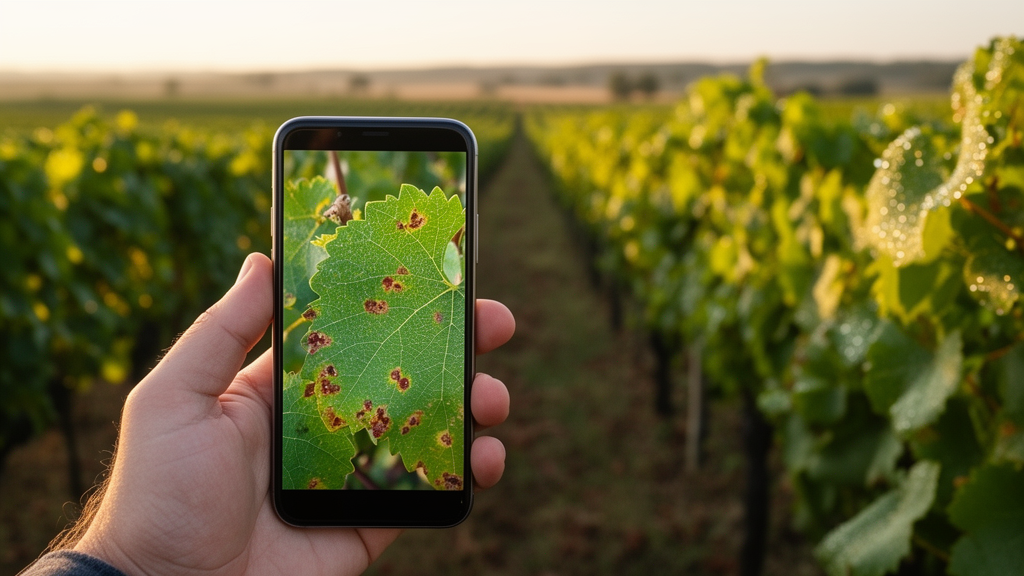
Grapevines face a constant barrage of diseases that threaten both yield and fruit quality, and the lesions that betray these infections are often maddeningly small. Black rot spots, black measles patches, and blighted areas can appear in dense clusters across a leaf, each occupying only a tiny fraction of the surface. A research team led by Guangda Chen, Shiyu Jin, Yanfei Jia, and Shuaiwei Fu has now built a compact artificial intelligence detector, called YOLOv10n-RLF, designed to find these fine-grained symptoms while remaining small enough to run on the kinds of low-power devices that farmers actually carry into the vineyard. The work, published as an open-access research article in Discover Artificial Intelligence, reports a model that cuts parameters by 30.4 percent, computational load by 26.2 percent, and file size by 36.4 percent relative to its YOLOv10n baseline, while sacrificing only 0.3 percentage points of mean average precision at an intersection-over-union threshold of 0.5 and 0.2 percentage points at the stricter 0.5:0.95 range.
The motivation is practical. Grape disease identification still relies largely on manual observation and expert experience, which is labor-intensive, time-consuming, and dependent on the skill of the observer. Accurate and timely identification can reduce yield losses and help curb excessive pesticide use, but existing machine-vision approaches have struggled with two problems at once: the targets themselves are small and morphologically diverse, and the models that detect them well tend to be too heavy for mobile deployment. Earlier systems illustrate the tension. A YOLOv8-based model for grape leaf disease recognition reached a size of 49.3 megabytes, and a citrus disease detector built on a ConvNeXtV2 backbone demanded 16.4 gigafloating-point operations, both figures that strain embedded hardware.
The team chose YOLOv10n as its starting point for several reasons. YOLOv10 uses an end-to-end detection paradigm based on a consistent dual-assignment strategy, which eliminates the need for non-maximum suppression during inference and trims computational overhead. It also offers a favorable accuracy-efficiency balance for closed-set agricultural tasks, whereas Transformer-based detectors such as DETR and ViTDet, despite competitive accuracy, carry computational complexity poorly suited to resource-constrained edge devices. COCO-pretrained weights provided strong initialization for fine-tuning on the researchers’ relatively small domain-specific dataset, helping to mitigate overfitting.
Four modifications define YOLOv10n-RLF. The first is the C2f-RVB module, which replaces the Bottleneck blocks inside YOLOv10’s C2f feature-learning units with RepViT blocks. RepViT separates token mixing from channel mixing, moving the 3-by-3 depthwise convolution and an optional squeeze-and-excitation module to the front of the block, and uses structural reparameterization so that parallel branches can be fused into a single depthwise convolution at inference time. This decoupling improves feature-extraction efficiency and reduces redundancy, cutting parameters by 21.74 percent and gigafloating-point operations by 19.54 percent on its own.
The second change is a lightweight shared-convolution detection head, v10_LSCD, which swaps batch normalization for group normalization and shares convolutional weights across all three detection scales. Group normalization is independent of batch size, an advantage when memory constraints force small batches, and previous studies have linked it to improved localization and classification in detection heads. The shared design reduces the detection head’s parameter count from roughly 471,000 to 121,779, a cut of about 74 percent, while per-level Scale layers compensate for cross-scale magnitude differences. Both the one-to-one and one-to-many heads are retained during training for richer supervision, but only the one-to-one head runs at inference, preserving the NMS-free pipeline.
The third and arguably most interesting component is the Feature Pyramid Shared Convolution module, or FPSC, which replaces the Spatial Pyramid Pooling-Fast block. Instead of non-learnable max pooling, FPSC applies a single shared 3-by-3 kernel three times with dilation rates of 1, 3, and 5, yielding effective kernel sizes of 3-by-3, 7-by-7, and 11-by-11 without adding parameters or operations, and effective receptive fields of 3, 9, and 19 comparable to SPPF. Because lesion textures show self-similar morphology across scales, reusing one kernel encourages scale-invariant feature extraction and acts as a regularizer on the small dataset. The serial arrangement follows the Hybrid Dilated Convolution principle: moderate, pairwise-coprime dilation rates stacked in series let each layer’s sampling pattern complement the previous one, avoiding the gridding artifacts that can leave gaps in coverage. FPSC is not lighter than SPPF, containing 312,064 parameters against 164,608; its role is to recover accuracy lost during aggressive compression, and the ablation experiments show it does exactly that, lifting mAP@0.5 by 1.7 percentage points when added to the compressed configuration, compared with only 0.2 points on the full baseline.
The fourth modification replaces the default complete intersection-over-union regression loss with SIoU, which adds an angle cost that aligns the center of the predicted box with the ground-truth center, alongside distance and shape costs. This accelerates convergence and sharpens localization of small, densely packed lesions. Consistent with that design intent, the final model converged faster during the first 50 training epochs, and its validation loss stabilized after epoch 150 with no obvious overfitting across the 300-epoch schedule.
The evidence base is a dataset of 4,290 images covering four categories: black rot, black measles (Esca), leaf blight, and healthy leaves. Of these, 2,360 were field-captured at Jiangbei Vineyard in Jilin City, Jilin Province, China, during the 2023 and 2024 growing seasons using a Canon EOS 80D camera under natural daylight at distances of 0.5 to 1.5 meters, with each physical leaf photographed exactly once at one of three viewing angles. The remaining 1,930 images came from the public PlantVillage database and were re-annotated at the lesion level, since the database originally provides only image-level labels. Annotations followed a two-level protocol: individual lesion boxes for the three disease categories and whole-leaf boxes for healthy leaves, with all annotations cross-validated by at least two experts from the Jilin Provincial Academy of Agricultural Sciences. Across the 12,847 bounding boxes, 67.7 percent of the 11,817 lesion boxes fall into the small category, below 32 by 32 pixels in the 640-by-640 input coordinate space, confirming that small targets dominate the task. A stratified 7:2:1 split by source and category yielded 3,003 training, 858 validation, and 429 test images, and because each leaf appears in exactly one image, the split guarantees independence at the leaf level, though leaves from the same vine may span subsets, so the evaluation is leaf-level rather than vineyard-level validation.
The ablation and comparison results trace a deliberate engineering trade-off. Combining C2f-RVB, v10_LSCD, and SIoU cut parameters by 36.8 percent but cost 2.0 and 2.4 percentage points of mAP@0.5 and mAP@0.5:0.95; adding FPSC recovered most of that loss, producing the final model with a net 30.4 percent parameter reduction, from 2.3 million to 1.6 million, and a 2.0-megabyte size reduction. Size-stratified evaluation, computed exclusively from lesion boxes, showed FPSC alone improving AP_small by 2.8 percentage points over the baseline and the final model by 1.9 points, with slight decreases for medium and large lesions; the large bin contains only 242 boxes, so AP_large should be interpreted with caution. Multi-seed runs with seeds 3407, 42, and 2024 confirmed these effects, with standard deviations below 0.5. Lesion-only mean average precision fell just 0.1 points to 90.4 percent at IoU 0.5, and Grad-CAM heatmaps showed more concentrated responses around small lesions for the new model. Against nine other detectors trained under a common dataset, resolution, and budget, YOLOv10n-RLF had the lowest parameter count and model size and the lowest GFLOPs among YOLO-family models, trailing the best performer, YOLOv12n, by no more than 0.5 points on mAP@0.5.
Edge-device tests offer preliminary deployment evidence. On an NVIDIA Jetson Nano 4 GB running TensorRT in FP16 precision, YOLOv10n-RLF reduced latency by 30.6 percent, increased throughput by 43.9 percent, and cut peak memory use by 26.8 percent relative to the baseline, with similar trends on a Raspberry Pi 4B using ONNX Runtime. The reported latencies cover the network forward pass only, excluding preprocessing and decoding, so end-to-end latency in practice would be slightly higher. The authors are candid about the limits: the dataset spans only four categories, validation covered a small number of hardware platforms, cross-source and cross-vineyard validation remains to be done, and direct comparison with existing grape-disease-specific models such as GSGF was not possible because implementation details were unavailable. Even so, the study demonstrates that careful architectural surgery, decoupled feature extraction, shared convolutions, learnable multi-scale pooling, and angle-aware regression, can shrink a detector dramatically while keeping its eye on the smallest spots that matter in the vineyard.
Subject of Research: A lightweight improved YOLOv10n detector for small-target grape leaf disease detection on mobile devices
Article Title: A lightweight small-target detection method for grape leaf diseases based on improved YOLOv10n
Article References: Chen, G., Jin, S., Jia, Y., & Fu, S. (2026). A lightweight small-target detection method for grape leaf diseases based on improved YOLOv10n. Discover Artificial Intelligence, 6(1), Article 1636. https://doi.org/10.1007/s44163-026-02629-7
Image Credits: AI Generated
DOI: 10.1007/s44163-026-02629-7
Keywords: grape leaf diseases, YOLOv10n, lightweight detection, small-target detection, precision agriculture, deep learning, RepViT, dilated convolution, SIoU loss, edge deployment, Jetson Nano, PlantVillage
Cite Scienmag News
Alan Morgan. (October 25, 2026). Lightweight AI model spots tiny grape leaf diseases on mobile devices. Scienmag. https://scienmag.com/lightweight-ai-model-spots-tiny-grape-leaf-diseases-on-mobile-devices/
Alan Morgan. "Lightweight AI model spots tiny grape leaf diseases on mobile devices." Scienmag, 25 October 2026, https://scienmag.com/lightweight-ai-model-spots-tiny-grape-leaf-diseases-on-mobile-devices/. Accessed 25 October 2026.
Alan Morgan. "Lightweight AI model spots tiny grape leaf diseases on mobile devices." Scienmag. October 25, 2026. https://scienmag.com/lightweight-ai-model-spots-tiny-grape-leaf-diseases-on-mobile-devices/


