


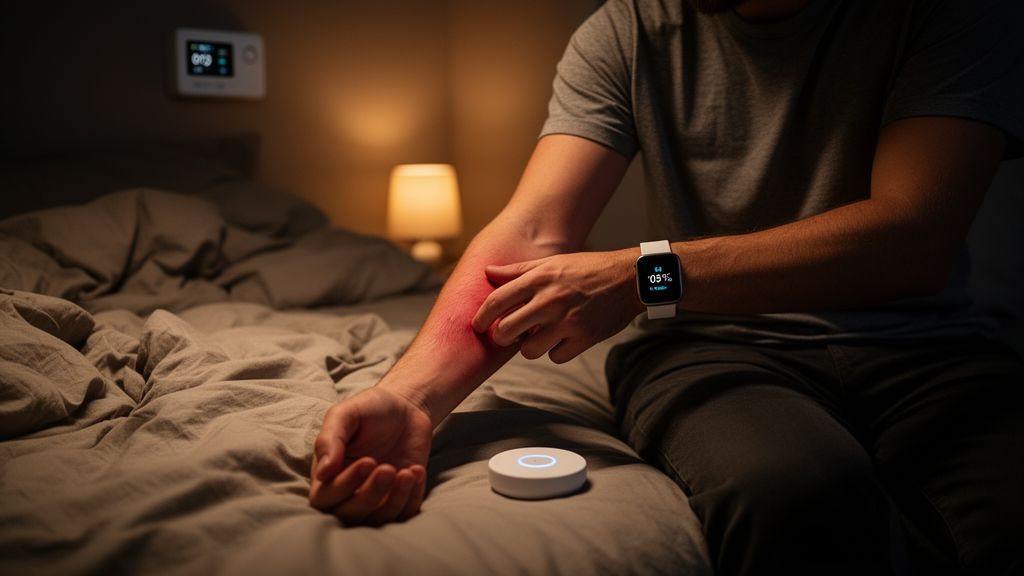
Heat, sweating, hot-water exposure and heat-retaining bedding are frequently reported by people with atopic dermatitis as triggers or aggravators of itch, but the evidence does not yet show that temperature alone causes nocturnal scratching. A 2026 critical narrative review assessed the clinical relevance, possible mechanisms and objective monitoring of thermally provoked itch in this chronic inflammatory skin disease. The authors conclude that warmth may interact with impaired skin barriers, sensitized peripheral nerves, immune signaling and altered central sensory processing.
Digital tools that detect scratching during sleep could also expose a burden that daytime examinations and retrospective itch scales miss. However, most device studies have reached only the stage of detecting scratching against a reference signal; relatively little evidence shows that these measurements are reliable across people, responsive to treatment or meaningful to patients. The review uses “thermally provoked itch” as an organizing term for itch perceived as triggered or aggravated by increased ambient temperature, higher skin temperature or heat-retaining conditions.
That definition does not make every heat-associated exposure equivalent. Hot water can alter skin temperature, hydration, surface lipids and barrier function, while sweating changes humidity, evaporation and the local chemical environment of the skin. Bedding can increase both heat retention and moisture, and clothing or physical exertion before sleep can alter the same thermal microenvironment.
These mechanisms overlap but are biologically distinct, so an association between warm conditions and itch cannot establish that temperature is the independent cause. Clinical reports often describe the heat-provoked sensation as sharp or stinging and qualitatively different from baseline itch. Observational studies have associated greater heat sensitivity with active flares, but the pattern could also reflect overall disease severity, lesion distribution, barrier condition or an individual’s sensory predisposition rather than a separate clinical subgroup.
Several molecular routes could make sensitized skin respond to warmth. TRPV1, a channel expressed in peripheral sensory neurons, keratinocytes and fibroblasts, detects noxious heat and chemical irritants and may contribute to neurogenic inflammation in inflamed skin. Its role in the mild warmth that provokes itch in human atopic dermatitis remains incompletely defined, and it is unlikely to explain the full spectrum on its own.
TRPV3 is particularly abundant in keratinocytes, where activation can initiate calcium entry and downstream signaling. Human lesional-skin observations and atopic-dermatitis-like animal models suggest that enhanced TRPV3 activity in keratinocytes may promote warmth-responsive production of thymic stromal lymphopoietin, nerve growth factor and prostaglandin E2. These findings supply a plausible epithelial mechanism, but direct causal evidence from humans is lacking.
Results from animal models are mechanistic support and do not demonstrate that targeting either channel would benefit people with the disease. Other proposed mechanisms connect the inflamed dermis with sensory nerves. Fibroblasts from patients with atopic dermatitis have been reported to secrete artemin in response to inflammatory mediators including substance P. In experimental systems, artemin can promote nerve sprouting and thermal hyperalgesia, and its accumulation in lesional skin offers a plausible route to altered warmth sensitivity.
Neuropeptides such as substance P and calcitonin gene-related peptide may also promote neurogenic inflammation and vasodilation, potentially helping explain burning, stinging or sharp sensations. At the same time, scratching can damage the epidermis and release alarmins such as interleukin-33 and thymic stromal lymphopoietin, which can intensify local inflammation. The resulting heat–itch–scratching–inflammation loop is biologically coherent, but direct longitudinal evidence that heat-triggered scratching precedes barrier deterioration, increased inflammation or an atopic dermatitis flare is limited.
The loop therefore remains a model that requires prospective testing rather than a demonstrated causal sequence in every patient. The sensory abnormalities associated with atopic dermatitis may extend beyond the skin. Neurophysiological studies have found distinct brain responses to electrical stimuli and delayed thermal-evoked potentials in affected patients, consistent with altered peripheral or central processing.
Healthy volunteers can experience counter-irritation, in which noxious heat and repeated scratching suppress itch. In people with atopic dermatitis, however, those stimuli may fail to inhibit histamine-induced itch, suggesting weakened control of itch transmission. This could explain why mild warmth that is comfortable on healthy skin produces a strong urge to scratch in sensitized skin.
The evidence also cautions against a search for one universal target: the contributions of TRPV1, TRPV3, epithelial mediators, fibroblast signals, spinal circuits and central processing may differ with disease stage, lesion status and individual sensory phenotype. The relative importance of these routes in routine heat-aggravated itch has not been established. Nocturnal scratching makes altered sensory regulation especially consequential because it connects itch, sleep and skin injury.
Video-based studies have found that people with severe atopic dermatitis may spend more than 14% of recorded time scratching, with bouts occurring in both rapid-eye-movement and non-rapid-eye-movement sleep. The behavior is often more frequent in the first third of the night. The direction of causation is uncertain: itch can fragment sleep, while poor sleep may lower sensory thresholds and amplify later itch.
A conceptual-model study found that approximately 65% of patients reported nocturnal scratching at least once a week. In a US cross-sectional sample, sleep disturbance affected 66.9% of children aged 5 to 17 years with atopic dermatitis and, after adjustment for disease severity, itch intensity and sociodemographic factors, was associated with depression, fatigue, anxiety, inattention and impulsivity. The analysis did not establish effects on objectively measured academic performance.
The burden extends beyond sleep and visible skin inflammation. In a US National Health and Wellness Survey analysis, adults with atopic dermatitis had more work absenteeism and activity impairment than propensity-matched controls, along with poorer health-related quality of life and higher self-reported rates of anxiety, depression and sleep disorders. A Swedish patient-reported survey also associated greater itch intensity and activity impairment with poorer quality of life and higher out-of-pocket and productivity-related costs.
Yet routine consultations may underestimate nocturnal disease because patients can normalize scratching, forget episodes or report only their worst nights. Visual analog and numeric rating scales depend on recall and are less reliable for young children or events occurring during sleep. Objective measurement may therefore complement patient reports, particularly when visible skin lesions do not capture the full burden, but the aim is not to replace subjective experience with a movement count.
Wrist actigraphy is among the most scalable home-monitoring approaches, using movement and acceleration to estimate sleep activity. Its central challenge is separating finger-dominant scratching from turning over, adjusting bedding and other wrist motion. In an initial smartwatch study, five adults with moderate atopic dermatitis were recorded for one inpatient night with simultaneous video annotation.
For video-defined, non-weak scratches lasting at least three seconds, the investigators reported a positive predictive value of 90.2% ± 6.6% and sensitivity of 84.6% ± 10.2%, but no independent external-cohort validation. A separate machine-learning actigraphy study used accelerometer and gyroscope data from five patients and two healthy volunteers during two inpatient nights. In subject-level hold-out testing, its gradient-boosting model reported precision of 0.44, recall of 0.46, an F1 score of 0.45 and accuracy of 0.84.
These results are not directly comparable because populations, event prevalence, reference standards, algorithms and recording conditions differed, and both studies were small. Other systems capture signals more closely associated with the hand or bed. A skin-conformable dorsal-hand device combined motion and acousto-mechanical data in 11 predominantly pediatric patients with moderate-to-severe disease over 46 sleep nights.
Using manually labeled infrared video as the reference, it reported 99.0% accuracy, 84.3% sensitivity, 99.3% specificity, 82.5% precision and an F1 score of 82.9%; it did not undergo independent external-cohort validation. A sensorized glove was evaluated in six children with atopic dermatitis, reporting 83% prediction accuracy in validation data and detection of 94.4% of scratching while worn. Thermal cameras can infer scratching from frictional heat and exposure of warmer underlying skin, while sheet-shaped body vibrometers measure mattress vibrations but cannot distinguish scratching from general movement on their own.
Acoustic detectors analyze the frequency and energy of scratching sounds, and multimodal rings or gloves combine motion, contact and acoustic information. Greater technical complexity does not automatically provide greater clinical value. The review proposes a staged pathway for evaluating digital scratch endpoints.
Sensor and algorithm performance concerns acquiring and processing relevant signals. Analytical validation establishes whether an algorithm identifies scratching against an appropriate reference, such as video annotation. Clinical validation then asks whether the measure is associated with itch severity, sleep impairment, daily functioning and health-related quality of life.
Longitudinal responsiveness assesses whether the metric changes with treatment or clinically meaningful disease change, while threshold work determines what degree of change matters to patients. Most available evidence remains at the first two stages. The central research need is prospective, repeated measurement within individuals, combining ambient temperature and humidity, skin temperature, bedding, clothing, sweating, scratching, sleep stage, reported itch, severity, treatment and barrier measures.
Such studies could test whether thermal exposure independently predicts subsequent nocturnal scratching without presuming causality, and determine whether reproducible digital measures eventually help quantify an otherwise hidden part of atopic dermatitis.
Subject of Research: Mechanisms and digital monitoring of thermally provoked itch and nocturnal scratching in atopic dermatitis
Article Title: Thermally provoked itch in atopic dermatitis: current evidence, knowledge gaps, and digital approaches to nocturnal scratching
Article References: Xia, D., Yue, Y., & Huang, J. (2026). Thermally provoked itch in atopic dermatitis: current evidence, knowledge gaps, and digital approaches to nocturnal scratching. Frontiers in Medicine, 13, Article 1935603. https://doi.org/10.3389/fmed.2026.1935603
Image Credits: AI Generated
DOI: 10.3389/fmed.2026.1935603
Keywords: atopic dermatitis, thermally provoked itch, nocturnal scratching, digital health, wearable sensors, skin barrier, neuroimmune mechanisms, sleep disturbance, thermal exposure, digital biomarkers, Thermally, provoked
Cite Scienmag News
Ophelia Keating. (October 25, 2026). Thermally provoked itch in atopic dermatitis: current evidence, knowledge gaps, and digital approaches to nocturnal scratching. Scienmag. https://scienmag.com/thermally-provoked-itch-in-atopic-dermatitis-current-evidence-knowledge-gaps-and-digital-approaches-to-nocturnal-scratching/
Ophelia Keating. "Thermally provoked itch in atopic dermatitis: current evidence, knowledge gaps, and digital approaches to nocturnal scratching." Scienmag, 25 October 2026, https://scienmag.com/thermally-provoked-itch-in-atopic-dermatitis-current-evidence-knowledge-gaps-and-digital-approaches-to-nocturnal-scratching/. Accessed 25 October 2026.
Ophelia Keating. "Thermally provoked itch in atopic dermatitis: current evidence, knowledge gaps, and digital approaches to nocturnal scratching." Scienmag. October 25, 2026. https://scienmag.com/thermally-provoked-itch-in-atopic-dermatitis-current-evidence-knowledge-gaps-and-digital-approaches-to-nocturnal-scratching/


