

Sunday, October 25, 2026
Science
No Result
View All Result
  • Login
  • HOME
  • SCIENCE NEWS
  • CONTACT US
  • HOME
  • SCIENCE NEWS
  • CONTACT US
No Result
View All Result
Scienmag
No Result
View All Result
Home Science News Technology and Engineering

860 °C solution treatment optimizes aging response in Ti–5Cu alloy

October 25, 2026
in Technology and Engineering
Neil Sanderson
By Neil Sanderson Scienmag Editorial Profile - Materials Characterization
Reading Time: 2 mins read
0
860 °C solution treatment optimizes aging response in Ti–5Cu alloy

860 °C solution treatment optimizes aging response in Ti–5Cu alloy

65
SHARES
587
VIEWS
Share on FacebookShare on Twitter
ADVERTISEMENT

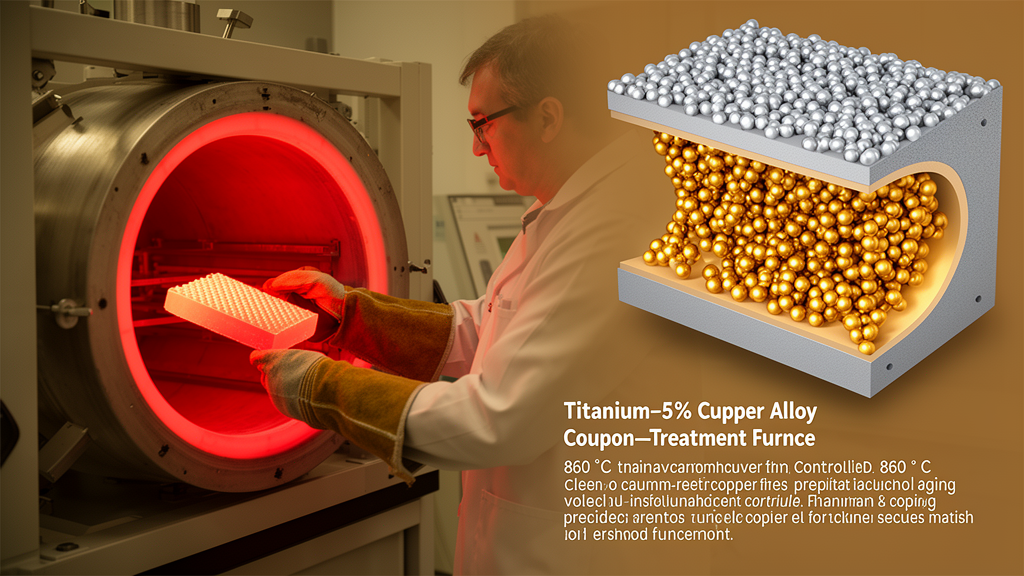
Solution treatment at 860 °C for 1,800 s produced the best overall mechanical properties among the conditions tested for Ti–5Cu alloy sheets, according to a materials study examining phase dissolution, recrystallization and aging strengthening. The treatment yielded an ultimate tensile strength of 995 ± 4 MPa, a yield strength of 909 ± 2 MPa and an elongation after fracture of 9.4%. Researchers investigated solution temperatures from 780 to 900 °C and holding times from 20 to 3,000 s, then assessed how the resulting microstructures responded to aging.

The study identifies Ti₂Cu as the primary intermediate phase in the alloy. At a constant solution temperature, the aging strength initially increased rapidly as solution-treatment time increased, then gradually stabilized and declined slightly at prolonged holding times. The researchers developed a quasi-steady-state solute-diffusion kinetic model based on the geometric characteristics of the intermediate phase to estimate Ti₂Cu dissolution.

Calculated dissolution times for Ti₂Cu particles with radii of 0.1–0.5 μm at 860 °C agreed well with the experimentally observed hardness evolution and mechanical-property results. Microstructural observations showed that recrystallization at 860 °C was essentially complete within approximately 600 s, when the average grain size was about 3.96 μm. Extending the solution treatment beyond this period was associated with accelerated grain-boundary migration and weakened boundary pinning, followed by rapid grain coarsening.

The study links these observations with the way solution-treatment duration changes the alloy’s structure before aging, while avoiding a simple relationship in which longer treatment always produces stronger material. Analysis of aging precipitation showed that higher solution temperatures significantly promoted precipitation during aging, whereas solution-treatment time had a relatively limited influence on precipitation morphology. In other words, temperature and duration affected distinct parts of the observed response: the aging analysis emphasized temperature’s association with precipitation, while the microstructural analysis documented substantial changes in recrystallization and grain size as treatment time increased.

The phase-dissolution model supplied an additional comparison between estimated Ti₂Cu dissolution times and measured hardness and mechanical-property changes. These findings are specific to the investigated Ti–5Cu alloy sheets, experimental conditions and ranges of 780–900 °C and 20–3,000 s. They do not establish that the same optimum or mechanism applies to other titanium-copper compositions or processing routes.

Subject of Research: Effects of solution-treatment temperature and duration on Ti₂Cu dissolution, recrystallization and aging strengthening in Ti–5Cu alloy sheets.

Article Title: Phase dissolution during solution treatment and its effect on aging strengthening in Ti–5Cu alloy

Article References: Wang, W., He, Y., & Yue, X. (2026). Phase dissolution during solution treatment and its effect on aging strengthening in Ti–5Cu alloy. Journal of Materials Science, 61(41), 31984-32002. https://doi.org/10.1007/s10853-026-13648-1

Image Credits: AI Generated

DOI: 10.1007/s10853-026-13648-1

Keywords: Ti–5Cu alloy, Ti₂Cu dissolution, solution treatment, aging strengthening, recrystallization, grain coarsening, solute diffusion, tensile strength, precipitation, materials processing, Phase, dissolution

Cite Scienmag News

Neil Sanderson. (October 25, 2026). 860 °C solution treatment optimizes aging response in Ti–5Cu alloy. Scienmag. https://scienmag.com/860-c-solution-treatment-optimizes-aging-response-in-ti-5cu-alloy/

Neil Sanderson. "860 °C solution treatment optimizes aging response in Ti–5Cu alloy." Scienmag, 25 October 2026, https://scienmag.com/860-c-solution-treatment-optimizes-aging-response-in-ti-5cu-alloy/. Accessed 25 October 2026.

Neil Sanderson. "860 °C solution treatment optimizes aging response in Ti–5Cu alloy." Scienmag. October 25, 2026. https://scienmag.com/860-c-solution-treatment-optimizes-aging-response-in-ti-5cu-alloy/


Tags: aging strengtheningDissolutioneffects of prolonged heat treatment on alloy propertieseffects of solution temperature and time on mechanical propertiesGraingrain coarseninghigh-temperature aging response in titanium alloysinfluence of solution treatment on tensile strength and ductilitymaterials processingmicrostructural analysis of recrystallization in titanium alloysmicrostructure evolution during alloy agingPhasephase dissolution and recrystallization in Ti–Cu alloysprecipitationquasi-steady-state solute diffusion model in titanium alloysrecrystallizationsolute diffusionsolution treatmenttensile strengthTi–5Cu alloyTi–5Cu alloy solution treatment optimizationTi₂Cu dissolutionTi₂Cu phase behavior during heat treatment
Share26Tweet16
Previous Post

Industrial Waste Cement Blend Locks Away CO2 and Rebuilds Its Own Binding Gel

Next Post

Matched study links three factors with trachomatous trichiasis in Ethiopian women

Related Posts

Industrial Waste Cement Blend Locks Away CO2 and Rebuilds Its Own Binding Gel
Technology and Engineering

Industrial Waste Cement Blend Locks Away CO2 and Rebuilds Its Own Binding Gel

October 25, 2026
Frequency-aware transformer spots AI-generated fake voices and shows its reasoning
Technology and Engineering

Frequency-aware transformer spots AI-generated fake voices and shows its reasoning

October 25, 2026
Mamba-based model tames noisy urban traffic prediction with frequency-domain filtering
Technology and Engineering

Mamba-based model tames noisy urban traffic prediction with frequency-domain filtering

October 25, 2026
Pelletized straw cuts nitrous oxide emissions in saline-alkali soil
Technology and Engineering

Pelletized straw cuts nitrous oxide emissions in saline-alkali soil

October 25, 2026
Wall Insulation Dominates Heating Savings in Cold-Region Factory Simulations
Technology and Engineering

Wall Insulation Dominates Heating Savings in Cold-Region Factory Simulations

October 25, 2026
Digital NeuroEpiTool lets non-specialists assess neurological signs in population studies
Technology and Engineering

Digital NeuroEpiTool lets non-specialists assess neurological signs in population studies

October 25, 2026
Next Post
Matched study links three factors with trachomatous trichiasis in Ethiopian women

Matched study links three factors with trachomatous trichiasis in Ethiopian women

  • Mothers who receive childcare support from maternal grandparents show more optimized

    Mothers who receive childcare support from maternal grandparents show more parental warmth, finds NTU Singapore study

    27656 shares
    Share 11059 Tweet 6912
  • University of Seville Breaks 120-Year-Old Mystery, Revises a Key Einstein Concept

    1061 shares
    Share 424 Tweet 265
  • Bee body mass, pathogens and local climate influence heat tolerance

    682 shares
    Share 273 Tweet 171
  • Researchers record first-ever images and data of a shark experiencing a boat strike

    546 shares
    Share 218 Tweet 137
  • Groundbreaking Clinical Trial Reveals Lubiprostone Enhances Kidney Function

    531 shares
    Share 212 Tweet 133
Science

Embark on a thrilling journey of discovery with Scienmag.com—your ultimate source for cutting-edge breakthroughs. Immerse yourself in a world where curiosity knows no limits and tomorrow’s possibilities become today’s reality!

RECENT NEWS

  • Matched study links three factors with trachomatous trichiasis in Ethiopian women
  • 860 °C solution treatment optimizes aging response in Ti–5Cu alloy
  • Industrial Waste Cement Blend Locks Away CO2 and Rebuilds Its Own Binding Gel
  • Frequency-aware transformer spots AI-generated fake voices and shows its reasoning

Categories

  • Agriculture
  • Anthropology
  • Archaeology
  • Athmospheric
  • Biology
  • Biotechnology
  • Blog
  • Bussines
  • Cancer
  • Chemistry
  • Climate
  • Earth Science
  • Editorial Policy
  • Marine
  • Mathematics
  • Medicine
  • Pediatry
  • Policy
  • Psychology & Psychiatry
  • Science Education
  • Science News
  • Social Science
  • Space
  • Technology and Engineering

Subscribe to Blog via Email

Enter your email address to subscribe to this blog and receive notifications of new posts by email.

Join 5,151 other subscribers

© 2025 Scienmag - Science Magazine

Welcome Back!

Login to your account below

Forgotten Password?

Retrieve your password

Please enter your username or email address to reset your password.

Log In
No Result
View All Result
  • HOME
  • SCIENCE NEWS
  • CONTACT US

© 2025 Scienmag - Science Magazine

Discover more from Science

Subscribe now to keep reading and get access to the full archive.

Continue reading