


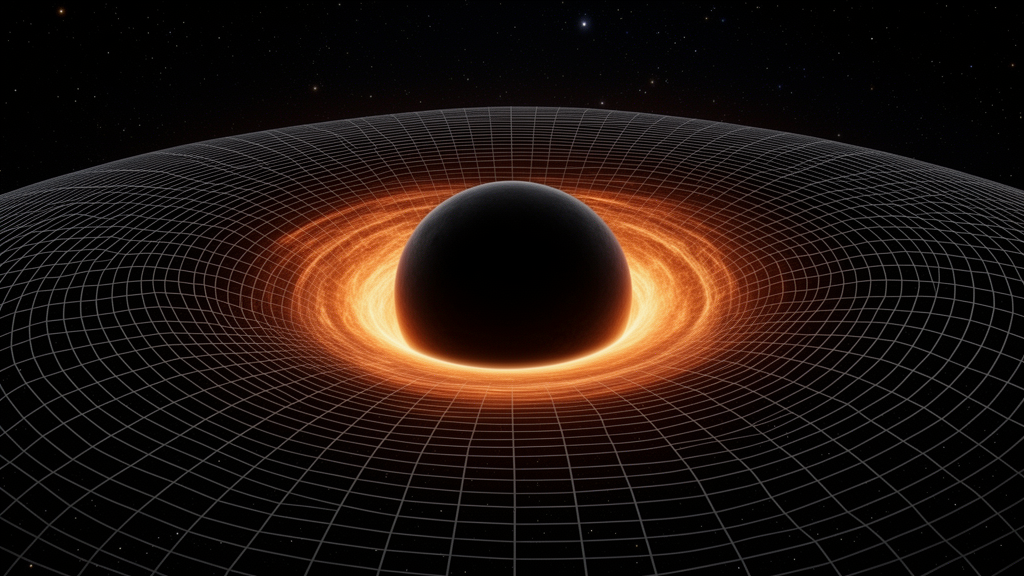
A team of theoretical physicists has constructed a new kind of regular black hole in which the deepest interior stays smooth, the curvature never exceeds the Planck scale anywhere in the spacetime, and the notorious inner-horizon instability known as mass inflation is replaced by a tame, power-law process. The construction, reported in The European Physical Journal C by Zhong-Wen Feng, Hong-Lin Liu, Yi Ling, and Qing-Quan Jiang, is a mathematical solution of classical general relativity supplemented by an effective stress-energy source, not an observation of a real astrophysical object. Its appeal lies in a single unifying feature: one internal length scale, the radius of the inner horizon, simultaneously fixes the maximum curvature of the entire geometry and the finite mass scale reached by perturbations deep inside the hole.
Classical general relativity predicts that black holes harbor spacetime singularities, a sign that the classical description breaks down in the strong-field regime. Regular black holes have long been studied as effective models of singularity resolution, arising from nonlinear electrodynamics, effective matter sources, or quantum-gravity-inspired corrections. In these geometries the Schwarzschild behavior is recovered at large radii while the deep interior is modified to avoid a central singularity. Yet removing the central singularity is only part of the problem. Most regular black holes also contain an inner, or Cauchy, horizon that is famously sensitive to perturbations: ingoing and outgoing radiation are exponentially blueshifted as they approach it, driving rapid growth of the effective internal mass. This phenomenon, mass inflation, can destabilize the interior and undermine the semiclassical description, so a viable regular black hole must control the inner horizon as well as the core.
The new geometry is static and spherically symmetric, with an asymptotically Schwarzschild exterior, a non-extremal outer horizon, and a degenerate inner horizon whose surface gravity vanishes exactly. The metric function is built so that the outer horizon is a simple root while the inner horizon is an effective triple root, achieved through an auxiliary function that behaves quadratically near the inner horizon and grows rapidly toward the center. The authors note that a double zero would already give vanishing surface gravity but would not restore the correct sign of the metric function inside the core, so the effective cubic order is essential. The same cubic structure turns out to govern everything that follows, from the curvature bound to the response of the geometry to perturbations.
The headline result concerns the Kretschmann scalar, a curvature invariant whose value marks the strength of spacetime curvature. At the center the spacetime approaches flat Minkowski space, with the Ricci scalar, the quadratic Ricci invariant, and the Kretschmann scalar all vanishing as the radius goes to zero, independently of the black hole’s mass. More importantly, in the large-mass regime where the outer horizon radius equals twice the ADM mass, the maximal Kretschmann scalar becomes nearly independent of the mass and is controlled mainly by the inner-horizon radius. Rewriting the metric in dimensionless variables shows that the leading curvature contribution scales as the inverse fourth power of the inner-horizon radius, with mass dependence entering only as subleading corrections. Numerically, for a fixed inner-horizon radius of 20 in Planck units, the maximal curvature converges to about 0.00866 as the mass grows from 10,000 to 1,000,000 Planck masses, with the curves for the two largest masses nearly indistinguishable.
This mass-independence yields a simple sufficient condition for global regularity in the strongest sense. Because the curvature vanishes both at the center and at infinity, its global maximum must occur at a finite radius, which the calculations place inside the inner horizon. In Planck units, choosing the inner-horizon radius to be at least approximately 6.10174 guarantees that the Kretschmann scalar stays below 1, the Planck value, everywhere in the spacetime. Since Planck-scale curvature marks the regime where higher-curvature and quantum corrections can no longer be assumed negligible, this limiting-curvature property means the geometry never enters territory where the effective description would fail. The location of the maximum also tracks the inner-horizon radius, remaining inside it throughout the parameter range studied.
The authors also examined the effective stress-energy tensor reconstructed from the geometry through the null energy condition, a diagnostic of whether the source matter behaves reasonably. Along radial null directions the condition is identically saturated, with the radial pressure exactly canceling the energy density. The nontrivial angular component is strictly satisfied at the inner horizon and at the regular center, and it approaches zero at large distances. For a representative configuration with mass 1,000,000 in Planck units and inner-horizon radius 20, the most significant violation is confined to a finite shell between roughly 2.54 and 9.46, well below the inner horizon, and is strongly suppressed elsewhere. The model therefore does not evade energy-condition scrutiny entirely, but it confines the violation to a controlled interior region.
The second major result addresses mass inflation directly. A massless scalar test field propagated on the fixed background reveals how the cubic zero of the metric function reshapes the near-horizon physics. For a generic nondegenerate inner horizon, outgoing null rays approach the horizon exponentially and the geometric blueshift factor grows exponentially with advanced time, the mechanism behind runaway mass inflation. In the new geometry, the cubic degeneracy forces outgoing rays to approach the inner horizon only algebraically, and the blueshift factor grows as a power law, proportional to the three-halves power of advanced time. The effective potential governing the scalar modes is likewise cubically suppressed near the horizon, so wave propagation directly reflects the same near-horizon structure that controls the curvature bound.
To test the consequences for the internal mass, the authors employed two complementary effective descriptions. In the double-null shell model of Dray, ‘t Hooft, and Redmount, an ingoing and an outgoing null shell intersect inside the hole, and the nonlinear shell-crossing term in the matching condition is what drives standard mass inflation. Because the inner-horizon radius is held fixed while the ADM mass varies, the first nonvanishing response of the Misner-Sharp mass to a change in the mass parameter is cubic in the distance from the inner horizon, rather than quadratic as in families where the inner horizon moves with mass. Combined with the algebraic approach of the crossing point, this cubic response makes the nonlinear contribution decay as the inverse three-halves power of advanced time at late times, provided the shell amplitudes remain finite or decay sufficiently fast. The future Misner-Sharp mass then approaches the finite value r-minus over two, half the inner-horizon radius.
The Ori model, in which the outgoing perturbation is a null shell and the ingoing perturbation is a continuous stream of infalling radiation following a Price-law tail with decay exponent 12, tells the same story. Numerically solving the coupled evolution, the authors found that the internal Misner-Sharp mass remains bounded and settles onto a plateau at late times. For an inner-horizon radius of 20, the mass approaches 10, exactly half the inner-horizon radius, in agreement with the geometric expectation that the mass function tends to r-minus over two as the shell asymptotes to the degenerate horizon. Within both effective descriptions, the exponential amplification characteristic of a nondegenerate Cauchy horizon is absent, and the same inner-horizon scale that bounds the global curvature fixes the finite mass scale reached by the dynamics.
The study comes with clear caveats. The analysis treats the inner-horizon radius as an independent fixed scale; if that radius depends on the mass, additional terms appear in the mass response and the near-horizon power laws can change, requiring a separate analysis. The curvature discussion covers invariants built algebraically from the Riemann tensor, not those involving covariant derivatives of the curvature, and the shell and scalar-field probes are test-field and effective models rather than fully nonlinear evolutions. Previous fully nonlinear simulations of scalar collapse in related geometries have shown that sufficiently strong perturbations can still drive an inner horizon to zero, so the stability question is not closed. What the new work demonstrates is a proof of principle: a single explicit geometry can combine a Minkowski core, a softened inner horizon, and a globally sub-Planckian curvature bound, with one internal scale governing both the geometry and its response to perturbations.
Subject of Research: A theoretical model of a regular black hole with a Minkowski core and a degenerate inner horizon that bounds curvature and suppresses mass inflation
Article Title: Global curvature control in a regular black hole with Minkowski core and inner-extremal horizon
Article References: Feng, Z.-W., Liu, H.-L., Ling, Y., & Jiang, Q.-Q. (2026). Global curvature control in a regular black hole with Minkowski core and inner-extremal horizon. The European Physical Journal C, 86(10), Article 1205. https://doi.org/10.1140/epjc/s10052-026-16504-3
Image Credits: AI Generated
DOI: 10.1140/epjc/s10052-026-16504-3
Keywords: regular black holes, singularity resolution, mass inflation, inner horizon, Kretschmann scalar, Planck scale curvature, surface gravity, null energy condition, Misner-Sharp mass, general relativity, theoretical physics, Cauchy horizon
Cite Scienmag News
Grant Pearson. (October 25, 2026). New Black Hole Model Keeps Curvature Below the Planck Scale Everywhere. Scienmag. https://scienmag.com/new-black-hole-model-keeps-curvature-below-the-planck-scale-everywhere/
Grant Pearson. "New Black Hole Model Keeps Curvature Below the Planck Scale Everywhere." Scienmag, 25 October 2026, https://scienmag.com/new-black-hole-model-keeps-curvature-below-the-planck-scale-everywhere/. Accessed 25 October 2026.
Grant Pearson. "New Black Hole Model Keeps Curvature Below the Planck Scale Everywhere." Scienmag. October 25, 2026. https://scienmag.com/new-black-hole-model-keeps-curvature-below-the-planck-scale-everywhere/


