


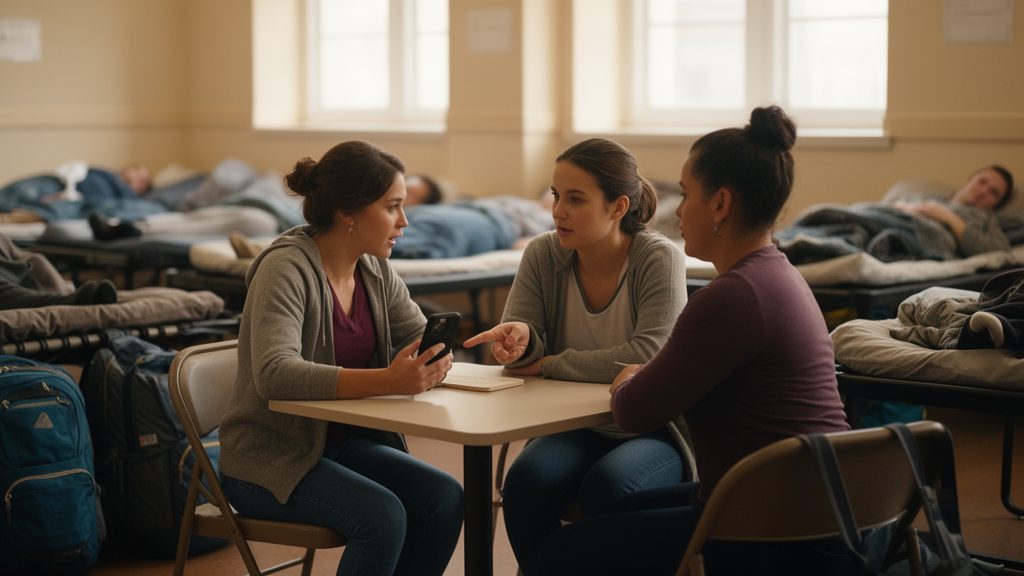
A qualitative study published in BMC Health Services Research has drawn a detailed map of how healthcare and social service providers coordinate care for people experiencing homelessness, and where mobile health technology could strengthen that process. Researchers led by Alexandra Macdonald interviewed twenty-six providers who work with people experiencing homelessness, asking them to give feedback on an existing mHealth intervention. A subset of questions from those interviews was then analyzed to address two aims: understanding providers' perspectives on care coordination for this population, and exploring how mHealth tools might facilitate the coordination process.
People experiencing homelessness typically have complex healthcare and social service needs. Care coordination is one strategy used to help them navigate healthcare and social services, but the study team noted that gaps remain in understanding how coordination operates across both the healthcare and social services sectors. mHealth technology has the potential to enhance coordination, yet providers' views on how such tools could fit into practice had not been fully explored. Methodologically, the researchers conducted a thematic, deductive qualitative analysis.
They used the Agency for Healthcare Research and Quality Care Coordination Framework as a guide for the main themes. Subthemes were coded inductively, meaning they emerged from the interview data itself, and the literature was used to define codes where appropriate. From the analysis, nine main themes were developed using the framework: Align Resources with Patient and Population Needs; Assess and Prioritize Needs and Goals; Communication; Create a Proactive Plan of Care; Establish Accountability and Negotiate Responsibility; Facilitate Transitions; Link to Community Resources; Monitor, Follow-Up, and Respond to Changes; and Support Self-Management Goals.
Subthemes were identified for each of these categories, reflecting the specific ways providers described carrying out coordination work in practice. Three ideas proved salient across the themes and subthemes. The analysis also revealed that the context of homelessness was essential for understanding care coordination in this setting.
Four contextual elements shaped providers' accounts: accessibility, competing demands, resource scarcity and awareness, and system assumptions. Against this backdrop, the study found that mHealth technology can serve as a tool to activate people experiencing homelessness in three ways: increasing awareness, enhancing self-efficacy, and enabling self-care. In other words, mobile tools could help individuals become more aware of their care and available resources, build confidence in managing their own health, and carry out self-care activities.
The researchers concluded that the study identified important mechanisms in coordinating care for people experiencing homelessness as described by healthcare and social service providers. These findings may help other providers understand the key interplay of healthcare and social services for this population, along with the role that mHealth interventions can play as potential facilitators of that process. For the field, the study's contribution lies in connecting an established care coordination framework to the specific circumstances of homelessness, and in grounding the promise of mHealth in providers' practical perspectives.
The open access article, published on 03 September 2026, provides the full thematic analysis for providers and researchers working at the intersection of homelessness, healthcare, and mobile technology.
Subject of Research: Care coordination for people experiencing homelessness and the potential role of mHealth technology
Article Title: Homeless care providers’ perspectives about care coordination and how mhealth technology can facilitate care coordination for people experiencing homelessness: a qualitative analysis
Article References: Macdonald, A., Moczygemba, L. R., Allen, C. D., Medellin, T., Hilbelink, M., & Seales, E. (2026). Homeless care providers’ perspectives about care coordination and how mhealth technology can facilitate care coordination for people experiencing homelessness: a qualitative analysis. BMC Health Services Research. https://doi.org/10.1186/s12913-026-15457-3
Image Credits: AI Generated
DOI: 10.1186/s12913-026-15457-3
Keywords: care coordination, homelessness, mHealth, mobile health, qualitative analysis, AHRQ Care Coordination Framework, health services research, relational continuity, self-care agency, inter-organizational collaboration, Homeless, care
Cite Scienmag News
Ophelia Keating. (October 25, 2026). Care Providers Map How Mobile Health Could Coordinate Homeless Care. Scienmag. https://scienmag.com/care-providers-map-how-mobile-health-could-coordinate-homeless-care/
Ophelia Keating. "Care Providers Map How Mobile Health Could Coordinate Homeless Care." Scienmag, 25 October 2026, https://scienmag.com/care-providers-map-how-mobile-health-could-coordinate-homeless-care/. Accessed 25 October 2026.
Ophelia Keating. "Care Providers Map How Mobile Health Could Coordinate Homeless Care." Scienmag. October 25, 2026. https://scienmag.com/care-providers-map-how-mobile-health-could-coordinate-homeless-care/


