


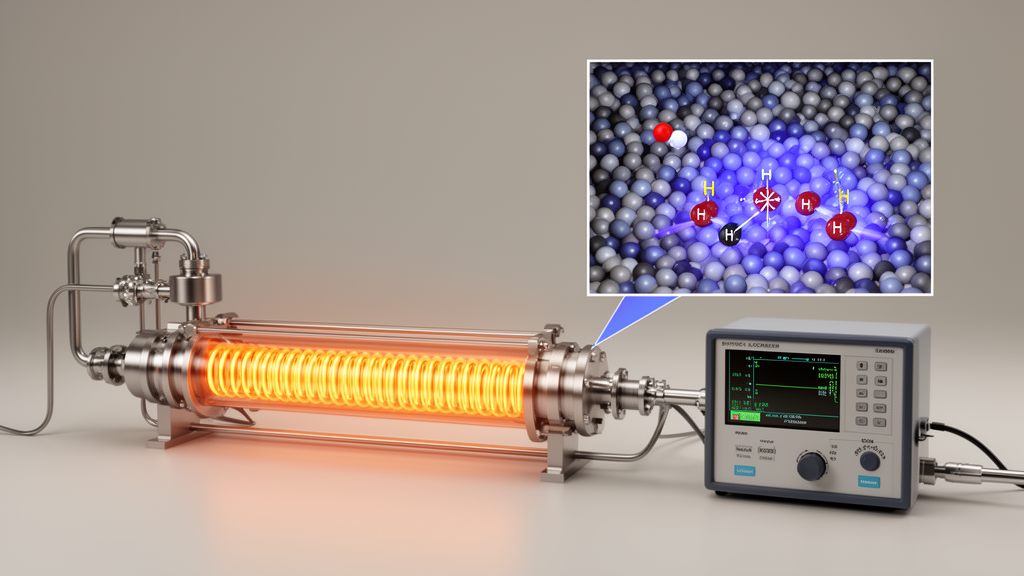
Formaldehyde is one of the quiet workhorses of the chemical industry, an essential building block for resins, polymers and, increasingly, for polyoxymethylene ethers that serve as cleaner fuels and fuel additives. For decades, nearly all of it has come from selectively oxidizing methanol over silver or molybdenum-iron catalysts in the well-established FormOx process. That reaction releases heat, but it carries stubborn baggage: competing pathways churn out carbon monoxide and carbon dioxide as unwanted byproducts, the organic feed and oxygen can form potentially explosive mixtures that demand costly safety engineering, and the stoichiometric water produced alongside formaldehyde forces tedious purification steps to deliver the dry product the market requires.
There is, in principle, a far more elegant route. Direct dehydrogenation of methanol, written simply as CH3OH yielding formaldehyde and hydrogen, would eliminate the explosion hazard in one stroke, slash the probability of carbon dioxide formation, and turn the byproduct stream into a valuable commodity. The hydrogen released could be recycled to the methanol production unit, fed to other processes, or converted directly into electricity in a fuel cell. The catch is thermodynamics. The reaction is endergonic by 84 kilojoules per mole, and at reasonable reaction temperatures the equilibrium allows only very limited methanol conversion, far below what any practical plant would need. Overcoming that ceiling requires what chemists call non-thermal activation, and light is the most promising way to deliver it.
In heterogeneous photocatalysis, irradiation energy from the sun or an artificial source excites electronic states in the catalyst, enabling otherwise endergonic reactions or helping to clear activation barriers. Since the pioneering work of Fujishima and Honda in 1972, the most intensively studied photocatalyst has been titania, in its rutile or anatase crystal phases. Titania is cheap and commercially available in bulk, and when decorated with tiny platinum particles it becomes a competent catalyst for methanol dehydrogenation. Surface science groups, including the team around Heiz working in ultra-high vacuum on platinum deposited on rutile, have pieced together a detailed mechanism: methanol first adsorbs dissociatively in a thermally induced step, forming a methoxy species on titanium and a hydrogen atom on a surface oxygen; the methoxy then reacts with a photogenerated hole in a photo-induced homolytic cleavage of a carbon-hydrogen bond; formaldehyde desorbs thermally; and the remaining hydrogen atoms diffuse to the platinum, where they recombine and desorb as molecular hydrogen. Platinum’s sole job is to act as the recombination site for hydrogen.
Despite this solid mechanistic foundation, studies pushing the reaction toward technical use have been scarce. The vast majority have been run in batch reactors, focused on catalyst design and hydrogen evolution rates rather than process-level methanol conversions and formaldehyde yields. Continuous photocatalytic methanol dehydrogenation remains a rarity: one membrane reactor study reported conversions up to 6.7 percent, while a recent demonstration of continuous operation over a gold-titania catalyst did not report conversions or yields at all. Now a research team has delivered what it describes as the first successful attempt to perform thermally assisted photocatalytic methanol dehydrogenation in a continuous reactor over an extended steady-state period, using a spray-coated platinum-titania catalyst in a continuous flow plate reactor under remarkably mild conditions, below 120 degrees Celsius and at atmospheric pressure.
The catalyst itself was characterized before coating by scanning transmission electron microscopy and energy-dispersive X-ray spectroscopy. Platinum particles appear as bright, roughly spherical or elliptical spots on titania particles about 40 nanometers across. Counting 327 particles gave a peak platinum particle size of 2.10 nanometers with a narrow distribution, and the total platinum content measured by ICP-AES was 0.39 weight percent. Because the coating procedure operates at temperatures of at most 100 degrees Celsius, thermal sintering of the catalyst during plate preparation was avoided, preserving the finely dispersed metal that the mechanism depends on.
Activation proved to be a decisive factor. A freshly prepared catalyst plate operated in the dark and then under irradiation at 78 degrees Celsius showed only meager activity of 0.06 millimoles per minute per gram of catalyst. A reductive pretreatment in hydrogen offered no benefit, but an oxidative pretreatment with 3 volume percent oxygen in nitrogen under irradiation changed everything, and the effect reproduced several times on the same sample. After the first hour-long oxidation, activity rose above 0.4 millimoles per minute per gram before decaying to a stable 0.2; a second, three-hour treatment pushed the initial value to roughly 0.9 and the stable level to around 0.4. During the oxidation phases, water and carbon dioxide were released in a ratio of about 1.9, suggesting that surface-bound hydrocarbon residues are burned off, liberating blocked sites. Crucially, the product gas analysis showed that water formation drops abruptly to feed-contamination levels when reaction conditions resume, while hydrogen appears instead, unambiguously demonstrating that dehydrogenation, not oxidation, is the dominant pathway for formaldehyde formation under oxygen-free conditions.
Deactivation, however, lurks in the background. After the second activation, a slight but steady activity loss set in, and thermogravimetric analysis coupled with mass spectrometry of a used catalyst revealed strongly bound carbonaceous deposits, oxidizing between 180 and 380 degrees Celsius in a pattern consistent with formate species or polymeric structures such as paraformaldehyde. Graphitic carbon, which oxidizes above 500 degrees Celsius, was absent, and no carbon monoxide was detected in the exhaust gas, ruling out platinum poisoning by that route. Notably, purely thermal oxidation in the analysis required at least 180 degrees Celsius, while ultraviolet light enabled efficient oxidation on the catalyst at temperatures as low as 78 degrees. The team also traced a second deactivation route to the loss of surface oxygen species: at the highest reaction temperature of 120 degrees, surface hydroxyls recombine thermally into water, leaving oxygen vacancies behind, and the elevated water signals in the product gas at higher temperatures support exactly that picture.
The parameter sweeps tell a coherent story. Raising the reaction temperature from 78 to 120 degrees Celsius produced a modest exponential increase in methanol conversion and hydrogen yield, while formaldehyde selectivity climbed from 91.1 to 95.0 percent as methyl formate selectivity fell from 8.9 to 5.0 percent, because faster thermal desorption shortens formaldehyde’s residence on the surface. Increasing the irradiance from 120 to 255 milliwatts per square centimeter raised conversion linearly from 1.3 to 1.9 percent, which is 60 times higher than the thermodynamic equilibrium conversion for the purely thermally activated dehydrogenation at 78 degrees, with a maximum formaldehyde yield of 1.7 percent. Doubling the residence time nearly doubled the conversion, delivering a peak formaldehyde yield of 2.0 percent at 23.3 seconds, though longer contact shifts selectivity toward methyl formate, itself a valuable chemical building block and energy carrier.
The most striking result came from continuously co-dosing trace oxygen. Adding just 0.2 mole percent oxygen tripled the methanol conversion relative to oxygen-free conditions, and at 1 mole percent the conversion reached 12.0 percent, a fivefold enhancement, while total oxidation stayed marginal with carbon dioxide selectivity below 5.4 percent. The hydrogen yield rose severalfold as well, showing that hydrogen oxidation to water is not the main reaction; the hydrogen-to-water ratio shifted from 1.56 at 0.2 mole percent oxygen to 1.14 at 1 mole percent. Doubling the residence time to 23.5 seconds under 1 mole percent oxygen co-dosing pushed the peak methanol conversion to 17.8 percent with a hydrogen yield of 11.2 percent. Methyl formate selectivity grew from 11.0 to 31.3 percent as formaldehyde selectivity declined from 89.0 to 63.3 percent, a trade-off the team attributes to higher surface oxygen concentrations raising the coverage of methoxy and adsorbed formaldehyde species. In 70-hour long-term runs at 78 degrees Celsius, after a run-in period of about 20 hours, both oxygen-free and oxygen-co-dosed operation reached stationary conversion of 2.2 and 8.3 percent respectively, with hydrogen yields of 1.4 and 4.7 percent and stable product selectivities over the following 50 hours, with no significant deactivation. The work establishes a robust, highly selective method for converting methanol into formaldehyde, methyl formate and hydrogen in continuous flow, with conversion levels that far exceed the thermodynamic equilibrium of purely thermal processes, and it hands future researchers a clear benchmark: optimize the catalyst and conditions to further trim oxidative methanol conversion wherever oxygen co-dosing is used for surface activation.
Subject of Research: Continuous-flow thermally assisted photocatalytic dehydrogenation of methanol over Pt/TiO2
Article Title: Thermally Assisted Photocatalytic Dehydrogenation of Methanol in Continuous Steady‐State Operation
Article References: Stubenrauch, F., Nathrath, P., Schörner, M., Mahayni, Y., Fritsch, B., Hutzler, A., Wasserscheid, P., Bösmann, A., & Schühle, P. (2026). Thermally Assisted Photocatalytic Dehydrogenation of Methanol in Continuous Steady‐State Operation. Advanced Science, 13(59), Article e76842. https://doi.org/10.1002/advs.76842
Image Credits: AI Generated
DOI: 10.1002/advs.76842
Keywords: photocatalysis, methanol dehydrogenation, formaldehyde, hydrogen, Pt/TiO2, continuous flow, oxygen co-dosing, methyl formate, titanium dioxide, reaction engineering, Thermally, Assisted
Cite Scienmag News
Denise Maddox. (October 25, 2026). Thermally Assisted Photocatalytic Dehydrogenation of Methanol in Continuous Steady-State Operation. Scienmag. https://scienmag.com/thermally-assisted-photocatalytic-dehydrogenation-of-methanol-in-continuous-steady-state-operation/
Denise Maddox. "Thermally Assisted Photocatalytic Dehydrogenation of Methanol in Continuous Steady-State Operation." Scienmag, 25 October 2026, https://scienmag.com/thermally-assisted-photocatalytic-dehydrogenation-of-methanol-in-continuous-steady-state-operation/. Accessed 25 October 2026.
Denise Maddox. "Thermally Assisted Photocatalytic Dehydrogenation of Methanol in Continuous Steady-State Operation." Scienmag. October 25, 2026. https://scienmag.com/thermally-assisted-photocatalytic-dehydrogenation-of-methanol-in-continuous-steady-state-operation/


