


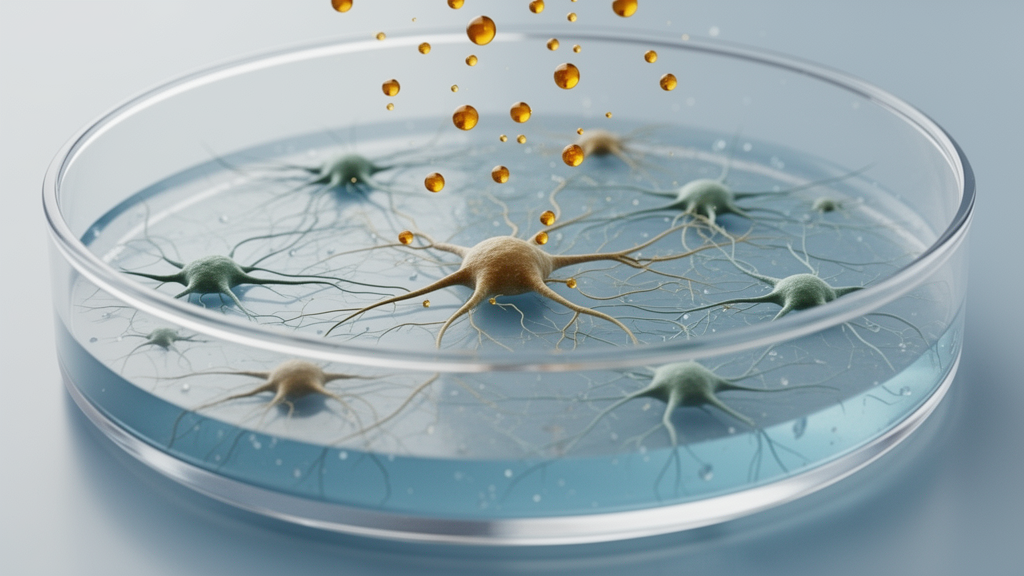
A standardized St. John’s wort extract altered signals exchanged between two mouse cell types in laboratory culture, according to an in vitro study. Researchers treated immortalized mouse hippocampal HT-22 neuronal cells co-cultured with SIM-A9 microglia under unstimulated conditions and measured neurite outgrowth, cell migration, viability and the release of several soluble proteins. At noncytotoxic concentrations, the extract increased neurite formation and cholinergic differentiation factor/leukemia inhibitory factor, or CDF/LIF, release in the neuronal-microglial system. It also reduced release of growth/differentiation factor 15, or GDF-15, a protein detected in the microglial cells. The findings suggest that St. John’s wort may influence paracrine communication between neurons and microglia, but the researchers emphasized that the results cannot establish antidepressant effects in people.
The experiment examined STW3-VI, a characterized dry extract of Hypericum perforatum supplied by Steigerwald Arzneimittelwerk. Its drug-to-extract ratio was 3–6:1, and 80% ethanol was used for extraction. The extract contained 9.9%–10% flavonoids, including 3.7% hyperoside in the total extract. Hyperoside, one of the extract’s active components, was tested separately. Escitalopram served as an antidepressant comparison, while recombinant nerve growth factor, or NGF, served as a positive control for neurite outgrowth. The extract and comparator compounds were dissolved directly in the culture medium, making this a test of direct cellular exposure rather than an oral or systemic treatment.
HT-22 cells and SIM-A9 microglia were maintained under identical conditions, with separate controls for neuronal cells alone and for the co-culture. In the main co-culture arrangement, the microglial cells occupied a transwell insert with a 0.4-micrometer membrane above the neurons. The membrane allowed soluble molecules to pass between the compartments while preventing direct contact. Neurons were treated for 24 hours after the two cell types had been co-cultured, and concentrations judged to be noncytotoxic in preliminary assays were used. The investigators combined a semiquantitative Mouse XL Cytokine Array with enzyme-linked immunosorbent assays, or ELISA, to screen and then quantify candidate paracrine markers.
The clearest morphological result involved neurite outgrowth from HT-22 cells, which was enhanced only when the cells were co-cultured with microglia. The untreated co-culture produced 2.3-fold less neurite outgrowth than neurons cultured alone. Adding 0.25 or 0.50 micrograms per milliliter of St. John’s wort extract increased outgrowth by 1.75-fold and 2.10-fold, respectively, relative to the untreated co-culture. Hyperoside at 0.0094 and 0.019 micrograms per milliliter produced 2.1-fold and 1.8-fold increases. Escitalopram produced larger increases of 3.53-fold at 2.10 micrograms per milliliter and 5.9-fold at 4.2 micrograms per milliliter, while NGF produced increases of 3.22-fold and 5.14-fold at the tested concentrations. In contrast, none of the compounds significantly increased neurite outgrowth in HT-22 cells cultured without microglia.
St. John’s wort also changed the abundance of signaling proteins in the co-culture medium. By ELISA, 0.50 micrograms per milliliter of extract increased CDF/LIF release by 35.2% compared with the untreated co-culture. Hyperoside at 0.019 micrograms per milliliter and escitalopram at 2.10 micrograms per milliliter increased CDF/LIF by 12.9% and 50.0%, respectively. The increase associated with 0.25 micrograms per milliliter of extract was 15.3% and was not statistically significant. CDF/LIF was present in extracts from both cell types, but no significant treatment-related differences were found in the cell homogenates. The study therefore documented a change in secreted protein but did not directly establish which cell type was responsible for it or which receptor mediated the response.
GDF-15 moved in the opposite direction. St. John’s wort at 0.50 micrograms per milliliter reduced GDF-15 release from the co-culture by 16.0%, while 0.019 micrograms per milliliter of hyperoside reduced it by 17.5%, according to ELISA. Only the microglial cell homogenates contained detectable GDF-15, supporting a microglial source under the experimental conditions, although treatment did not significantly alter the amount in cell lysates. IL-10 responses were less clear for the whole extract. Although the screening array indicated increases in some comparisons, ELISA found that 0.25 and 0.50 micrograms per milliliter of St. John’s wort did not significantly raise IL-10 relative to the corresponding neuronal monoculture. Hyperoside, escitalopram and NGF did significantly increase IL-10 in those comparisons, by 52.7%, 35.8% and 54.4%, respectively.
The two pro-inflammatory cytokines used as indicators of inflammatory stimulation remained stable. Co-cultured, unstimulated SIM-A9 cells released 25 picograms per milliliter of tumor necrosis factor alpha, compared with a lower level in neurons alone, and 92.6 picograms per milliliter of interleukin-6. Neither St. John’s wort, hyperoside, escitalopram nor NGF significantly changed these concentrations. This basal pattern was consistent with an unstimulated co-culture and did not resemble activation by pro-inflammatory stimuli. The findings therefore cannot be described as demonstrating an anti-inflammatory effect, because the researchers did not apply lipopolysaccharide or another inflammatory challenge. BDNF release also declined in several co-culture comparisons, including after St. John’s wort treatment, rather than rising alongside the enhanced neurite outgrowth.
Cell migration did not explain the structural effect. Scratch-wound assays showed no significant change in the migratory capacity of HT-22 cells after treatment with St. John’s wort, hyperoside, escitalopram or NGF, either alone or with microglia. The authors noted that HT-22 cells have a doubling time of about 15 hours, so proliferation during the assay could have masked differences in migration. The finding nevertheless separates migration from neuritogenesis: the treatments altered the extension of cellular projections in the co-culture without producing a detectable shift in wound closure.
Several limitations constrain how the results can be interpreted. The system used immortalized cell lines rather than primary neurons and microglia, and the transwell arrangement excluded direct cell contact, phagocytosis and synaptic pruning. Soluble factors were diluted through the medium in both compartments, making their cellular origin uncertain. Both populations had to share one medium that may not have been optimal for each, and the proteomic screening used pooled samples that could not reveal replicate-level variation. Concentrations were selected from cell-viability measurements rather than from concentrations achievable in brain tissue, a major issue because St. John’s wort constituents cross the blood–brain barrier poorly or only to limited degrees. The research also did not perform functional tests such as neutralizing antibodies, gene silencing, receptor inhibition or conditioned-medium transfer that would establish a causal paracrine pathway.
Accordingly, the study identifies associations between the extract and changes in cellular signaling under controlled laboratory conditions rather than evidence of efficacy against depression. Its mechanistic candidates include increased CDF/LIF, decreased microglial GDF-15 and enhanced neurite outgrowth, with IL-10 changes more clearly supported for hyperoside, escitalopram and NGF than for St. John’s wort itself. The researchers call for additional in vitro work in inflammatory and organotypic models, functional pathway validation, animal studies and appropriate clinical studies before drawing conclusions about therapeutic benefit in depressive disorders. Even though St. John’s wort has been used traditionally and studied clinically for mild to moderate depression, the concentrations applied directly to this mouse cell culture cannot be equated with doses taken by patients or with exposure within the human brain.
Subject of Research: In vitro effects of a St. John’s wort extract on signaling and neurite outgrowth in co-cultured mouse hippocampal neuronal cells and microglia
Article Title: Effects of St. John’s Wort extract on the release of paracrine markers and neurite outgrowth in mouse hippocampal HT-22 neuronal cells co-cultured with SIM-A9 microglia
Article References: Bonaterra, G. A., Much, L., Hahn, J., Aziz-Kalbhenn, H., Kelber, O., Bedal, K., Schwarzbach, H., Schwarz, A., & Kinscherf, R. (2026). Effects of St. John’s Wort extract on the release of paracrine markers and neurite outgrowth in mouse hippocampal HT-22 neuronal cells co-cultured with SIM-A9 microglia. Frontiers in Pharmacology, 17, Article 1916960. https://doi.org/10.3389/fphar.2026.1916960
Image Credits: AI Generated
DOI: 10.3389/fphar.2026.1916960
Keywords: St. John’s wort, HT-22 cells, SIM-A9 microglia, neurite outgrowth, paracrine signaling, CDF/LIF, GDF-15, IL-10, neuronal plasticity, in vitro study, Effects, John
Cite Scienmag News
Cassandra Pierce. (October 25, 2026). St. John’s Wort Alters Microglia-Neuron Signals in Cell Culture. Scienmag. https://scienmag.com/st-johns-wort-alters-microglia-neuron-signals-in-cell-culture/
Cassandra Pierce. "St. John’s Wort Alters Microglia-Neuron Signals in Cell Culture." Scienmag, 25 October 2026, https://scienmag.com/st-johns-wort-alters-microglia-neuron-signals-in-cell-culture/. Accessed 25 October 2026.
Cassandra Pierce. "St. John’s Wort Alters Microglia-Neuron Signals in Cell Culture." Scienmag. October 25, 2026. https://scienmag.com/st-johns-wort-alters-microglia-neuron-signals-in-cell-culture/


