


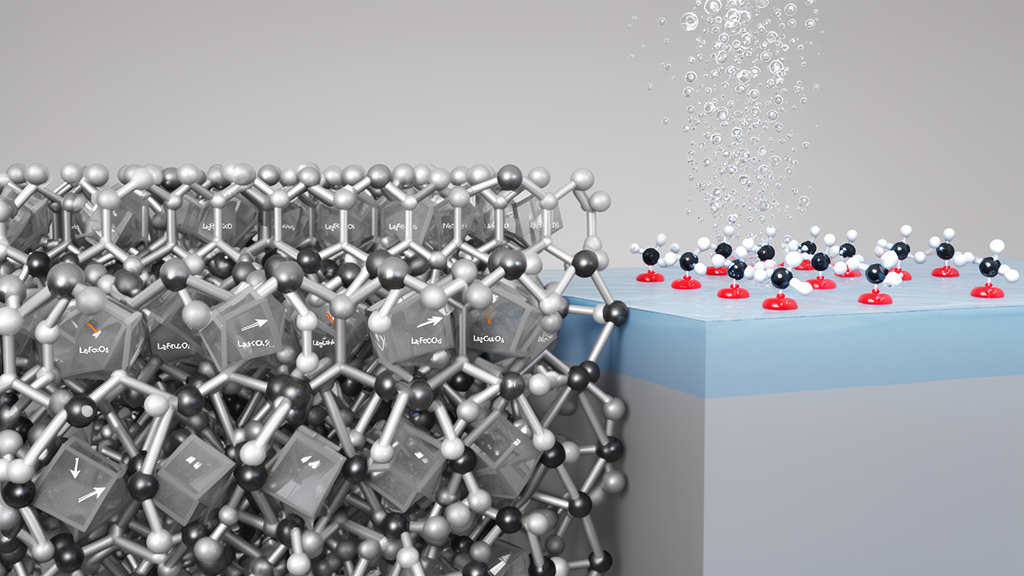
A newly investigated double perovskite, La₂FeCuO₆, combines a distorted transition-metal oxide lattice with moderate activity for the alkaline hydrogen evolution reaction, according to structural, optical, magnetic and electrochemical measurements. The researchers synthesized polycrystalline material by a conventional solid-state reaction and found that it formed predominantly a monoclinic phase with a small amount of La₂CuO₄. The compound exhibited a direct optical band gap of about 3.45 electron volts, ferrimagnetic-like magnetic behavior that remained unsaturated even under strong fields, and operation for 120 hours at a constant current density of 10 milliamperes per square centimetre. These results make the composition a model for studying how crystal chemistry and magnetic interactions relate to electrocatalysis, although its hydrogen-evolution performance remained modest.
The material was produced by weighing stoichiometric quantities of lanthanum oxide, iron oxide and copper oxide, mixing them in an agate mortar and pelletizing the resulting powder. The pellets were calcined at 1,100 degrees Celsius for 12 hours, then reground, repelletized and sintered at 1,300 degrees Celsius for another 12 hours. X-ray diffraction collected with cobalt K-alpha radiation was refined by the Rietveld method, while X-ray absorption near-edge structure spectroscopy, scanning electron microscopy with energy-dispersive X-ray spectroscopy, Fourier transform infrared spectroscopy, diffuse-reflectance spectroscopy and magnetometry were used to characterize the product. Electrochemical testing was conducted in a three-electrode cell containing 1 molar sodium hydroxide at 298 kelvin.
Rietveld refinement assigned 93.8% of the sample to monoclinic La₂FeCuO₆ in space group P2₁/n and 6.2% to the secondary phase La₂CuO₄. The principal phase had lattice parameters of 5.5520, 5.5562 and 7.8448 angstroms for its a, b and c axes, respectively, with a monoclinic beta angle of 89.889 degrees and a unit-cell volume of 242.00 cubic angstroms. Its framework consists of corner-sharing FeO₆ and CuO₆ octahedra arranged in a rock-salt-like pattern on the B and B′ sites, with lanthanum and oxygen occupying the A-site environment. The refined average Fe/Cu–O bond length was 2.0259 angstroms, and the average Fe–O–Cu angle was 151.310 degrees, indicating appreciable departure from ideal cubic geometry. A calculated Goldschmidt tolerance factor of about 0.93 was consistent with stabilization of the monoclinic structure.
The structural distortions were attributed not only to the different sizes of Fe³⁺ and Cu²⁺ ions but also to the Jahn–Teller-active 3d⁹ configuration of Cu²⁺. X-ray absorption near-edge spectra supported the proposed valence assignment: the iron edge resembled the Fe₂O₃ reference and was shifted relative to FeO, indicating predominantly high-spin Fe³⁺, while the copper edge lay close to that of CuO and differed from Cu₂O, indicating predominantly Cu²⁺. These electronic states also fit the refined charge balance of the double perovskite. Difference–stress analysis of the diffraction peaks gave a crystallite size of 74 ± 1.8 nanometres and a microstrain of 7.96 × 10⁻⁴, while a Williamson–Hall estimate gave 76 ± 2.9 nanometres and 3.82 × 10⁻⁴, respectively. A separate Scherrer calculation yielded approximately 64.88 nanometres. These figures describe coherent diffraction domains rather than the full physical particles visible by microscopy.
Scanning electron micrographs showed densely agglomerated particles composed mainly of sharply edged, roughly cubic grains. The average grain size obtained from the microscopy images was about 6.62 micrometres, much larger than the nanometre-scale crystallites inferred from diffraction because the micrometre-sized grains contain multiple crystallites joined during thermal treatment. Elemental mapping showed broadly uniform distributions of lanthanum, iron, copper and oxygen across the analyzed particle cluster. The sum-of-maps composition was approximately 59.8 weight percent lanthanum, 20.9% oxygen, 15.0% iron and 4.3% copper. The authors noted that the lower measured copper content could reflect partial volatilization of copper species during high-temperature processing, potentially creating B-site vacancies, although the elemental analysis alone does not establish the exact defect concentration. Compact packing is important for the electrochemical results because it can restrict the surface area exposed to the electrolyte.
Fourier transform infrared spectroscopy showed one broad absorption band between 450 and 650 reciprocal centimetres, assigned to overlapping Fe–O and Cu–O stretching vibrations within the metal–oxygen octahedra. The breadth of the feature was consistent with the simultaneous presence of two transition-metal species at the B sites. Diffuse-reflectance measurements revealed a pronounced absorption edge in the near-ultraviolet region, between 320 and 380 nanometres, together with a weaker tail extending through the visible range. The authors associated that tail with intra-atomic d–d transitions of Fe³⁺ and Cu²⁺, possible localized states and structural disorder; the minor La₂CuO₄ phase was considered a negligible contributor. A Tauc analysis of the absorption data gave a direct band gap of approximately 3.45 electron volts, classifying the compound as a wide-bandgap semiconductor. The authors identified possible areas for further investigation in ultraviolet-responsive systems, including photocatalysis and photodetection, but did not demonstrate those applications in the reported experiments.
Magnetization was measured from 2 to 300 kelvin under a 100-oersted field, with field-cooled and zero-field-cooled curves separating across nearly the entire range. The divergence indicates magnetic irreversibility, which the researchers associated with disorder, magnetic frustration, competing interactions and possible cluster-glass-like behavior rather than assigning it to a single established mechanism. A shoulder occurred around 80–120 kelvin, while both curves rose sharply below 10 kelvin. Above approximately 150 kelvin, magnetization gradually decreased as temperature increased, yet the zero-field-cooled curve remained above the field-cooled curve; the authors said this unusual ordering required further investigation. Isothermal loops at 2 and 300 kelvin, measured to ±70 kilooersteds, displayed ferrimagnetic-like characteristics without saturation. They interpreted the response as the result of competing Fe³⁺–O–Cu²⁺ superexchange, anti-site disorder, octahedral distortion and possible Fe–O–Fe and Cu–O–Cu pathways. Because the magnetization remained unsaturated under the maximum field, antiferromagnetic contributions were judged to predominate rather than disappear.
For hydrogen evolution, the La₂FeCuO₆ powder was dispersed with ethanol and Nafion, sonicated for 30 minutes and deposited on a 3-millimetre glassy carbon electrode. Linear sweep voltammetry showed that the modified electrode required an overpotential of 539 millivolts to reach 10 milliamperes per square centimetre, compared with 824 millivolts for the bare electrode in the same 1 molar sodium hydroxide electrolyte. The reduction of 285 millivolts demonstrated that the coating improved hydrogen evolution relative to the unmodified carbon surface, but the authors characterized the activity as moderate. A Tafel slope of 181 millivolts per decade indicated sluggish apparent kinetics; because it exceeds the commonly cited value for a Volmer-limited process, the researchers cautioned that it should not be treated as direct evidence of one specific rate-determining step. Electrochemical impedance spectroscopy produced a single high-frequency semicircle, consistent with charge-transfer control, and the fitted charge-transfer resistance was 308 ohms.
Cyclic voltammetry in the non-Faradaic region gave a double-layer capacitance of 10.2 microfarads per square centimetre and an estimated electrochemically active surface area of 0.25 square centimetres. The authors linked this modest accessible area to the dense ceramic microstructure, in which micrometre-scale grains are built from nanometre-scale crystallites. Chronopotentiometry at 10 milliamperes per square centimetre showed that the potential remained comparatively stable for 120 hours, with small fluctuations attributed to hydrogen-bubble formation. Taken together, the results show a clear trade-off: the La₂FeCuO₆ phase can sustain alkaline hydrogen evolution and remains operationally stable under the tested conditions, but sluggish charge transfer and limited active surface area constrain its performance. The work provides a multifunctional characterization of an underexplored non-noble-metal oxide and a basis for testing how cation disorder, octahedral geometry and interfacial accessibility govern catalysis, rather than establishing a commercially competitive catalyst or demonstrating hydrogen production at device scale.
Subject of Research: Structural, optical, magnetic and electrocatalytic characterization of the La₂FeCuO₆ double perovskite for alkaline hydrogen evolution
Article Title: Structural, optical and magnetic investigation of the novel double perovskite La2FeCuO6 for hydrogen energy conversion application
Article References: Jucá, R. F., Oliveira, F. G. S., Evaristo, D. S., Vasconcelos, D. L. M., Sarmento, J. S., de Vasconcelos, F. W. C., dos Santos, A. P. B., Magalhães, K. F., Attah-Baah, J. M., Ferreira, N. S., Saraiva, G. D., & Freire, P. T. C. (2026). Structural, optical and magnetic investigation of the novel double perovskite La2FeCuO6 for hydrogen energy conversion application. Journal of Materials Science, 61(40), 30613-30630. https://doi.org/10.1007/s10853-026-13610-1
Image Credits: AI Generated
DOI: 10.1007/s10853-026-13610-1
Keywords: La₂FeCuO₆, double perovskite, hydrogen evolution, electrocatalysis, transition-metal oxides, ferrimagnetism, X-ray diffraction, XANES spectroscopy, wide-bandgap semiconductor, green hydrogen, Structural, optical
Cite Scienmag News
Bethany Barker. (October 25, 2026). La2FeCuO6 double perovskite combines magnetic ordering with alkaline hydrogen catalysis. Scienmag. https://scienmag.com/la2fecuo6-double-perovskite-combines-magnetic-ordering-with-alkaline-hydrogen-catalysis/
Bethany Barker. "La2FeCuO6 double perovskite combines magnetic ordering with alkaline hydrogen catalysis." Scienmag, 25 October 2026, https://scienmag.com/la2fecuo6-double-perovskite-combines-magnetic-ordering-with-alkaline-hydrogen-catalysis/. Accessed 25 October 2026.
Bethany Barker. "La2FeCuO6 double perovskite combines magnetic ordering with alkaline hydrogen catalysis." Scienmag. October 25, 2026. https://scienmag.com/la2fecuo6-double-perovskite-combines-magnetic-ordering-with-alkaline-hydrogen-catalysis/


