


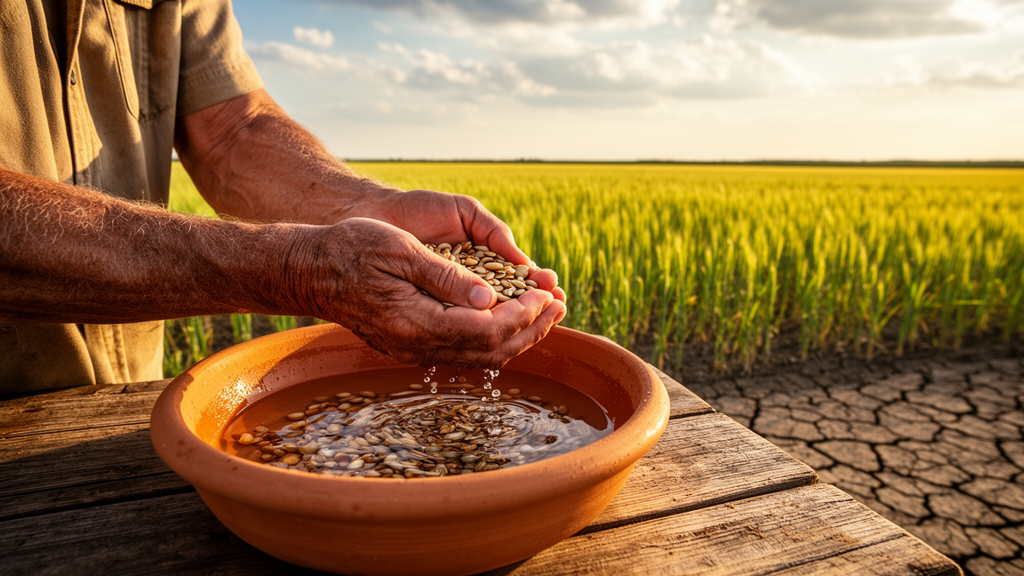
As drought, salinity, heat and cold increasingly disrupt agriculture around the world, a new review argues that one of the simplest tools available to farmers may also be among the most underused: treating seeds before they ever touch the soil. Writing in the journal Discover Plants, Muhammad Waqar Nasir, Rabia Manzoor and Muhammad Haseeb Javaid synthesize evidence on seed priming, a pre-sowing technique in which seeds are hydrated under controlled conditions and then dried back before planting. The treatment jump-starts the earliest phases of germination without allowing the embryonic root to emerge, so that when seeds are finally sown, they germinate faster, more uniformly and with greater tolerance of hostile conditions. The authors frame priming as a practical, low-cost complement to breeding and other agronomic strategies, but they are equally clear about its limits: benefits are strongest at germination and early seedling stages, and do not always translate into proportional yield gains in the field.
The scale of the problem the technique addresses is considerable. According to figures cited in the review, more than 10 percent of the global land area, some 1.4 billion hectares, is already affected by salinity, while roughly 40 percent of the world’s land surface is exposed to drought stress. Climate change and human activity are intensifying both the frequency and the severity of these stresses, making crop establishment increasingly unstable. Germination and early seedling establishment are the most vulnerable phases of the crop cycle, and a poor stand at this stage often produces irreversible yield losses later in the season. Against this backdrop, the review positions seed priming as a pre-emptive intervention: rather than trying to rescue a struggling crop, farmers prepare the seed itself to face stress from the first hours of its life.
The simplest form of the technique, hydropriming, involves soaking seeds in aerated water for a defined period, typically between two and 48 hours in the studies surveyed, followed by drying. Because it requires no special chemicals or equipment, it has attracted particular attention in low-input farming systems, although the review notes that its effects may be less consistent than those of more specialized methods. Osmopriming refines the approach by soaking seeds in solutions of low water potential, such as polyethylene glycol, which regulates water uptake more precisely and reduces the risk of over-imbibition damage while still activating repair and metabolic processes. Halopriming uses inorganic salt solutions, including calcium chloride, potassium nitrate, potassium chloride, sodium chloride and sodium hydrosulfide, and is considered especially relevant for osmotic and ionic stresses such as salinity. In comparative studies cited by the authors, halopriming outperformed hydropriming for stress mitigation in rapeseed.
Beyond these hydration-based methods, the review catalogues a growing family of targeted approaches. Hormonal priming applies plant growth regulators such as salicylic acid, gibberellic acid, jasmonates and auxins at low concentrations, aiming not only to improve germination but to pre-activate stress-signaling pathways; in wheat, hormonal priming outperformed both halopriming and osmopriming against heat and drought in several studies. Nutripriming supplies essential nutrients such as zinc, selenium and phosphorus during imbibition, supporting early seedling nutrition, although excessive nutrient concentrations can harm germination, so dosing must be optimized. In an extensive study of chilling tolerance in rice cultivars, nutripriming and hormonal priming performed better than other techniques. Biopriming pairs hydration with beneficial microorganisms such as plant growth-promoting bacteria and fungi, linking seed technology to biological stress management, while nanopriming, the youngest and least established method, uses nanomaterials whose mechanisms and biosafety remain incompletely characterized.
What unites these methods is a shared set of underlying mechanisms, which the review dissects in detail. Controlled hydration initiates cellular repair and metabolic reactivation, including restoration of membrane function damaged during storage, and accelerates the mobilization of stored reserves that fuel embryo growth. This explains the most consistently reported outcomes: higher germination percentage and germination index, faster emergence, greater seed vigor, and reductions in mean germination time and time to 50 percent germination. Priming also reshapes the seed’s handling of reactive oxygen species. Moderate ROS production during hydration acts as a signal that primes defense pathways, so that when stress later triggers excessive ROS, primed seeds and seedlings show higher activity of antioxidant enzymes such as superoxide dismutase, catalase and peroxidase, along with greater non-enzymatic antioxidant capacity, limiting damage to lipids, proteins and nucleic acids.
Osmotic and ionic regulation form a second mechanistic pillar. Under drought and salinity, low external water potential impedes water uptake and turgor maintenance; priming increases osmoprotective compounds such as proline and soluble sugars, which stabilize proteins and membranes while preserving cellular hydration. Reported consequences include improved relative water content, leaf water status and water-use efficiency. Priming also modulates hormonal balance: shifts in the abscisic acid to gibberellin ratio influence whether a seed remains dormant or proceeds toward germination, while salicylic acid, jasmonates, auxin and ethylene regulate antioxidant defense, root development and stress signaling. A focused synthesis of salicylic-acid priming under salinity, cited in the review, identifies coordinated regulation of antioxidant defense, osmotic adjustment, ion homeostasis, photosynthesis and hormone crosstalk as central to the response, with efficacy depending on crop, dose and treatment duration.
At the molecular level, priming appears to reprogram gene expression rather than tweak single pathways. The review highlights work in soybean under salinity showing drastic alterations in histone 3 lysine 4 dimethylation and trimethylation and in histone 3 lysine 9 acetylation, epigenetic marks that coordinately modified stress responses, ion homeostasis and cell wall modification. Transcriptomic, proteomic and metabolomic studies increasingly point to changes in regulatory networks, and chromatin modification and altered DNA methylation have been proposed as contributors, though direct evidence remains limited for many crop-priming combinations. The review also addresses stress memory: primed plants can retain enhanced stress responsiveness for hours, days or potentially across generations, and some studies report transgenerational drought tolerance linked to better tissue water status, osmolyte accumulation and reduced lipid peroxidation. However, the authors caution that evidence for memory within the treated generation is stronger than evidence for stable inheritance, and claims of heritable effects should await multi-generation experiments.
Performance across stresses is encouraging but uneven. Under drought, priming in wheat, maize, rice, chickpea and sunflower has frequently improved germination, emergence, seedling vigor and early root development, with osmopriming showing advantages over hydropriming for crop growth rate, leaf area development and sustained drought adaptation. Under salinity, osmopriming and halopriming generally perform best, with benefits extending to potassium-sodium homeostasis and membrane stability; recent tomato evidence shows that combining potassium nitrate, hydrogen peroxide and calcium chloride can outperform the individual compounds under sodium chloride stress, improving growth and antioxidant activity while reducing sodium accumulation. Against thermal stress, hormonal priming showed comparatively strong performance in wheat under heat, while primed seeds under cold displayed better starch metabolism, soluble sugar accumulation and respiratory activity. For waterlogging, heavy-metal toxicity and combined stresses, evidence is thinner and responses less predictable, requiring crop-specific optimization.
The review’s most sobering message concerns the gap between laboratory promise and field reliability. Much of the evidence base comes from Petri dishes, growth chambers and pot experiments where stress intensity is tightly controlled, and improved early establishment does not always guarantee proportional yield gains, particularly when stress becomes severe later in the season or when other factors override the initial advantage. The authors identify a series of research gaps: the lack of standardized protocols, with studies varying widely in seed quality, concentration, duration, drying procedure and storage interval; crop, cultivar and seed-lot-specific responses that make universal protocols unrealistic; the need for mechanistic validation and predictive biomarkers linking molecular responses to yield; the urgency of multi-location, multi-season field trials; and the neglect of combined and sequential stresses that crops face in reality. Storage behavior of primed seeds, whose vigor may decline faster after partial hydration, poses a further commercial challenge, as do microbial viability in biopriming and particle toxicity and environmental fate in nanopriming.
For immediate application, the review offers a pragmatic hierarchy. Hydropriming currently offers the greatest simplicity, affordability and ease of adoption, though with less specialized or persistent effects; biopriming is promising for sustainable production because it couples seed enhancement with microbial support for roots, nutrient acquisition and stress defense; and nanopriming can produce strong responses at low doses but cannot yet be considered universally suitable given limited multi-location evidence, dose-dependent toxicity concerns and regulatory uncertainty. Osmopriming, halopriming, hormonal priming and nutripriming may be preferable for specific crop-stress combinations but demand accurate control of concentration, duration and drying. The authors conclude that seed priming should be developed as part of an integrated crop-management strategy, compatible with stress-tolerant cultivars, adjusted sowing dates and climate-smart practices, rather than promoted as a stand-alone solution. With targeted, field-oriented research, they argue, this simple intervention could move from a promising experimental tool to a dependable component of climate-resilient crop production.
Subject of Research: Seed priming techniques for improving abiotic stress tolerance in field crops
Article Title: Seed priming as a strategy to enhance crop resilience under abiotic stress conditions
Article References: Nasir, M. W., Manzoor, R., & Javaid, M. H. (2026). Seed priming as a strategy to enhance crop resilience under abiotic stress conditions. Discover Plants, 3(1), Article 481. https://doi.org/10.1007/s44372-026-00966-6
Image Credits: AI Generated
DOI: 10.1007/s44372-026-00966-6
Keywords: seed priming, abiotic stress, drought, salinity, crop resilience, germination, hydropriming, osmopriming, biopriming, nanopriming, antioxidant defense, stress memory
Cite Scienmag News
Alan Morgan. (October 25, 2026). Seed Priming Emerges as a Low-Cost Route to Climate-Resilient Crops. Scienmag. https://scienmag.com/seed-priming-emerges-as-a-low-cost-route-to-climate-resilient-crops/
Alan Morgan. "Seed Priming Emerges as a Low-Cost Route to Climate-Resilient Crops." Scienmag, 25 October 2026, https://scienmag.com/seed-priming-emerges-as-a-low-cost-route-to-climate-resilient-crops/. Accessed 25 October 2026.
Alan Morgan. "Seed Priming Emerges as a Low-Cost Route to Climate-Resilient Crops." Scienmag. October 25, 2026. https://scienmag.com/seed-priming-emerges-as-a-low-cost-route-to-climate-resilient-crops/


