

Sunday, October 25, 2026
Science
No Result
View All Result
  • Login
  • HOME
  • SCIENCE NEWS
  • CONTACT US
  • HOME
  • SCIENCE NEWS
  • CONTACT US
No Result
View All Result
Scienmag
No Result
View All Result
Home Science News Social Science

Murky Water Changes How Stickleback Shoals Search for Food

October 25, 2026
in Social Science
Courtney Benton
By Courtney Benton Scienmag Editorial Profile - Science and Technology Policy
Reading Time: 3 mins read
0
Murky Water Changes How Stickleback Shoals Search for Food

Murky Water Changes How Stickleback Shoals Search for Food

65
SHARES
587
VIEWS
Share on FacebookShare on Twitter
ADVERTISEMENT

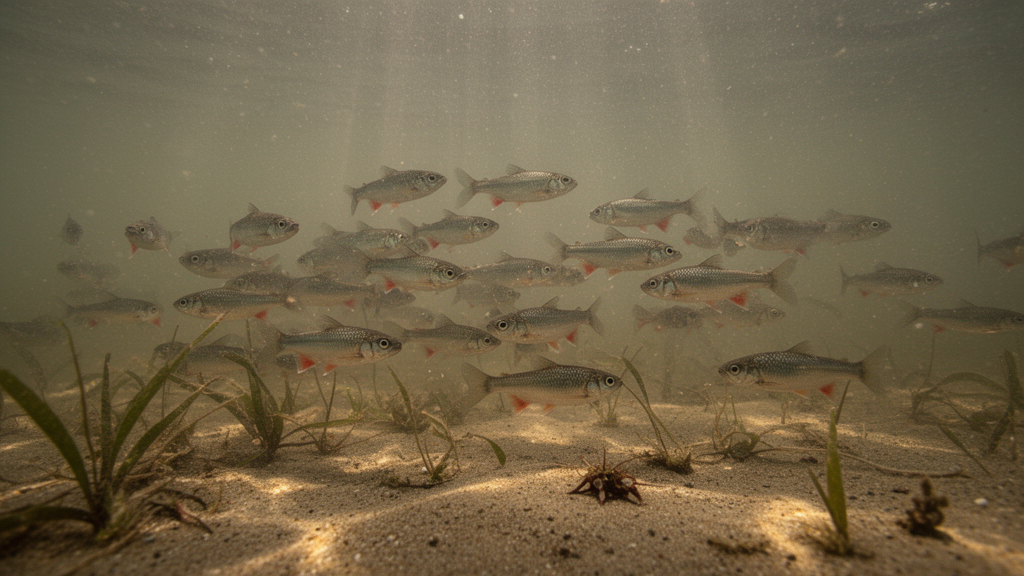
Three-spined sticklebacks took longer to swim toward food that unexpectedly appeared in cloudier water, but the fish compensated by becoming more closely connected and coordinated within their shoals, according to a peer-reviewed study by University of Bristol researchers published in Proceedings of the Royal Society B. The changes in collective behaviour reduced the disadvantage associated with reduced visibility without fully eliminating the delay in locating food.

Sticklebacks are common freshwater fish that often form small shoals in ponds, streams and rivers across the Northern Hemisphere, where they can encounter water ranging from clear to deeply murky. Turbidity, the cloudiness of water caused by suspended particles such as algae, mud and silt, can make it harder for aquatic animals to see food, other animals or potential threats. The release notes that turbidity is increasing in many rivers and coastal waters because of farming, mining, construction and other forms of pollution.

Researchers from Bristol’s School of Biological Sciences examined how shoals of three-spined sticklebacks responded as their water became cloudier and then observed their reactions when food suddenly appeared. In murkier conditions, individual fish generally took longer to move toward the food than fish in clear water. Individuals in larger groups, however, responded more quickly overall. The results indicate that both group size and the degree of coordination within a group influenced how effectively the fish responded when visibility was limited.

The relationship between coordination and response time differed across group sizes and levels of turbidity. In small groups in murky water, fish reached the food more quickly when they stayed close together and swam in the same direction. In larger groups in clear water, by contrast, tighter coordination slowed the group’s response. Before the food appeared, fish in murky water tended to swim closer together, align their movements more closely and respond more readily to the behaviour of nearby group members, particularly in smaller groups.

These observations show behavioural plasticity, meaning that the fish adjusted their social responses to changing environmental conditions rather than following one fixed pattern of grouping. The study’s central result is that increased cohesion, alignment and responsiveness to neighbours helped sticklebacks mitigate some of the information lost through turbid water. The compensation was not complete: the release reports that fish in murkier water still took longer to reach the unexpected food than those in clear water.

Corresponding author Christos Ioannou, Professor of Behavioural Ecology, said the results showed that the fish “were able to compensate for this challenge by changing their shoaling behaviour.” According to Ioannou, their shoals became more coordinated in poor conditions, with fish moving and aligning themselves together more closely, allowing the coordinated groups to find food faster than if the animals had not coordinated.

Co-author Sean Rands, Senior Lecturer, said the findings show that behavioural rules governing animal grouping can change in response to environmental challenges. He noted that shifts between hot, dry periods and heavy rains can produce sudden surges of muddy, highly turbid water in rivers and streams, creating conditions in which flexible social behaviour may matter. The study therefore documents how the tested sticklebacks modified shoaling and foraging responses under different water-clarity conditions, linking their collective behaviour to the challenge of finding food when visual information is restricted.

Subject of Research: How water turbidity changes three-spined stickleback shoaling and food-search behaviour

Article Title: Muddying the waters makes fish more sociable, study finds

Article References: Muddying the waters makes fish more sociable, study finds. Original publication (Bibliographic details unavailable.)

Image Credits: AI Generated

DOI: Not provided

Keywords: three-spined sticklebacks, shoaling behaviour, water turbidity, collective behaviour, behavioural plasticity, animal coordination, foraging behaviour, aquatic pollution, group size, fish shoals, Muddying, waters

Cite Scienmag News

Courtney Benton. (October 25, 2026). Murky Water Changes How Stickleback Shoals Search for Food. Scienmag. https://scienmag.com/murky-water-changes-how-stickleback-shoals-search-for-food/

Courtney Benton. "Murky Water Changes How Stickleback Shoals Search for Food." Scienmag, 25 October 2026, https://scienmag.com/murky-water-changes-how-stickleback-shoals-search-for-food/. Accessed 25 October 2026.

Courtney Benton. "Murky Water Changes How Stickleback Shoals Search for Food." Scienmag. October 25, 2026. https://scienmag.com/murky-water-changes-how-stickleback-shoals-search-for-food/


Tags: adaptive behaviors of sticklebacks in turbid conditionsanimal coordinationaquatic pollutionbehavioural plasticitycollective behavior of fish shoalscollective behavioureffects of pollution-induced turbidity on aquatic ecosystemseffects of water pollution on fish foragingenvironmental factors affecting fish foraging efficiencyfish communication and cooperation in low visibilityfish shoaling coordination in murky waterfish shoalsforaging behaviourfreshwater fish response to environmental changegroup sizeimpact of water turbidity on aquatic animalsinfluence of water clarity on fish feedingMuddyingpredator-prey interactions in cloudy watershoaling behaviourstickleback fish behaviorthree-spined sticklebackswater turbiditywaters
Share26Tweet16
Previous Post

Chinese polyherbals show preliminary benefits in diabetic osteoporosis

Next Post

Case Links Persistent Kidney Failure to Infection-Related Glomerular Inflammation

Related Posts

Requests and refusals in English reveal shared strategies but cultural divides among Nigerian students
Social Science

Requests and refusals in English reveal shared strategies but cultural divides among Nigerian students

October 25, 2026
US-centered polarization research may mislead global policy
Social Science

US-centered polarization research may mislead global policy

October 25, 2026
Talent policy news attention linked nonlinearly to public response in Chinese cities
Social Science

Talent policy news attention linked nonlinearly to public response in Chinese cities

October 25, 2026
Musical training associated with earlier prediction in sequence learning
Social Science

Musical training associated with earlier prediction in sequence learning

October 25, 2026
Machine Learning Maps Why Traditional Villages Cluster Across Southwest China
Social Science

Machine Learning Maps Why Traditional Villages Cluster Across Southwest China

October 25, 2026
Personality’s genetic links extend across health, careers and relationships
Social Science

Personality’s genetic links extend across health, careers and relationships

October 25, 2026
Next Post
Case Links Persistent Kidney Failure to Infection-Related Glomerular Inflammation

Case Links Persistent Kidney Failure to Infection-Related Glomerular Inflammation

  • Mothers who receive childcare support from maternal grandparents show more optimized

    Mothers who receive childcare support from maternal grandparents show more parental warmth, finds NTU Singapore study

    27656 shares
    Share 11059 Tweet 6912
  • University of Seville Breaks 120-Year-Old Mystery, Revises a Key Einstein Concept

    1061 shares
    Share 424 Tweet 265
  • Bee body mass, pathogens and local climate influence heat tolerance

    682 shares
    Share 273 Tweet 171
  • Researchers record first-ever images and data of a shark experiencing a boat strike

    546 shares
    Share 218 Tweet 137
  • Groundbreaking Clinical Trial Reveals Lubiprostone Enhances Kidney Function

    531 shares
    Share 212 Tweet 133
Science

Embark on a thrilling journey of discovery with Scienmag.com—your ultimate source for cutting-edge breakthroughs. Immerse yourself in a world where curiosity knows no limits and tomorrow’s possibilities become today’s reality!

RECENT NEWS

  • Cosmic frame-dragging may explain MOND’s mysterious acceleration constant
  • Case Links Persistent Kidney Failure to Infection-Related Glomerular Inflammation
  • Murky Water Changes How Stickleback Shoals Search for Food
  • Chinese polyherbals show preliminary benefits in diabetic osteoporosis

Categories

  • Agriculture
  • Anthropology
  • Archaeology
  • Athmospheric
  • Biology
  • Biotechnology
  • Blog
  • Bussines
  • Cancer
  • Chemistry
  • Climate
  • Earth Science
  • Editorial Policy
  • Marine
  • Mathematics
  • Medicine
  • Pediatry
  • Policy
  • Psychology & Psychiatry
  • Science Education
  • Science News
  • Social Science
  • Space
  • Technology and Engineering

Subscribe to Blog via Email

Enter your email address to subscribe to this blog and receive notifications of new posts by email.

Join 5,151 other subscribers

© 2025 Scienmag - Science Magazine

Welcome Back!

Login to your account below

Forgotten Password?

Retrieve your password

Please enter your username or email address to reset your password.

Log In
No Result
View All Result
  • HOME
  • SCIENCE NEWS
  • CONTACT US

© 2025 Scienmag - Science Magazine

Discover more from Science

Subscribe now to keep reading and get access to the full archive.

Continue reading