


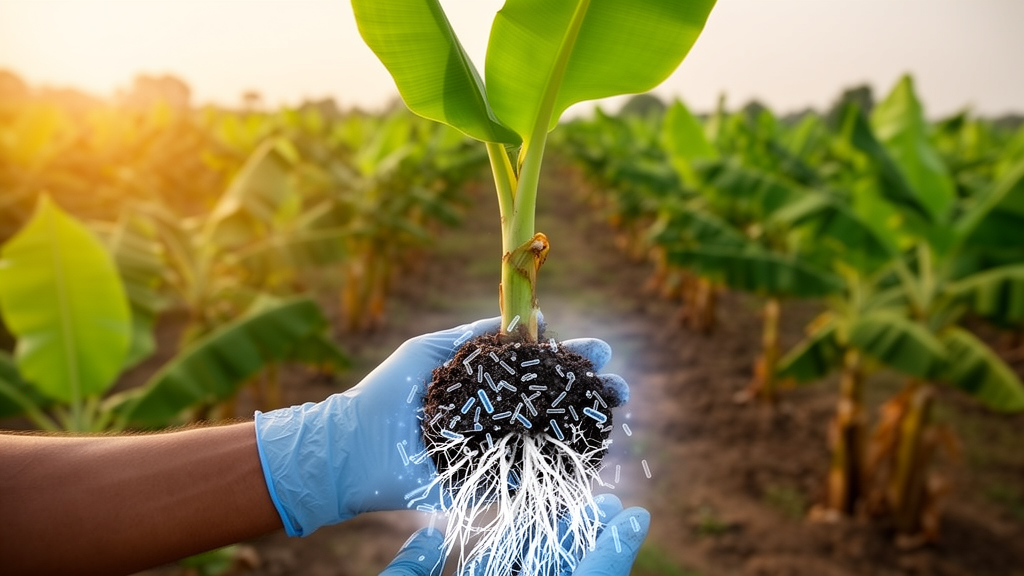
A soil-dwelling killer is stalking the world's banana plantations, and a team of researchers in Pakistan and China has now isolated a native bacterium that can fight back. Fusarium oxysporum f. sp. cubense tropical race 4, the fungal strain behind the dreaded Panama disease, has reached the banana fields of Sindh province, where nearly the entire commercial crop belongs to the susceptible Cavendish group. In a new study published in Frontiers in Microbiology, scientists screened bacteria living inside and around healthy banana plants growing in TR4-infested soil and identified a rhizosphere isolate, named F2, that suppressed fungal mycelial growth by up to 74 percent in laboratory assays.
Molecular and biochemical analyses revealed that this Bacillus amyloliquefaciens strain carries a full arsenal of antifungal weapons, from cyclic lipopeptide antibiotics and hydrolytic enzymes to volatile organic compounds, and that it switches on its key defense genes the moment it encounters the pathogen. The stakes for Pakistan could hardly be higher. Bananas grew on roughly 40,106 hectares in the country, producing about 311,166 tons, concentrated in Sindh where soil and climate favor the crop.
The dominant variety is Dwarf Cavendish, known locally as Basrai, which covers about 90 percent of the cultivated area, and most of the harvest is consumed domestically while around 82,000 metric tons are exported to neighboring countries. Production on a single hectare can bring in approximately Rs. 1.4 million, equivalent to about 5,000 US dollars, the highest return among fruits grown in the country.
Fusarium wilt was first detected in Pakistan in 2012 in the Thatta district of Hyderabad and formally reported in 2015, with an average disease incidence of 17 percent that ranged from 2 to 42 percent across different regions. Because every variety grown in Sindh is a Cavendish banana, the arrival of TR4 is described as an alarming threat to the future of the national banana industry. TR4 is not an ordinary plant pathogen.
Since its emergence in Taiwan in 1967, it has swept across Southeast Asia, reaching China, India, Indonesia, Malaysia, the Philippines, Laos, Myanmar, Vietnam, and Pakistan, and has jumped intercontinentally to Australia, Jordan, Lebanon, Oman, Mozambique, Colombia, and Turkey. The fungus is a vascular, soil-borne invader that can survive in soil for more than 20 years even without a plant host, making eradication virtually impossible. Non-systemic fungicides cannot reach the pathogen once it has entered the plant's vascular system, and intensive chemical use breeds resistance while contaminating the environment.
Global losses from Fusarium wilt already run to millions of US dollars annually and are predicted to reach about 10 billion US dollars by 2040. Breeding resistant varieties offers little immediate relief, because banana is parthenocarpic and largely sterile, resistant germplasm is scarce, and market acceptance of new cultivars is uncertain. These constraints have pushed researchers toward biological control, the use of beneficial microbes to suppress soil-borne pathogens in an eco-friendly way.
The research team, led by scientists at COMSATS University Islamabad in collaboration with the Chinese Academy of Tropical Agricultural Sciences in Haikou, collected eight samples of healthy banana plants from six farms in Sindh province, all located in fields infested with Foc TR4. From rhizospheric soil, root tissues, and stem samples, they isolated a total of 138 bacteria, including 82 morphologically distinct isolates from soil, 14 from roots, and 42 from stems. Each isolate was tested in dual culture assays against 21 genetically diverse Foc TR4 fungal isolates revived from laboratory stocks, measuring mycelial growth after seven days of co-incubation and calculating percentage inhibition relative to uninhibited controls.
Statistical analysis using Duncan's Multiple Range Test at the 5 percent significance level revealed that seven isolates inhibited fungal growth by more than 50 percent. Among them, isolate F2 stood out dramatically, showing strong antagonistic activity against 19 of the 21 fungal isolates, with inhibition values ranging from 65 to 74 percent, while the other leading isolates, A41b, C2, A3, F8, and R18, displayed narrower and generally weaker activity spectra. To identify their star antagonist, the researchers extracted DNA from F2, amplified the 16S rRNA gene with universal primers, and sequenced the product.
BLAST comparison against the NCBI database showed 99.49 percent sequence identity with a Bacillus amyloliquefaciens strain, and phylogenetic analysis in MEGA clustered F2 firmly within the B. amyloliquefaciens clade, closely affiliated with strain NBRC 15535 with a strong bootstrap value of 97 percent. The sequence was deposited in GenBank under accession number OQ221535. Morphologically, F2 forms off-white, rhizoid-shaped colonies with undulate margins and a sticky texture, and its cells are Gram-positive, occurring in long chains.
Bacillus amyloliquefaciens has a strong track record as a plant pathogen antagonist, suppressing foes through competition for nutrients, production of antibiotics and secondary metabolites, and induction of systemic resistance in plants, which made the identification of F2 as a member of this species particularly encouraging. Biochemical profiling then revealed how F2 promotes plant growth and attacks fungi simultaneously. The bacterium actively produces indole-3-acetic acid, a plant hormone that stimulates root and shoot development and induces systemic resistance against phytopathogens, along with siderophores, which chelate environmental iron and starve competing pathogens of this essential nutrient, and ammonia, which creates an alkaline milieu that inhibits spore germination while serving as a soil biofertilizer.
Notably, F2 tested negative for hydrogen cyanide production and showed no ability to solubilize phosphate, potassium, or zinc, three traits often considered classical hallmarks of plant growth-promoting rhizobacteria. Despite lacking these traits, F2 displayed the highest antifungal activity of any isolate in the screen, suggesting that suppression of TR4 may depend more heavily on antimicrobial metabolite production than on nutrient mobilization alone. Enzyme assays confirmed that F2 secretes amylase, pectinase, protease, catalase, cellulase, and chitinase, but not esterase or lipase.
Chitinase is especially significant because chitin is a major structural component of fungal cell walls, and its hydrolysis can physically degrade the pathogen's defenses. The most technically revealing part of the study came from molecular screening of biocontrol-related genes. PCR amplification confirmed that F2 carries all 13 genes the team searched for, including srfAA, fenD, ituC, bamD, yngG, yndJ, and dhbA, which encode non-ribosomal peptide synthetases for metabolites such as surfactin, fengycin, iturin, bacillomycin, and bacillibactin; mln, bae, dfn, and bac, which encode polyketide synthetases for macrolactin, bacillaene, difficidin, and bacilysin; and sboA and bioA, ribosomal peptide synthetase genes for subtilosin and biotin biosynthesis.
When the researchers co-cultivated F2 with Foc TR4 and quantified gene expression by RT-qPCR, normalizing transcripts against the RopB housekeeping gene with the 2−ΔΔCt method, they found significant upregulation compared with bacteria grown alone. The strongest responses were fenD, upregulated 30.83-fold, srfAA at 27.64-fold, ituC at 26.33-fold, and dhbA at 21.94-fold. These four genes govern the biosynthesis of fengycin, surfactin, iturin, and bacillibactin, respectively, indicating that the bacterium activates its lipopeptide antibiotic machinery and iron-scavenging siderophore system specifically upon sensing the pathogen.
These cyclic lipopeptides are well-characterized fungal killers. Fengycin induces fungal cell death by disrupting membrane integrity and increasing cell permeability, triggering ultrastructural destruction of hyphae and the accumulation of reactive oxygen species. Surfactin initiates antagonistic mechanisms against TR4 and upregulates plant defense gene biosynthesis, while surfactin and fengycin together effectively inhibit the pathogen, a synergy already demonstrated in other B. amyloliquefaciens strains such as SQR9, whose bacillomycin D and fengycin collectively suppress Fusarium wilt.
Supporting evidence came from cell-free culture filtrate experiments: after six days of growth, F2's sterile filtrate, confirmed free of viable cells, inhibited all 21 fungal isolates by an average of 38 percent, ranging from 31 to 48 percent, proving that soluble secreted metabolites alone carry antifungal power. Gas chromatography–mass spectrometry profiling then uncovered the chemical dimension of the interaction. Extracts of the fungus alone yielded 25 compounds, F2 alone 17, but the co-culture of F2 with Foc TR4 produced 73 compounds, including 36 distinct molecules not detected in either single culture.
These included diketopiperazines, amino acid derivatives, fatty acids such as octanoic and pentanoic acid, and 2,4-di-tert-butylphenol, a compound reported to damage fungal membranes and inhibit spore germination. The authors note that the change in culture medium during co-cultivation could partly contribute to the altered metabolite profile, but the pattern indicates that F2 responds metabolically to the pathogen and activates specific chemical defenses. The performance of F2 sits credibly within the international literature.
A B. amyloliquefaciens strain NJN-6 isolated from healthy banana rhizosphere soil achieved 40 percent inhibition of Foc, while a fermented NJN-6 biofertilizer suppressed banana Fusarium wilt in a seasonal pot experiment. More strikingly, another rhizosphere B. amyloliquefaciens strain inhibited TR4 by 79.6 percent in vitro and reduced disease severity by 82.6 percent under field conditions. F2's in vitro inhibition falls in the lower-to-middle range of these established agents, which the authors interpret as evidence that the isolate possesses biocontrol capacity comparable to strains already validated against TR4.
Crucially, the study shows that F2 does not rely on a single mode of action: its antagonism weaves together hydrolytic enzymes, secondary metabolites from non-ribosomal peptide synthetase, polyketide synthetase, and ribosomal peptide synthetase pathways, siderophore-mediated iron competition, and volatile compounds that can suppress fungal development over distance by inhibiting mycelial growth, spore germination, and fungal gene expression. The researchers conclude that the F2 isolate is a promising candidate for controlling banana Fusarium wilt, and their findings carry particular weight because the bacterium was recovered from the rhizosphere of a healthy plant thriving in TR4-infested Pakistani soil. The authors themselves flag the essential next step: further in vivo validation of biocontrol efficacy would strengthen the isolate's potential as a biocontrol agent, since all evidence so far comes from laboratory assays rather than field trials.
As TR4 continues its intercontinental march and the global banana monoculture remains dangerously uniform, such rhizosphere allies, isolated from the very soils where the fungus already reigns, offer a research avenue worth pursuing for the world's most popular fruit.
Subject of Research: Biocontrol of banana Fusarium wilt tropical race 4 by a rhizosphere-associated Bacillus amyloliquefaciens isolate from Pakistan
Article Title: Biocontrol potential of a rhizosphere-associated Bacillus amyloliquefaciens F2 isolate against Fusarium oxysporum f. sp. cubense Tropical Race 4 in Pakistan
Article References: Shabbir, A., Farrakh, S., Rubab, S., Mehreen, S., Shabbir, S., Benabdelkader, S., Hassan, N., Yasmin, T., Shafqat, M. N., Yin, H., Yu, N., & Hassan, M. N. (2026). Biocontrol potential of a rhizosphere-associated Bacillus amyloliquefaciens F2 isolate against Fusarium oxysporum f. sp. cubense Tropical Race 4 in Pakistan. Frontiers in Microbiology, 17, Article 1957002. https://doi.org/10.3389/fmicb.2026.1957002
Image Credits: AI Generated
DOI: 10.3389/fmicb.2026.1957002
Keywords: Fusarium oxysporum f. sp. cubense, TR4, Panama disease, Bacillus amyloliquefaciens, biological control, banana, Pakistan, rhizosphere bacteria, cyclic lipopeptides, hydrolytic enzymes, volatile organic compounds, plant growth promotion
Cite Scienmag News
Morgan Morrow. (October 24, 2026). Rhizosphere bacterium Bacillus amyloliquefaciens F2 shows strong biocontrol against banana Fusarium wilt TR4 in Pakistan. Scienmag. https://scienmag.com/rhizosphere-bacterium-bacillus-amyloliquefaciens-f2-shows-strong-biocontrol-against-banana-fusarium-wilt-tr4-in-pakistan/
Morgan Morrow. "Rhizosphere bacterium Bacillus amyloliquefaciens F2 shows strong biocontrol against banana Fusarium wilt TR4 in Pakistan." Scienmag, 24 October 2026, https://scienmag.com/rhizosphere-bacterium-bacillus-amyloliquefaciens-f2-shows-strong-biocontrol-against-banana-fusarium-wilt-tr4-in-pakistan/. Accessed 24 October 2026.
Morgan Morrow. "Rhizosphere bacterium Bacillus amyloliquefaciens F2 shows strong biocontrol against banana Fusarium wilt TR4 in Pakistan." Scienmag. October 24, 2026. https://scienmag.com/rhizosphere-bacterium-bacillus-amyloliquefaciens-f2-shows-strong-biocontrol-against-banana-fusarium-wilt-tr4-in-pakistan/


