


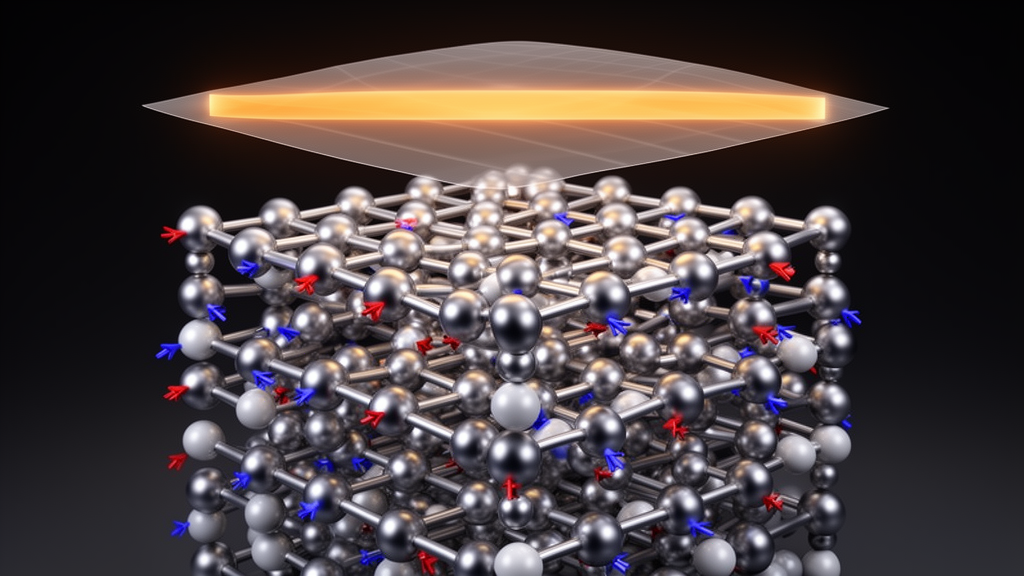
Flat electronic bands, in which electron energies are squeezed into a narrow window and electron kinetic energy is effectively frozen, have become one of the most sought-after prizes in condensed matter physics, because they amplify electron correlations and can host exotic quantum states. Until now, the standard recipes for making them have relied on special geometry, such as the destructive interference built into Kagome lattices, or on the long-wavelength moiré potentials that appear when atomically thin sheets are stacked with a small twist angle. A new computational study points to a strikingly different route: in the predicted magnetic topological material CoBi2Te4, flat bands emerge at the edges of the material purely from the cooperation between topological band inversion and an intrinsically non-collinear antiferromagnetic spin texture.
The work, based on first-principles density functional theory calculations combined with Wannier interpolation and Monte Carlo simulations, examined thin films of CoBi2Te4, a compound built from the same septuple-layer architecture as the well-known magnetic topological insulator MnBi2Te4. The researchers found that both one-septuple-layer and two-septuple-layer films settle into an intralayer non-collinear antiferromagnetic ground state with an in-plane easy axis. In this state, the magnetic moments of the cobalt atoms point along different directions but cancel out, yielding zero net magnetization while still breaking time-reversal symmetry locally. Molecular dynamics simulations on a three-by-three supercell at 300 kelvin showed the one-layer structure retaining its integrity over the simulation time, with the free energy equilibrating around a stable value and no bond breakage, supporting its thermodynamic stability.
The electronic structure of the single-layer film is insulating. Without spin-orbit coupling, the conduction band minimum draws contributions from both cobalt d and bismuth p orbitals, while the valence band maximum is dominated by tellurium p states. Switching on spin-orbit coupling, which is strong for the heavy bismuth and tellurium atoms, pushes the bismuth p states downward toward the Fermi level and shrinks the gap from 1.05 to 0.32 electronvolts at the PBE level of theory. Hybrid functional calculations gave larger gaps of 1.37 and 0.59 electronvolts with and without spin-orbit coupling respectively, while preserving the overall band shape. The calculated Chern number is zero, marking the single layer as topologically trivial.
Layer stacking proved decisive for the two-layer system, echoing the sensitivity of MnBi2Te4-family materials to interlayer coupling. Comparing AA stacking, in which atoms of the upper layer sit directly above their counterparts below, with AB stacking, in which the bottom layer is shifted along a specific in-plane direction, the team found AB stacking energetically favoured by 13.29 millielectronvolts per atom, with a shorter interlayer distance of 2.70 angstroms versus 3.73 angstroms. Projected density of states analysis revealed a high-spin cobalt configuration, with five of seven d electrons occupying spin-up states and the remaining two filling lower-energy t2g levels, giving a cobalt moment of 3 Bohr magnetons. Among five candidate magnetic configurations tested, the non-collinear antiferromagnetic state won out as the ground state.
The magnetic energetics translate into a measurable transition temperature. A Heisenberg model fitted to the cobalt lattice yielded a nearest-neighbour exchange coupling of −1.46 millielectronvolts, stronger than the −0.82 millielectronvolts found in the single layer, and spin-orbit calculations identified an in-plane easy axis with a magnetocrystalline anisotropy energy of −0.05 millielectronvolts per cobalt atom. Monte Carlo simulations built on these parameters predicted a Néel temperature of roughly 20 kelvin for the two-layer film, double the approximately 10 kelvin estimated previously for the single layer. That is cold by everyday standards, but it sits in the same range as MnBi2Te4, whose zero-field quantum anomalous Hall effect has been observed at 1.4 kelvin, and it is far more accessible than the 30 millikelvin temperatures needed for chromium-doped bismuth telluride devices.
With spin-orbit coupling included, the AB-stacked two-layer film becomes an insulator with a small 52 millielectronvolt direct gap at the gamma point, and the gap closing is accompanied by a band inversion: the bismuth p band inverts toward the valence band maximum at the zone centre while tellurium p states take over the conduction band minimum. Tests with Hubbard U values of 2 and 6 electronvolts showed that the cobalt d conduction bands shift with the correction strength but the bismuth and tellurium bands, which define the gap edges, remain largely unaffected, keeping the inversion intact. Yet despite this nontrivial inversion and the broken time-reversal symmetry, the Wannier charge center calculation gave a Chern number of zero. The reason is instructive: a Chern insulator needs not only inversion and broken symmetry but a net magnetization to supply the uniform magnetic field that supports chiral edge states, and the non-collinear spins of CoBi2Te4 cancel globally, precluding that outcome.
The real surprise appeared at the edges. Nanoribbons cut along the (100) and (010) directions showed gapped Dirac points at the gamma point with gaps of about 0.01 electronvolts, confirming the non-metallic character of those terminations. But a nanoribbon cut along the higher-index (210) direction behaved differently. There, the outermost exposed cobalt atoms adopt three distinct magnetization directions whose moments sum to zero on each side, forming what the authors call a non-collinear antiferromagnetic edge. Wannier-interpolated edge spectra revealed two flat bands, labelled fb1 and fb2, running near the Fermi level inside the bulk gap. The fb1 band traces a nearly straight trajectory across the entire X–gamma path, while fb2 sits slightly above it with only mild bending. Their bandwidths are remarkably narrow: 23.91 and 38.53 millielectronvolts at the left edge and 17.63 and 37.46 millielectronvolts at the right edge, all well below the roughly 52 millielectronvolt bulk gap. Flatness ratios exceeded 1 in every case, reaching 2.95 for fb1 at the right edge, a value that surpasses the ratios of roughly 1 typical of representative Kagome flat-band systems, indicating bands that are both weakly dispersive and well isolated from neighbouring edge states.
Local density of states analysis confirmed that these bands are genuinely edge-born. Grouping atomic layers into slabs numbered from the boundary inward, the calculations showed sharp resonance peaks at the flat-band energies concentrated in the outermost slab, decaying rapidly into the bulk background within a few slabs. The flat bands are composed primarily of bismuth p and tellurium p orbitals, consistent with the bulk band inversion. Two control experiments pinned down the recipe. In an AA-stacked film, which retains the non-collinear order but lacks band inversion, no edge bands appear in the gap at all. Conversely, an artificial AB-stacked nanoribbon forced into collinear edge magnetism still shows bands in the gap, but they bend strongly and shift away from the Fermi level. Band inversion supplies the states; the non-collinear magnetic order, through the spatially varying local exchange field it generates and its exchange coupling to the bismuth and tellurium p orbitals, suppresses their dispersion.
The mechanism appears to generalize. A heterostructure pairing a single CoBi2Te4 septuple layer with a quintuple layer of the parent topological insulator Bi2Te3, with a lattice mismatch of only about 1 percent, also favours the non-collinear antiferromagnetic state, shows a spin-orbit-induced band inversion, and, cut along (210), reproduces the flat edge bands, albeit with more bending near the gamma point. Because the heterostructure contains only one cobalt layer, its non-collinear order is governed by intralayer coupling alone, underscoring that this coupling is the essential ingredient. The team also reports that FeBi2Te4, recently predicted to share the same in-plane non-collinear ordering, possesses both key ingredients and likewise hosts flat bands along its (210) edge, suggesting the phenomenon may be a general feature of non-collinear antiferromagnetic bismuth telluride-based materials rather than a quirk of cobalt.
If experiments confirm these predictions, the implications could be far-reaching. Edge-localized flat bands carry a high density of states and near-zero group velocity, an ideal starting point for hunting strongly correlated phenomena such as Luttinger liquids and charge density waves, and they would suppress carrier transport along the (210) direction relative to others, producing strongly anisotropic conduction. The authors note that high-index terminations are unlikely to emerge from simple mechanical cleavage but could be accessed through epitaxial growth on vicinal substrates or bottom-up synthesis under controlled chemical potentials, and the calculated local density of states signatures offer concrete targets for scanning tunneling microscopy. Unlike Kagome lattices, where geometric frustration blocks electron hopping, or moiré superlattices, where twist-engineered periodic potentials confine electrons, this route welds topology and magnetism together, expanding the materials space in which flat-band physics, and the correlated quantum states it promises, might be realized.
Subject of Research: Flat bands induced by non-collinear antiferromagnetism in the predicted magnetic topological insulator CoBi2Te4
Article Title: Flat Bands Induced by Non‐Collinear Antiferromagnetism in CoBi2Te4
Article References: Zhao, Z., Yin, Y., Gu, J., Edmonds, M. T., & Medhekar, N. V. (2026). Flat Bands Induced by Non‐Collinear Antiferromagnetism in CoBi 2 Te 4. Advanced Science, 13(59), Article e76833. https://doi.org/10.1002/advs.76833
Image Credits: AI Generated
DOI: 10.1002/advs.76833
Keywords: CoBi2Te4, flat bands, non-collinear antiferromagnetism, topological insulator, band inversion, spin-orbit coupling, edge states, first-principles calculations, magnetic topological materials, Chern number, nanoribbons, strongly correlated states
Cite Scienmag News
Denise Maddox. (October 24, 2026). Non-Collinear Magnetism Creates Flat Electronic Bands in Predicted Topological Material CoBi2Te4. Scienmag. https://scienmag.com/non-collinear-magnetism-creates-flat-electronic-bands-in-predicted-topological-material-cobi2te4/
Denise Maddox. "Non-Collinear Magnetism Creates Flat Electronic Bands in Predicted Topological Material CoBi2Te4." Scienmag, 24 October 2026, https://scienmag.com/non-collinear-magnetism-creates-flat-electronic-bands-in-predicted-topological-material-cobi2te4/. Accessed 24 October 2026.
Denise Maddox. "Non-Collinear Magnetism Creates Flat Electronic Bands in Predicted Topological Material CoBi2Te4." Scienmag. October 24, 2026. https://scienmag.com/non-collinear-magnetism-creates-flat-electronic-bands-in-predicted-topological-material-cobi2te4/


