


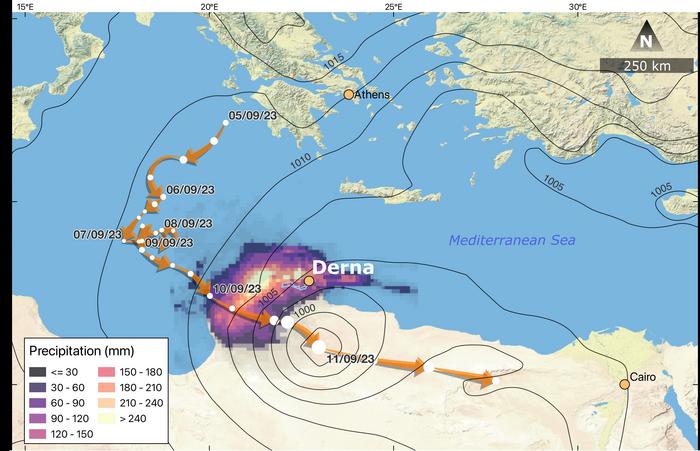
A significant disaster struck the city of Derna, Libya, in September 2023, as catastrophic flooding resulted in severe destruction, loss of life, and critical infrastructure failure. While Storm Daniel, a Mediterranean tropical-like cyclone, brought intense rainfall to the region, recent research indicates that the devastating effects of the flood were not just a consequence of natural weather phenomena. Instead, they were amplified by the collapse of two embankment dams, revealing critical flaws in infrastructure design and flood risk management that ultimately led to a tragic humanitarian crisis.
The study, which has gained traction for its thorough analysis, relied on cutting-edge hydrological modeling and satellite data to piece together the events leading up to the disaster. Researchers conducted atmospheric reanalysis to examine prior weather patterns and precipitation levels that contributed to the flooding. Their findings underscore the importance of understanding how climate anomalies interact with human-made structures, as the mismanagement of infrastructure played a pivotal role in the flood’s magnitude.
The rainfall associated with Storm Daniel was indeed intense, with significant precipitation recorded over the Wadi Derna catchment, which eventually buckled under the pressure. However, the researchers assert that this level of rainfall, while severe, was not unprecedented for the region. In fact, such storms are expected in the area every few decades. Understanding this cyclical nature of severe weather is essential for establishing better flood preparedness strategies.
The researchers’ simulations demonstrated that the structural integrity of the dams was severely compromised. When the dams finally breached, the resulting deluge wreaked havoc on the city of Derna. This was not merely a situation of nature unleashing its fury; it was a clear sign of complacency fueled by over-reliance on flood protection infrastructures. The dams, initially perceived as safe havens, transformed into catastrophic facilitators of disaster when they failed.
In a setting where climate variability is already high, it becomes increasingly critical for communities situated in flood-prone areas to engage in proactive risk management. The existence of the dams, rather than offering security, fostered an illusion that led to considerable construction and development in vulnerable neighborhoods. Thus, when the dams gave way, the flood surge brought about unprecedented destruction, engulfing homes, community facilities, and taking thousands of lives in the process.
The study emphasizes that the framework of risk assessment and communication surrounding infrastructure must be strengthened significantly. The interplay between natural systems and human activities requires a nuanced understanding of environmental risks. The researchers caution against a singular focus on infrastructure without integrating comprehensive risk communication strategies that engage communities in planning and preventive measures.
Emergency infrastructures are not foolproof; they must be continuously monitored and maintained. Unfortunately, in the case of Derna, inadequate risk assessments and poor management established conditions ripe for disaster. This glaring omission reinforces the idea that disasters stemming from natural events can be mitigated through strategic planning, prudent engineering practices, and maintaining an open line of communication with at-risk populations.
Furthermore, the research suggests that an over-reliance on constructed barriers—without recognizing their vulnerabilities—can lead to the very situations that cause tragedies. Nature-based solutions offer an alternative perspective, advocating for ecosystem restoration, wetland conservation, and other measures that can complement traditional flood defenses. These approaches may not only reduce the risks of flooding events but also offer sustainable benefits to local ecosystems.
Failing to heed the lessons from the Derna tragedy could spell future disasters as climate change continues to raise the stakes of extreme weather. The study implores stakeholders—be they local governments, environmental agencies, or community leaders—to adopt comprehensive strategies that prioritize both human safety and ecological integrity. The fallout from the 2023 flooding event serves as a potent reminder of the complexities surrounding natural disasters and human infrastructure, underscoring how critical proactive measures are in safeguarding vulnerable populations.
Finally, the researchers have called for rigorous dialogues around infrastructure and emergency planning to root out complacency and elevate the standards of risk management practices globally. Rethinking the strategies that influence how communities interact with their environment may not only save lives during future disasters but could also foster a culture of resilience we urgently need in the face of climate uncertainties.
In conclusion, the findings of the study shine a stark light on the inadequacies of risk management and infrastructure planning in the wake of the catastrophic flood in Derna. Drawing lessons from this tragedy emphasizes the critical need for a balanced approach to disaster risk reduction, one that intertwines engineering safeguards with nature-based solutions and community engagement. The benefits of this integrated strategy will foster not only more safety and resilience but also a deeper connection to the environmental forces that shape our world.
Cite Scienmag News
Violet Maxwell. (March 28, 2025). Examining the Role of Two Dam Failures in the Escalation of the Derna Flood Catastrophe. Scienmag. https://scienmag.com/examining-the-role-of-two-dam-failures-in-the-escalation-of-the-derna-flood-catastrophe/
Violet Maxwell. "Examining the Role of Two Dam Failures in the Escalation of the Derna Flood Catastrophe." Scienmag, 28 March 2025, https://scienmag.com/examining-the-role-of-two-dam-failures-in-the-escalation-of-the-derna-flood-catastrophe/. Accessed 1 September 2026.
Violet Maxwell. "Examining the Role of Two Dam Failures in the Escalation of the Derna Flood Catastrophe." Scienmag. March 28, 2025. https://scienmag.com/examining-the-role-of-two-dam-failures-in-the-escalation-of-the-derna-flood-catastrophe/


