


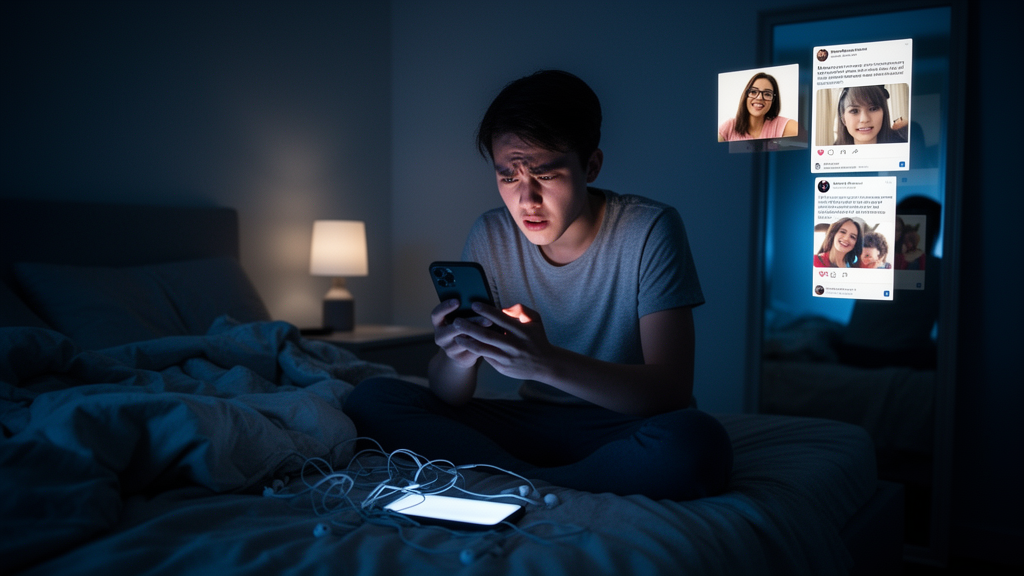
A survey of 555 adults found that problematic social media use was more common among participants with anxious or fearful attachment styles, while grandiose narcissism was not significantly associated with compulsive, impulsive use. The study, published in PLOS One on October 21, 2026, also linked vulnerable narcissism with higher problematic use and identified a combination of attachment anxiety and avoidance as a possible correlate of the behavior. Because the research was observational, the results do not show that insecure attachment or narcissism causes problematic social media use.
Researchers Chris Bjornsen and Allen Harbaugh of Longwood University recruited the U.S. participants through social media and crowdsourcing applications. Each completed a 76-item online questionnaire assessing problematic social media use, interpersonal attachment, narcissism and interpersonal competence. The investigators then used latent profile analysis, a statistical method that identifies groups sharing similar patterns of responses, to examine how these characteristics occurred together. The article defines problematic social media use as impulsive and compulsive behavior intended to improve mood despite negative consequences.
Attachment styles describe patterns in close relationships. Secure attachment is associated with trust in others, whereas anxious attachment combines a strong desire for closeness with worry that significant others will not be available. Avoidant attachment is characterized by a preference for emotional distance. Fearful attachment combines a desire for closeness with fear of the possible negative consequences of relying on others. In the survey, problematic social media use was lowest among participants classified as securely attached and increased across the avoidant, anxious and fearful profiles.
Not all forms of narcissism showed the same relationship with social media behavior. Vulnerable narcissism was associated with higher problematic use. The researchers describe this form of narcissism as involving a strong need for admiration alongside shyness, shame about needing others and sensitivity to imagined criticism. They suggest that online interaction may provide a route to obtaining relationship attention that is difficult to secure in face-to-face settings, although the survey cannot establish that mechanism as the cause of the association. Grandiose narcissism, characterized in the article by extraversion, a heightened need for admiration and a lack of empathy, was not significantly associated with problematic social media use.
The authors said the findings may be relevant to researchers, clinicians and prevention programs, particularly for people whose relationships involve both high attachment anxiety and attachment avoidance. Their interpretation is that such individuals may try to meet relationship needs through maladaptive social media behavior. The researchers also summarized the pattern as one in which adults who are confident in interpersonal relationships, or who remain more distant from others, did not generally report problematic use, while those who were more anxious or fearful about relationships also tended to display more covert or vulnerable narcissism and higher problematic use. These findings remain associations rather than clinical guidance: the sample was limited to U.S. adults recruited online, the design could not establish causality, and the results may not generalize to all populations.
Subject of Research: Associations among adult attachment styles, narcissism and problematic social media use
Article Title: Explaining the dark side of social media use
Article References: Explaining the dark side of social media use. Original publication (Bibliographic details unavailable.)
Image Credits: AI Generated
DOI: Not provided
Keywords: problematic social media use, attachment anxiety, fearful attachment, vulnerable narcissism, grandiose narcissism, latent profile analysis, online survey, interpersonal relationships, Explaining, dark, side, social
Cite Scienmag News
Glenn Wilkins. (October 24, 2026). Attachment anxiety and narcissism linked to problematic social media use. Scienmag. https://scienmag.com/attachment-anxiety-and-narcissism-linked-to-problematic-social-media-use/
Glenn Wilkins. "Attachment anxiety and narcissism linked to problematic social media use." Scienmag, 24 October 2026, https://scienmag.com/attachment-anxiety-and-narcissism-linked-to-problematic-social-media-use/. Accessed 24 October 2026.
Glenn Wilkins. "Attachment anxiety and narcissism linked to problematic social media use." Scienmag. October 24, 2026. https://scienmag.com/attachment-anxiety-and-narcissism-linked-to-problematic-social-media-use/


