


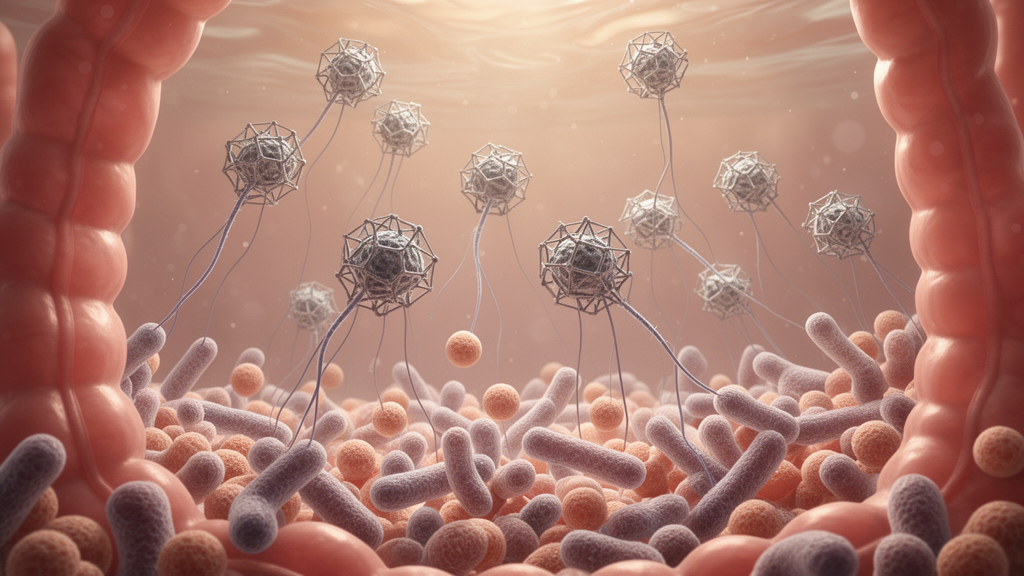
A 2026 review concludes that bacteriophages can selectively alter defined bacterial populations in experimental systems, while early human studies support the feasibility, gastrointestinal recovery and short-term safety of orally administered products. The evidence for precise microbiome manipulation is strongest for targeted bacterial depletion, but most phages remain investigational and no clinical study has demonstrated durable reconstruction of a diseased human gut ecosystem. The review separates human interventional evidence, preclinical findings, mechanistic observations and untested frameworks, warning against treating proposed ecological methods as established clinical techniques.
The distinction matters because gut dysbiosis is not simply the presence of a short list of harmful species. Disease-relevant properties can be restricted to particular strains, while bacterial receptors vary with oxygen, mucus, bile acids, nutrients and other environmental conditions. A phage may therefore remove a target without restoring a beneficial community. Experiments in mice have shown that selective phage perturbation can also change non-target bacteria and metabolites, while synthetic microbial communities can settle into alternative stable states. These observations make the trajectory of the whole community, rather than the decline in one target colony, the relevant experimental outcome.
Natural lytic phages remain the most direct depletion tool, but several engineered platforms can narrow their action from species to strain, gene, receptor or secreted function. Tail-fiber and receptor-binding-protein engineering can redirect adsorption, while CRISPR-Cas payloads enable sequence-selective killing. Other experimental systems use non-replicating phage-derived particles to deliver base editors, CRISPR-associated transposases to inactivate virulence genes and install payloads, resident bacteria as local protein factories, or phage-derived lysins for temporary pruning without replication. Evolutionary-steering phages are also being designed to select escape mutants with reduced virulence or fitness. Most of these approaches have supporting evidence from cell, mouse, chick or ex vivo models rather than clinical efficacy studies.
Human evidence remains concentrated on safety, tolerability, recovery from the gastrointestinal tract and selected microbiome outcomes. In the randomized PHAGE study, adults with mild gastrointestinal symptoms received the four-phage PreforPro preparation, producing selected bacterial changes without the broad loss of community diversity generally associated with antibiotics. PHAGE-2 paired the same phages with Bifidobacterium animalis subsp. lactis BL04, but its report did not find clear evidence that co-administration increased BL04 survival. SNIPR001, a cocktail of four orally administered engineered CRISPR-Cas phages, was recovered from stool in a dose-associated manner during first-in-human testing, remained predominantly gastrointestinal and produced no detectable global microbiome disruption relative to placebo. These results establish short-term feasibility and product-specific pharmacology, not efficacy for chronic dysbiosis or durable ecological change.
Preclinical studies provide stronger evidence for several disease-specific applications. A five-phage consortium targeting inflammatory Klebsiella pneumoniae strains reduced intestinal inflammation in mice, linking human strain association, experimental causality and therapeutic proof of concept. In humanized mice with alcohol-associated liver disease, phages targeting cytolytic Enterococcus faecalis reduced intestinal cytolysin and prevented ethanol-induced liver injury. Capsule-targeting phages against E. coli K1 selected capsule-deficient escape variants that were more susceptible to antibody-mediated clearance and competitive exclusion by probiotic E. coli Nissle. A chick model of multidrug-resistant Salmonella infection showed improvements in intestinal structure, barrier-gene expression, inflammatory markers and microbial metabolite profiles when phages were combined with Limosilactobacillus reuteri. These studies support specific component interactions, but they do not establish a complete treatment sequence.
The review proposes a four-stage development scaffold called Subtract-Seed-Feed-Lock. In the proposed sequence, a phage or phage-derived platform first subtracts, weakens or edits a disease-relevant strain or function; a niche-matched successor organism is then introduced or promoted; a selectively used nutrient supports that successor; and persistence is measured after active treatment is withdrawn. “Lock” therefore means a reproducible and safe functional state that survives treatment cessation, not merely suppression while dosing continues. Related ideas, including the proposed Ecological Vacancy Window, Minimum Ecological Dose and Functional Phageability assessment, are hypothesis-generating concepts that require prospective definitions and falsifiable tests.
Host effects are most defensibly interpreted as indirect. A phage may change bacterial abundance, genotype or activity, which then alters lipopolysaccharide, short-chain fatty acids, indoles, bile acids or other microbial products. Those intermediates may subsequently influence inflammatory, barrier, hepatic or neural pathways. Established microbial biology includes butyrate-mediated histone deacetylase inhibition and free-fatty-acid signaling, aryl-hydrocarbon-receptor activation by tryptophan derivatives, and FXR, TGR5 and RORγt responses to bile acids. Phage-specific restoration of these pathways remains largely unproven. Direct interactions between phage DNA or capsids and mammalian receptors are context-dependent and are better treated as safety and pharmacology variables than as evidence of a uniform beneficial immune response.
The proposed replacement of one bacterium with another faces major biological hurdles. Human studies show that probiotic mucosal engraftment is person- and region-specific and cannot be inferred reliably from detection in stool. Resident endogenous phages may also infect a proposed successor, while a therapeutic phage may suppress it inadvertently. The review therefore proposes a nutrient-conditioned phagogram that tests adsorption, plating efficiency, burst size and resistance under anaerobic, mucus-, bile- and prebiotic-conditioned conditions, including target-successor co-culture. A compatible combination must allow the phage to affect its intended target while sparing the successor and important commensals, enable the successor to compete in the post-phage niche, and use the nutrient without suppressing phage activity or nourishing the original target.
Applications involving the gut-brain axis remain especially preliminary. Imidazole propionate, a product of microbial urocanate reduction associated with the bacterial gene urdA, has been linked in experimental work to p38γ-mTORC1 signaling, dopaminergic pathology, endothelial barrier impairment and tau hyperphosphorylation. A proposed “neurophagomic reverse translation” workflow would begin with a host-active metabolite, identify its biosynthetic gene and strain-level producers, and test whether the function can be altered by depletion or non-lethal editing. No cited study has used a therapeutic phage to deplete an imidazole-propionate producer, edit urdA, lower the metabolite or improve a neurological phenotype. Likewise, a case-control multi-kingdom study that nominated a Ruminococcus gnavus–phage–bile-acid network in metabolic dysfunction-associated steatotic liver disease provides an observational target nomination rather than evidence of therapeutic benefit.
Translation also depends on manufacturing, measurement and surveillance that extend beyond conventional single-drug development. Products require qualified phage and bacterial banks, whole-genome characterization, validated potency and purity assays, and controls for endotoxin, exotoxin, residual host-cell material, adventitious agents and process contaminants. Stability studies must track viable titer, aggregation, genome integrity and adsorption competence, while longitudinal monitoring must address resistance, rebound, secondary blooms, immune neutralization, prophage induction, horizontal gene transfer, environmental shedding and unintended metabolites. Regulatory materials from the US Food and Drug Administration and European Medicines Agency do not provide a streamlined pathway for dynamically updated or multi-component microbiome products. The immediate opportunity is therefore evidence-matched, precise microbial perturbation with defined endpoints; durable ecological reconstruction remains an experimental objective rather than an established clinical capability.
Subject of Research: Experimental and clinical development of bacteriophage-based therapies for targeted gut microbiome manipulation.
Article Title: Phage-directed precision microbiome medicine: engineering pathobiont depletion, synbiotic succession, microbial-function editing, metabolite host signaling, neurophagomics, and durable ecological state control in gut dysbiosis associated diseases
Article References: Saeed, U., & Piracha, Z. Z. (2026). Phage-directed precision microbiome medicine: engineering pathobiont depletion, synbiotic succession, microbial-function editing, metabolite host signaling, neurophagomics, and durable ecological state control in gut dysbiosis associated diseases. Frontiers in Microbiology, 17, Article 1964616. https://doi.org/10.3389/fmicb.2026.1964616
Image Credits: AI Generated
DOI: 10.3389/fmicb.2026.1964616
Keywords: bacteriophages, gut microbiome, dysbiosis, phage therapy, CRISPR-Cas, ecological reconstruction, pathobionts, microbiome therapeutics, drug resistance, gut-brain axis, Phage-directed, precision
Cite Scienmag News
Morgan Morrow. (October 24, 2026). Phage therapies show promise for precise gut microbiome manipulation. Scienmag. https://scienmag.com/phage-therapies-show-promise-for-precise-gut-microbiome-manipulation/
Morgan Morrow. "Phage therapies show promise for precise gut microbiome manipulation." Scienmag, 24 October 2026, https://scienmag.com/phage-therapies-show-promise-for-precise-gut-microbiome-manipulation/. Accessed 24 October 2026.
Morgan Morrow. "Phage therapies show promise for precise gut microbiome manipulation." Scienmag. October 24, 2026. https://scienmag.com/phage-therapies-show-promise-for-precise-gut-microbiome-manipulation/


