


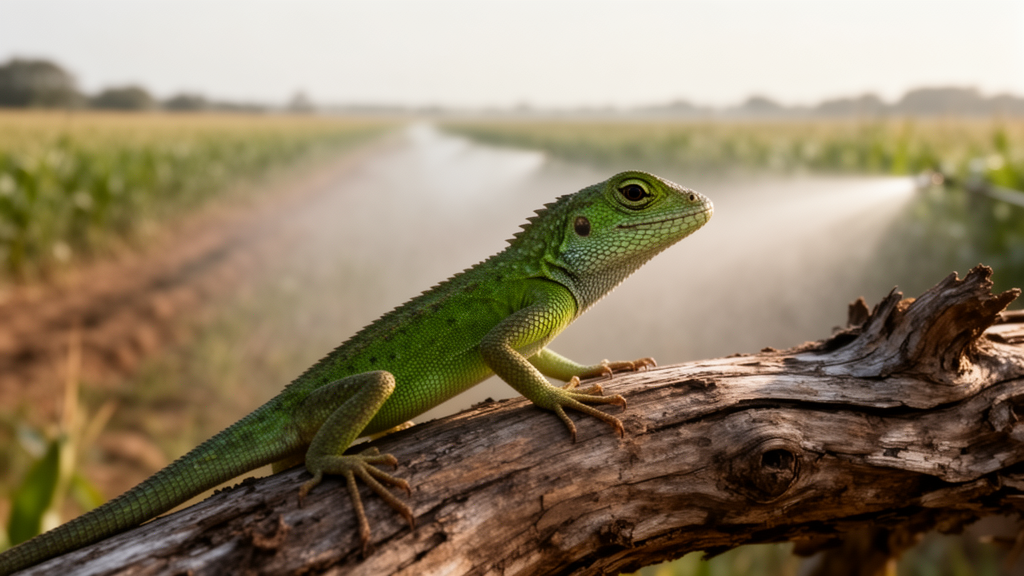
A widely used agricultural herbicide can inflict measurable damage on the liver and kidneys of a common tropical lizard even at doses regulators consider safe for mammals, according to a new study of the neotropical lizard Tropidurus torquatus. The research, published in the journal Ecotoxicology, exposed adult male lizards to 2,4-dichlorophenoxyacetic acid, better known as 2,4-D, at a dose equal to the acceptable daily intake established for mammals by the Brazilian Health Regulatory Agency. After just 30 days of exposure, the treated animals showed significant oxidative stress in both organs and clear degenerative changes in kidney tissue, including cell death in the renal tubules. The findings raise uncomfortable questions about whether safety thresholds derived from laboratory mammals can adequately protect reptiles and other ectothermic wildlife living in and around farmland.
2,4-D is one of the most heavily used pesticides in the world, applied extensively to soybean, corn, and sugarcane crops, particularly in tropical countries such as Brazil. Brazilian regulatory data place it among the most commercially sold pesticides nationally, and it is frequently detected in soil, water, and sediment samples from agricultural regions. Although its approval rests on mammalian toxicity assays, a growing body of evidence indicates that subchronic exposure, even within regulatory limits, can produce biochemical, physiological, and cellular alterations in non-model organisms including fish, amphibians, and reptiles. Because the herbicide readily reaches adjacent ecosystems through atmospheric drift, surface runoff, and leaching, non-target animals in agricultural landscapes face repeated, low-level exposure that standard testing regimes were never designed to evaluate.
Tropical lizards are especially likely to encounter such contaminants. They live in close contact with the soil, are active during the day, and are widely distributed in human-modified areas, yet terrestrial reptiles remain excluded from standardized toxicological testing. As a result, regulators extrapolate safety data to species with very different physiology and metabolism. Ectotherms such as reptiles have temperature-dependent metabolic rates and low renal and hepatic clearance rates, which can prolong the half-life of xenobiotics like 2,4-D in their bodies and intensify harmful effects. The liver and kidneys, the organs that handle detoxification and excretion, are the primary targets during herbicide exposure, making them the natural focus for any investigation of sublethal pesticide toxicity in these animals.
The research team, led by Letícia Menezes Freitas of the Federal University of Jataí and colleagues, chose Tropidurus torquatus, a lizard widely distributed in the Brazilian Cerrado, as their study species. The animal is abundant, occurs in agricultural environments, and has previously shown sensitivity to histological and biochemical changes in response to environmental stressors, making it an ideal bioindicator. Seventeen adult males were captured with handmade nooses in the urban area of Jataí, in the state of Goiás, during the reproductive season between October and February. Only males were collected to avoid confounding effects of vitellogenesis-related hepatic changes that occur in females. After a seven-day acclimation period, the lizards were randomly assigned to a control group of nine animals and a treatment group of eight.
The treatment group received the commercial formulation Mirant, a dimethylamine salt containing 288 grams of 2,4-D per liter, diluted in distilled water and administered by oral gavage at 0.01 milligrams per kilogram of body weight per day for 30 consecutive days. This dose was based on the acceptable daily intake established by ANVISA, the Brazilian health regulator. Animals were weighed weekly so that individual doses could be adjusted, and the control group received only distilled water by the same route and volume. At the end of the exposure period, all animals were euthanized by a veterinarian using intracardiac propofol, with death confirmed by the absence of heartbeat, spinal reflexes, and respiratory movements, following Brazilian guidelines for the euthanasia of wild animals.
The researchers then subjected liver and kidney samples to an unusually integrated battery of analyses combining histopathology, stereology, and biochemistry. Tissue sections stained with hematoxylin and eosin were examined by a veterinary pathologist blinded to group identity, who scored parameters such as vacuolation, fibrosis, necrosis, and pigment accumulation. Stereological methods, including Cavalieri’s principle for estimating total renal volume and the physical disector probe for counting glomeruli, provided unbiased three-dimensional quantitative data. Biochemical assays measured reactive oxygen species with fluorescent probes, lipid peroxidation through the TBARS assay, and the activities of the antioxidant enzymes superoxide dismutase and catalase, all performed in duplicate and expressed per milligram of total protein.
The liver results revealed a subtle but telling pattern. Conventional histopathology showed no significant differences between treated and control animals: hepatocellular vacuolization and melanomacrophage centers appeared in both groups and appear to be natural features of the species, while fibrosis and inflammation did not differ statistically. However, stereological analysis detected a significant reduction in the volume fraction occupied by hepatocytes, from an average of 85.0 percent of liver volume in controls to 81.0 percent in treated animals, a difference that reached statistical significance. The authors interpret this reduction as possibly reflecting the mobilization of energy reserves such as lipids and glycogen under increased metabolic demand and oxidative stress, a response consistent with patterns reported after sublethal pesticide exposure in other reptiles.
The kidneys told a more dramatic story. Treated lizards showed significant degenerative changes, including hydropic-vacuolar degeneration of tubular epithelial cells and multifocal areas of coagulative tubular necrosis characterized by eosinophilic cytoplasm and pyknotic, karyorrhectic, or absent nuclei. Tubular necrosis was entirely absent in the control group, an association with treatment that was highly significant. Brownish granular pigment, restricted to the proximal tubules, was also more frequent in treated animals. Based on its morphology and location, the pigment may correspond to hemosiderin, a product of hemoglobin degradation, or lipofuscin, which results from the degradation of peroxidized membranes under chronic cellular stress. The authors caution, however, that no specific literature links 2,4-D to pigment accumulation of this kind, so a direct causal relationship cannot be definitively established, though its increased frequency warrants further investigation.
Biochemically, both organs showed the signature of oxidative stress. In the liver, treated animals had significantly elevated production of both nonspecific reactive oxygen species and superoxide anion, higher levels of malondialdehyde, a marker of lipid peroxidation, and significantly reduced activity of both superoxide dismutase and catalase. The kidneys showed the same pattern of elevated reactive species and lipid peroxidation and reduced superoxide dismutase activity, though the reduction in catalase activity there did not reach statistical significance. This simultaneous deficiency of the two antioxidant enzymes impairs the cell’s capacity to neutralize intermediates of oxidative metabolism, favoring the formation of the highly reactive hydroxyl radical via the Fenton reaction and intensifying damage to membranes, proteins, and DNA. Notably, renal stereology found no significant differences in kidney volume or glomerular count, consistent with the multifocal and incipient nature of the lesions.
Collectively, the findings demonstrate that a dose deemed acceptable for mammals can induce redox imbalance and focal renal tubular injury in an ectothermic reptile, a pattern the authors characterize as early functional toxicity. The liver showed greater biochemical sensitivity while the kidney exhibited greater histomorphological vulnerability, reflecting physiological differences in xenobiotic biotransformation and excretion. Because Tropidurus torquatus plays an important ecological role in regulating populations of ants, termites, bees, and other small invertebrates, population-level impacts from chronic exposure could cascade through predator-prey dynamics and compromise biological pest control and nutrient cycling in Neotropical agroecosystems. The authors argue that the results expose the limitations of extrapolating mammalian safety thresholds to other taxonomic groups and reinforce the need to incorporate ectothermic species into ecotoxicological risk assessment and regulatory frameworks, with Tropidurus torquatus proving a sensitive and suitable bioindicator for monitoring herbicide impacts on tropical herpetofauna.
Subject of Research: Subchronic toxic effects of the herbicide 2,4-D on the liver and kidneys of the neotropical lizard Tropidurus torquatus
Article Title: Effects of 2,4-dichlorophenoxyacetic acid (2,4-d) on the liver and kidney of Tropidurus torquatus (Squamata, Tropiduridae)
Article References: Freitas, L. M., da Costa, R. M., Mascarenhas, L. J. S., de Oliveira, L. P., Lima, F. C., Kaplan, S., & Scalla Vulcani, V. A. (2026). Effects of 2,4-dichlorophenoxyacetic acid (2,4-d) on the liver and kidney of Tropidurus torquatus (Squamata, Tropiduridae). Ecotoxicology, 35(9), Article 194. https://doi.org/10.1007/s10646-026-03170-0
Image Credits: AI Generated
DOI: 10.1007/s10646-026-03170-0
Keywords: 2,4-D, herbicide, Tropidurus torquatus, reptiles, ecotoxicology, oxidative stress, kidney toxicity, liver, pesticide regulation, Brazil, Cerrado, bioindicators
Cite Scienmag News
Sloane Callahan. (October 24, 2026). Common Herbicide at ‘Safe’ Doses Damages Lizard Kidneys, Study Finds. Scienmag. https://scienmag.com/common-herbicide-at-safe-doses-damages-lizard-kidneys-study-finds/
Sloane Callahan. "Common Herbicide at ‘Safe’ Doses Damages Lizard Kidneys, Study Finds." Scienmag, 24 October 2026, https://scienmag.com/common-herbicide-at-safe-doses-damages-lizard-kidneys-study-finds/. Accessed 24 October 2026.
Sloane Callahan. "Common Herbicide at ‘Safe’ Doses Damages Lizard Kidneys, Study Finds." Scienmag. October 24, 2026. https://scienmag.com/common-herbicide-at-safe-doses-damages-lizard-kidneys-study-finds/


