


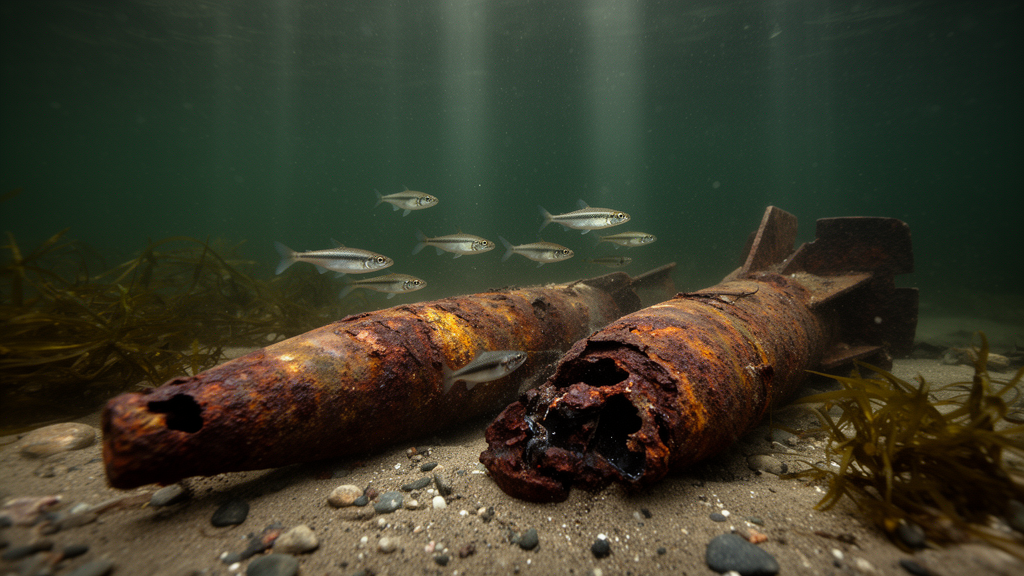
Three-spined sticklebacks exposed to environmentally relevant concentrations of the explosive TNT in laboratory tanks showed no significant behavioral response, according to a new study published in the journal Ecotoxicology. The finding matters because roughly 1.6 million tons of conventional munitions were dumped in German coastal waters after the Second World War, and corroding shells are steadily leaking toxic compounds into the North Sea and Baltic Sea. If fish cannot detect and avoid the leaking explosive, they may face chronic exposure at dump sites, with potentially harmful long-term consequences for their health and, ultimately, for seafood consumers.
The research team, led by Joy Willmer and Jörn Peter Scharsack, set out to test a simple hypothesis: given that TNT is toxic and carcinogenic, fish should benefit from detecting dissolved TNT in the water and swimming away before concentrations reach acutely toxic levels. To test this, they used three-spined sticklebacks (Gasterosteus aculeatus), a small fish common across the Northern Hemisphere, including the North Sea and Baltic Sea, and a well-established model species in behavioral research because of its physical and behavioral resilience.
The scale of the contamination problem is considerable. Of the 1.6 million tons of dumped conventional munitions, around 1.3 million tons are estimated to lie on the seabed of the North Sea and 300,000 tons in the Baltic Sea. At least 15 official dump sites have been documented, but the precise locations of much of the ordnance remain uncertain because of imprecise navigation records, displacement by currents or fishing activity, and munitions discarded en route to designated sites. After more than 70 years in salt water, the metal shells are corroding, allowing explosives such as 2,4,6-trinitrotoluene, or TNT, to leak into seawater, sediments, and marine organisms.
Field measurements show that TNT concentrations near dumped munitions depend strongly on distance. In close proximity to corroding munitions, less than one centimeter from freely accessible explosive matrix material, concentrations of up to 3,100 micrograms per liter have been measured, a level that exceeds lethal thresholds reported for several fish species. But the concentrations decline rapidly with distance, falling to about 16 micrograms per liter at one centimeter and 3.3 micrograms per liter at 50 centimeters. Fish approaching a dump site would therefore encounter low concentrations first, and the ability to detect and avoid TNT at these levels could protect them from harm.
Previous research shows that TNT is genuinely dangerous at such low doses. In zebrafish embryos, exposure to 100 micrograms per liter for 48 hours caused significant DNA damage, and that concentration lies within the range measured near exposed explosive material at dump sites. Uptake of TNT and its metabolites has been confirmed in flatfish collected near dump sites, including common dab, European flounder, and European plaice, with the compounds detected in urine, bile, and muscle tissue. Sessile organisms such as seaweed, mussels, and sea stars have also been found to contain TNT. Yet behavioral studies of fish responses to TNT have been almost entirely lacking; the only prior work, from 1976, examined fathead minnows at concentrations of 1,780 to 9,540 micrograms per liter, levels high enough to trigger shock responses, skittering, loss of equilibrium, and mortality.
To fill this gap, the researchers designed a choice experiment. Individual sticklebacks were placed in a glass tank with two hideout zones, each made of four artificial plants. Once a fish settled in one hideout for a continuous minute, the researchers began infusing either a 100 micrograms per liter TNT solution or control water directly into that hideout over five minutes, while the opposite hideout remained uncontaminated. The 100 micrograms per liter starting concentration was chosen to reflect environmentally relevant conditions recorded at Baltic Sea dump sites. The experiment was conducted double-blind, with food coloring added to the control solution to mask the yellowish tint of TNT, and was repeated in two independent runs, in August 2024 and February 2025, with 60 fish each, 120 individuals in total. All fish were laboratory-hatched in April 2023 from parental stock collected in the Weser estuary near Bremerhaven, and were 16 and 22 months old at the time of the two experiments.
The behavioral readouts included the total time the fish spent in the infused hideout zone, the time until the fish first left that zone, and the number of transitions between the two hideout zones as a proxy for swimming activity. On all three metrics, analyzed with generalized linear models, the researchers found no significant difference between the TNT-exposed and control groups. There was a non-significant trend suggesting that TNT-exposed fish spent slightly less time in the exposed hideout, and after the first three minutes slightly more TNT-exposed fish had left the hideout, but neither pattern reached statistical significance. Swimming activity, measured as line crossings between the tank halves, was likewise unaffected by treatment, sex, or experiment.
The team took several steps to ensure the null result was robust. Because some individuals remained in the first hideout for the entire observation period regardless of treatment, the data were re-analyzed with these inactive fish excluded, and still no significant effects of TNT emerged. Sex, age, and reproductive status were unlikely confounders, since all fish were reared under identical conditions, tested as non-breeding adults, and roughly evenly split between males and females across treatments, with 31 females and 29 males in the control group and 34 females and 26 males in the TNT group. With 120 fish and consistent results across two independent experiments, the authors argue that the absence of a significant behavioral effect is unlikely to be explained by insufficient statistical power, although very small effects cannot be ruled out.
Chemical verification confirmed that the fish were genuinely exposed. Infusion tests without fish showed a TNT recovery of 90 percent after passage through the infusion system and 68 percent after mixing in the aquarium, with some loss attributable to metabolization into amino-dinitrotoluene derivatives and trinitrobenzene, and possibly adsorption to glass and plastic surfaces. TNT concentrations in the occupied hideout started below the limit of detection and increased gradually during the infusion, reaching just above 1 microgram per liter, while remaining largely undetectable at the opposite hideout. The fish therefore experienced a concentration gradient comparable to that expected in the vicinity of submerged munitions.
The study cannot distinguish whether the sticklebacks failed to detect TNT at all or detected it without responding behaviorally. What is clear is that the fish sought shelter regardless of contamination, and the authors suggest that if TNT was detected, the benefit of shelter may have outweighed any impulse to avoid the contaminant. This interpretation fits field observations: fish and other marine organisms are regularly found near munition debris, and benthic species such as starfish and blue mussels use munition shells as hard substrate, which is otherwise scarce in deeper areas of the North Sea and Baltic Sea. Piles of munitions and wooden boxes may even offer attractive habitat, providing shelter from predators, structural complexity, and food. Such trade-offs have precedents: rainbow trout avoided zinc sulphate at a threshold of 5.6 micrograms per liter, and zebrafish and guppies avoided copper at 10 to 70 micrograms per liter, but food availability can override avoidance, as shown in tilapia fry that entered contaminated areas when food was present. Blue mussels exposed to far higher TNT concentrations, between 5,000 and 10,000 micrograms per liter, did reduce shell opening behavior, suggesting responses may emerge only at acutely toxic levels.
The implications are sobering. If adult fish do not avoid TNT-contaminated areas during reproduction, embryos and larvae may face elevated genotoxic stress during sensitive life stages, since concentrations as low as 100 micrograms per liter have been linked to DNA damage. As shell corrosion progresses, exposure may even increase over time. The authors conclude that regular monitoring of munition contaminants in fish is essential to assess risks to fish health and seafood consumers, and that clearance and remediation of dumped munitions represent important management strategies to reduce current and future exposure for marine organisms that appear unable, or unwilling, to avoid the danger.
Subject of Research: Behavioral response of three-spined sticklebacks to environmentally relevant TNT concentrations leaking from dumped munitions
Article Title: Three-spined sticklebacks do not respond behaviorally to environmentally relevant concentrations of the toxic explosive 2,4,6-trinitrotoluene
Article References: Willmer, J., Schubert, H., Hölzel, M.-B., Stegmann, N., Kammann, U. K. R., & Scharsack, J. P. (2026). Three-spined sticklebacks do not respond behaviorally to environmentally relevant concentrations of the toxic explosive 2,4,6-trinitrotoluene. Ecotoxicology, 35(9), Article 199. https://doi.org/10.1007/s10646-026-03169-7
Image Credits: AI Generated
DOI: 10.1007/s10646-026-03169-7
Keywords: TNT, three-spined stickleback, dumped munitions, North Sea, Baltic Sea, avoidance behavior, ecotoxicology, marine pollution, fish behavior, munition corrosion, genotoxicity, contaminant exposure
Cite Scienmag News
Sloane Callahan. (October 24, 2026). Sticklebacks Fail to Avoid TNT Leaking From Sunken Munitions. Scienmag. https://scienmag.com/sticklebacks-fail-to-avoid-tnt-leaking-from-sunken-munitions/
Sloane Callahan. "Sticklebacks Fail to Avoid TNT Leaking From Sunken Munitions." Scienmag, 24 October 2026, https://scienmag.com/sticklebacks-fail-to-avoid-tnt-leaking-from-sunken-munitions/. Accessed 24 October 2026.
Sloane Callahan. "Sticklebacks Fail to Avoid TNT Leaking From Sunken Munitions." Scienmag. October 24, 2026. https://scienmag.com/sticklebacks-fail-to-avoid-tnt-leaking-from-sunken-munitions/


