
Saturday, October 24, 2026
Science
No Result
View All Result
  • Login
  • HOME
  • SCIENCE NEWS
  • CONTACT US
  • HOME
  • SCIENCE NEWS
  • CONTACT US
No Result
View All Result
Scienmag
No Result
View All Result
Home Science News

Urban form may encode segregation, entropy study of São Paulo suggests

October 24, 2026
in Science News
Reading Time: 2 mins read
0
Urban form may encode segregation, entropy study of São Paulo suggests

Urban form may encode segregation, entropy study of São Paulo suggests

65
SHARES
587
VIEWS
Share on FacebookShare on Twitter
ADVERTISEMENT

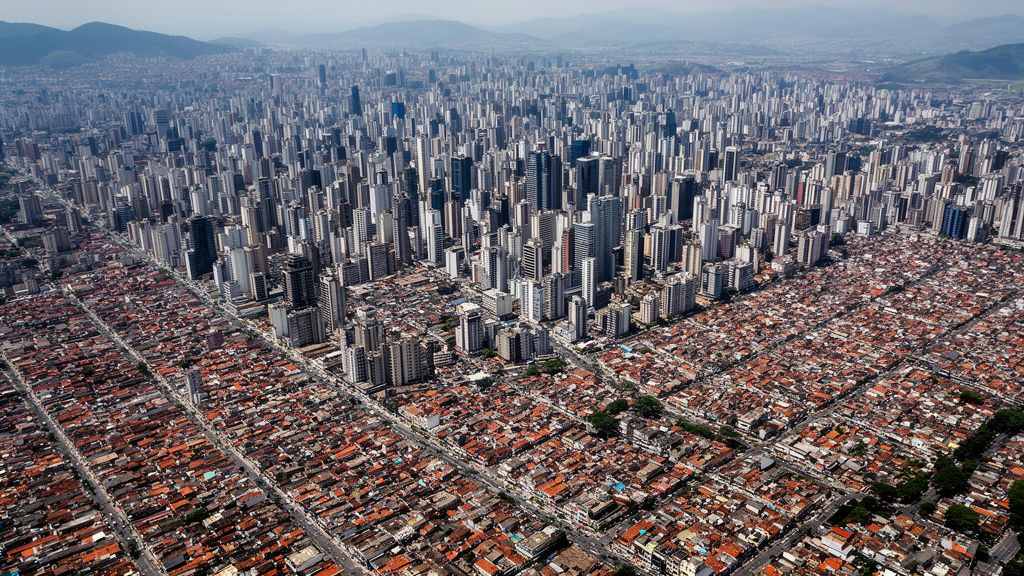
Residential segregation may leave measurable fingerprints in the physical structure of cities. A study of São Paulo, Latin America’s largest metropolis, suggests that the entropy of the built fabric—how varied and disordered the arrangement of buildings is—is linked in non-linear ways to income levels and the spatial clustering of income groups.

The research, by Vinicius M. Netto, Caio Cacholas, Camila Carvalho and Edgardo Brigatti, quantified built-form entropy using a Shannon-based measure computed from building footprints. Income distributions were characterised with the Gini index, a measure of inequality, and Moran’s I, which captures spatial autocorrelation or clustering. To compare these indicators directly, the team placed them on a common spatial footing using a regular tessellation of the city.

The analysis revealed a non-linear relationship between entropy, income and segregation. Income levels and residential clustering rose toward both extremes of the entropy spectrum, but the increase was stronger at the high-entropy end. In other words, both highly disordered and highly ordered urban fabrics were associated with distinctive socio-spatial patterns, with the disordered end showing the sharpest effects.

According to the authors, this asymmetry points to different segregation processes at different ends of the entropy scale. High-entropy urban forms appear associated with distinct spatial dynamics, including the enclaving of elite groups and the incremental, unplanned growth of lower-income settlements. Low-entropy forms, by contrast, seem to reflect more selective occupation of land, shaped by formal planning and by market filtering that restricts who can live where.

The findings suggest that urban form is not a neutral backdrop against which social patterns unfold. Instead, the configuration of buildings may function both as an affordance that enables segregation processes and as a signal that records them, offering researchers a spatial lens for reading social divisions directly from the built fabric of cities.

Subject of Research: The relationship between built-form entropy and income-based residential segregation in São Paulo

Article Title: Is segregation encoded in urban form? An entropy-based analysis

Article References: Netto, V. M., Cacholas, C., Carvalho, C., & Brigatti, E. (2026). Is segregation encoded in urban form? An entropy-based analysis. PLOS One, 21(10), e0360856. https://doi.org/10.1371/journal.pone.0360856

Image Credits: AI Generated

DOI: 10.1371/journal.pone.0360856

Keywords: urban form, segregation, entropy, São Paulo, income inequality, spatial analysis, Shannon entropy, Gini index, Moran's I, building footprints, urban morphology, encoded

Cite Scienmag News

Scienmag. (October 24, 2026). Urban form may encode segregation, entropy study of São Paulo suggests. https://scienmag.com/urban-form-may-encode-segregation-entropy-study-of-sao-paulo-suggests/

Scienmag. "Urban form may encode segregation, entropy study of São Paulo suggests." Scienmag, 24 October 2026, https://scienmag.com/urban-form-may-encode-segregation-entropy-study-of-sao-paulo-suggests/. Accessed 24 October 2026.

Scienmag. "Urban form may encode segregation, entropy study of São Paulo suggests." Scienmag. October 24, 2026. https://scienmag.com/urban-form-may-encode-segregation-entropy-study-of-sao-paulo-suggests/


Tags: building footprintsbuilt-form entropy in citiesencodedentropyGini indexGini index for income distributionimpact of city fabric disorderincome inequalityLatin American urban studiesMoran's IMoran's I for spatial clusteringnon-linear relationships in urban morphologyresidential clustering and income inequalitySão PauloSão Paulo city structuresegregationShannon entropyShannon entropy in urban planningspatial analysisspatial autocorrelation in urban areasurban formurban form and socio-economic segregationurban morphologyUrban segregation analysis
Share26Tweet16
Previous Post

Tiny Alignment Errors Skew Rolling Resistance Measurements, Study Warns

Next Post

Primordial Black Hole Hawking Radiation Could Reveal Dark Photon Tridents in Gamma Rays

Related Posts

Primordial Black Hole Hawking Radiation Could Reveal Dark Photon Tridents in Gamma Rays
Space

Primordial Black Hole Hawking Radiation Could Reveal Dark Photon Tridents in Gamma Rays

October 24, 2026
Tiny Alignment Errors Skew Rolling Resistance Measurements, Study Warns
Technology and Engineering

Tiny Alignment Errors Skew Rolling Resistance Measurements, Study Warns

October 24, 2026
Sustainable leadership boosts NGO project performance through engaged employees in Pakistan
Social Science

Sustainable leadership boosts NGO project performance through engaged employees in Pakistan

October 24, 2026
PARP1 Disassembles Nucleosomes to Open DNA for Repair
Cancer

PARP1 Disassembles Nucleosomes to Open DNA for Repair

October 24, 2026
MOGAD takes center stage in childhood neuroinflammatory disease
Cancer

MOGAD takes center stage in childhood neuroinflammatory disease

October 24, 2026
AI Reads Ultrasound to Predict Breast Cancer Spread Before Surgery
Medicine

AI Reads Ultrasound to Predict Breast Cancer Spread Before Surgery

October 24, 2026
Next Post
Primordial Black Hole Hawking Radiation Could Reveal Dark Photon Tridents in Gamma Rays

Primordial Black Hole Hawking Radiation Could Reveal Dark Photon Tridents in Gamma Rays

  • Mothers who receive childcare support from maternal grandparents show more optimized

    Mothers who receive childcare support from maternal grandparents show more parental warmth, finds NTU Singapore study

    27656 shares
    Share 11059 Tweet 6912
  • University of Seville Breaks 120-Year-Old Mystery, Revises a Key Einstein Concept

    1061 shares
    Share 424 Tweet 265
  • Bee body mass, pathogens and local climate influence heat tolerance

    682 shares
    Share 273 Tweet 171
  • Researchers record first-ever images and data of a shark experiencing a boat strike

    546 shares
    Share 218 Tweet 137
  • Groundbreaking Clinical Trial Reveals Lubiprostone Enhances Kidney Function

    531 shares
    Share 212 Tweet 133
Science

Embark on a thrilling journey of discovery with Scienmag.com—your ultimate source for cutting-edge breakthroughs. Immerse yourself in a world where curiosity knows no limits and tomorrow’s possibilities become today’s reality!

RECENT NEWS

  • Primordial Black Hole Hawking Radiation Could Reveal Dark Photon Tridents in Gamma Rays
  • Urban form may encode segregation, entropy study of São Paulo suggests
  • Tiny Alignment Errors Skew Rolling Resistance Measurements, Study Warns
  • Sustainable leadership boosts NGO project performance through engaged employees in Pakistan

Categories

  • Agriculture
  • Anthropology
  • Archaeology
  • Athmospheric
  • Biology
  • Biotechnology
  • Blog
  • Bussines
  • Cancer
  • Chemistry
  • Climate
  • Earth Science
  • Editorial Policy
  • Marine
  • Mathematics
  • Medicine
  • Pediatry
  • Policy
  • Psychology & Psychiatry
  • Science Education
  • Science News
  • Social Science
  • Space
  • Technology and Engineering

Subscribe to Blog via Email

Enter your email address to subscribe to this blog and receive notifications of new posts by email.

Join 5,152 other subscribers

© 2025 Scienmag - Science Magazine

Welcome Back!

Login to your account below

Forgotten Password?

Retrieve your password

Please enter your username or email address to reset your password.

Log In
No Result
View All Result
  • HOME
  • SCIENCE NEWS
  • CONTACT US

© 2025 Scienmag - Science Magazine

Discover more from Science

Subscribe now to keep reading and get access to the full archive.

Continue reading