


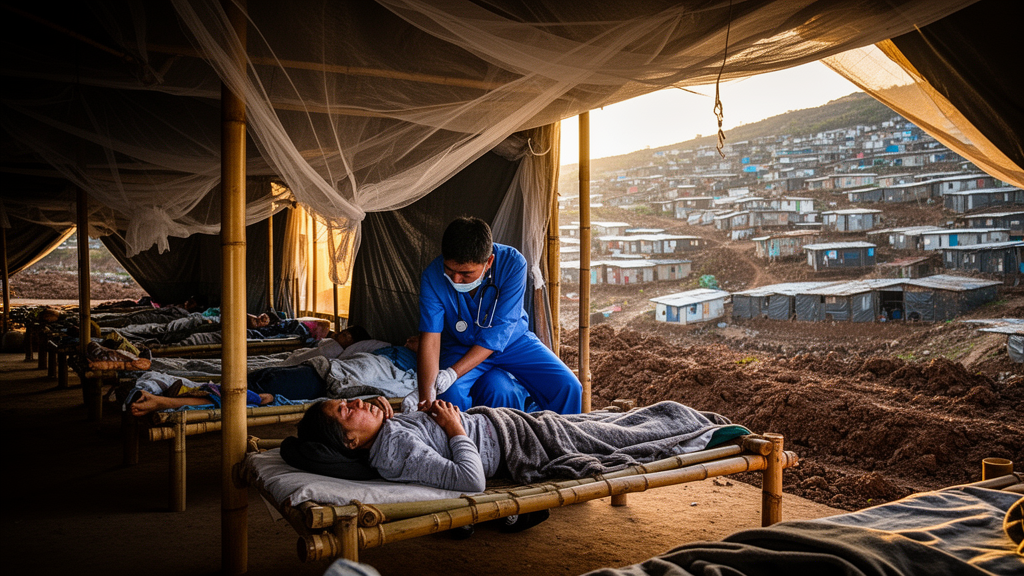
Dengue has become a persistent public health threat in the Rohingya refugee camps of Cox’s Bazar, Bangladesh, since it first emerged there in 2021, and a retrospective analysis of more than 35,000 rapid diagnostic test-confirmed cases now documents how the outbreaks have evolved between October 2021 and December 2024. The study, drawing on anonymized surveillance data from the International Organization for Migration (IOM) dengue patient database across 36 IOM-supported health facilities in Ukhiya and Teknaf, found that 90.2% of the 35,581 confirmed cases occurred among Rohingya refugees, with the remainder among the surrounding host communities. The annual caseload rose from 1,011 cases in 2021 to 11,752 in 2022, then remained at similarly high levels with 10,669 cases in 2023 and 12,149 in 2024, indicating that dengue has shifted from a novel emergency to a recurrent, large-scale burden in this protracted humanitarian setting.
The demographic profile of the outbreaks was notably young. The median age of confirmed cases was 17 years, with an interquartile range of 7 to 30 years, and 46.0% of all cases were among children aged 0 to 14 years. Weekly case counts aggregated by epidemiological week showed seasonal peaks during the monsoon period, and the analysis revealed a progressive change in epidemic shape over the years: peaks arrived later in each successive year, and the epidemics developed longer tails of ongoing transmission after the peak. Phase-specific Poisson regression models quantified this shift, showing epidemic growth rates declining from r = 0.449 in 2021 to r = 0.091 in 2024, with corresponding increases in doubling times. In contrast, decay rates remained broadly comparable across years, with halving times of roughly 4.4 to 6.0 weeks, meaning that while outbreaks took hold more slowly, they subsided at a similar pace once past their peak.
Clinical severity in the confirmed cohort was limited but not absent. Overall, 8.0% of cases required inpatient admission, 1.3% were referred to higher-level care, and four deaths were reported, yielding a case fatality below 0.1%. Multivariable logistic regression identified several factors associated with inpatient admission. Patients aged 60 years and older had substantially higher odds of admission than the reference group of children aged 0 to 14 years (adjusted odds ratio 2.48), and each additional day of delay in presentation to a health facility raised the odds of admission by 6% (adjusted odds ratio 1.06 per day). Refugee status itself was associated with higher odds of admission compared with host-community residents (adjusted odds ratio 1.43), as was fever of 38°C or higher at presentation (adjusted odds ratio 1.13). The strongest predictors, however, were clinical: the presence of any WHO warning sign carried an adjusted odds ratio of 28.87 for admission, and chronic co-morbidity carried an adjusted odds ratio of 6.63. Males had lower odds of admission than females (adjusted odds ratio 0.87).
The study also examined how diagnostic positivity patterns related to the timing of presentation, using separate models adjusted for age and sex to assess associations between delay in seeking care and rapid diagnostic test (RDT) positivity. The authors argue that these patterns underscore the need for phase-appropriate use of NS1 and IgM/IgG diagnostics in humanitarian settings, since RDT performance varies over the course of infection and missed diagnoses can allow progression to severe disease. They recommend strengthened surveillance, community-based early referral to shorten presentation delays, targeted monitoring of high-risk groups such as older adults and those with chronic co-morbidities, environmental vector control, and integrated diagnostic strategies that combine NS1 and IgM/IgG testing according to the phase of illness.
The authors conclude that these findings call for a policy shift away from episodic outbreak response toward sustained dengue preparedness in humanitarian settings. With caseloads holding above 10,000 confirmed cases per year in 2023 and 2024, progressively later monsoon peaks, and longer epidemic tails, Cox’s Bazar’s refugee settlements and host communities face recurring dengue transmission that outlasts the emergency-response model that characterized the initial 2021 outbreak. Sustained investment in surveillance systems, coordinated vector control interventions, and community-based early referral pathways is presented as essential to reducing missed diagnoses, preventing progression to severe disease, and maintaining the low case fatality observed to date as the outbreaks continue to evolve in this protracted refugee context.
Subject of Research: Retrospective surveillance study of dengue epidemiology, clinical characteristics, and diagnostic patterns among Rohingya refugees and host communities in Cox's Bazar, Bangladesh, 2021-2024
Article Title: Epidemiological, clinical, and diagnostic characteristics of a large-scale upsurge of dengue in the rohingya refugee camps and host communities in Cox’s Bazar, Bangladesh, 2021 to 2024: A retrospective study
Article References: Halder, C. E., Hasan, M. A., Soma, E. R., Charles Okello, J., Rahman, M. M., Das, P. P., Prue, U. M., Barasa, D. W., Atiquzzaman, M., Hosen, M. S., Shagar, S. H., Chong, E. Y. C., Paul, D., Mowla, S. M. N., Hoque, M., Bhuiyan, A. T. M., & Hussain, M. F. (2026). Epidemiological, clinical, and diagnostic characteristics of a large-scale upsurge of dengue in the rohingya refugee camps and host communities in Cox’s Bazar, Bangladesh, 2021 to 2024: A retrospective study. PLOS Neglected Tropical Diseases, 20(10), e0014198. https://doi.org/10.1371/journal.pntd.0014198
Image Credits: AI Generated
DOI: 10.1371/journal.pntd.0014198
Keywords: Epidemiological, clinical, diagnostic, characteristics, large-scale, upsurge, dengue, rohingya, refugee, camps, host, communities
Cite Scienmag News
Ophelia Keating. (October 24, 2026). Dengue Surge in Rohingya Refugee Camps Grows Larger but Slower Each Year. Scienmag. https://scienmag.com/dengue-surge-in-rohingya-refugee-camps-grows-larger-but-slower-each-year/
Ophelia Keating. "Dengue Surge in Rohingya Refugee Camps Grows Larger but Slower Each Year." Scienmag, 24 October 2026, https://scienmag.com/dengue-surge-in-rohingya-refugee-camps-grows-larger-but-slower-each-year/. Accessed 24 October 2026.
Ophelia Keating. "Dengue Surge in Rohingya Refugee Camps Grows Larger but Slower Each Year." Scienmag. October 24, 2026. https://scienmag.com/dengue-surge-in-rohingya-refugee-camps-grows-larger-but-slower-each-year/


