


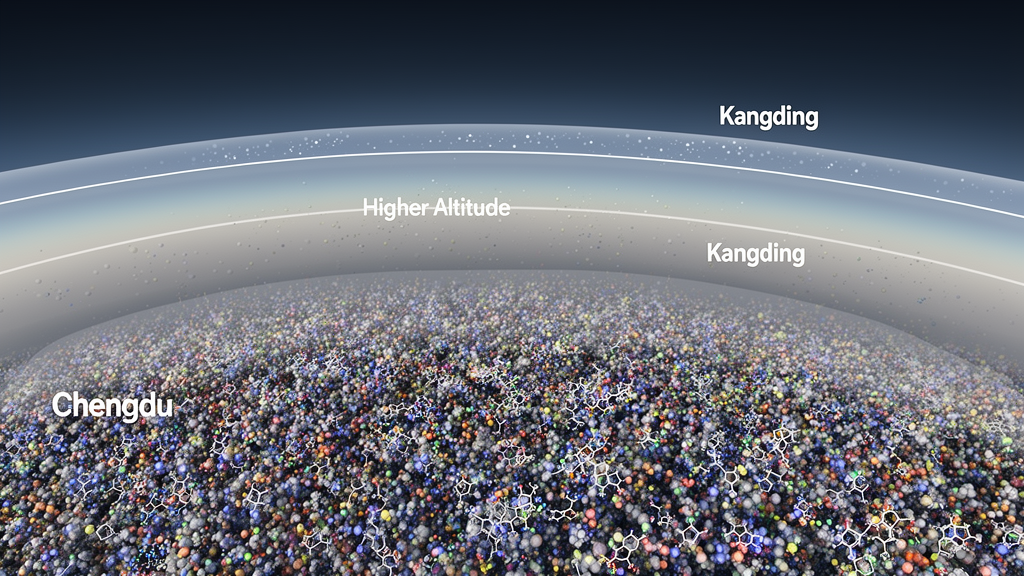
Fine particulate pollution in the basin-to-plateau transition zone of Southwest China behaves very differently depending on altitude and season, according to a study published in Environmental Monitoring and Assessment. Researchers led by Siyu Liu and Junke Zhang compared PM2.5 in Chengdu, a basin city at roughly 500 meters above sea level, and Kangding, a plateau city at about 2,500 meters, analyzing the chemical composition and sources of PM2.5 in summer and winter, along with the wintertime evolution of individual particles.
The measurements revealed a stark altitude gradient. Winter PM2.5 concentrations averaged 79.4 ± 27.7 micrograms per cubic meter in Chengdu, compared with 15.2 ± 5.1 micrograms per cubic meter in Kangding. Summer values were lower in both cities but followed the same pattern, at 29.1 ± 10.2 micrograms per cubic meter in Chengdu and 8.1 ± 2.4 micrograms per cubic meter in Kangding. The gap between the two cities was therefore large in every season sampled.
Composition differed as well as mass. Water-soluble inorganic ions carried more weight in Chengdu’s aerosol, whereas carbonaceous components contributed more substantially in Kangding. This split indicates that the two cities, though located within the same basin-plateau transition region, host chemically distinct fine particle populations.
Seasonal patterns in the ionic fractions showed a shift from sulfate dominance in summer to nitrate dominance in winter, with stronger secondary inorganic formation recorded in Chengdu. The study documents this seasonal reversal across an altitude transect within the same region, linking it to the stronger secondary inorganic aerosol formation observed at the lower-altitude basin site.
Positive matrix factorization, a receptor model that apportions measured concentrations to source categories, indicated that Chengdu’s PM2.5 was shaped by a mix of secondary sources (35.3%), traffic-related emissions (32.4%), and combustion sources (26.0%). Kangding, by contrast, was dominated by combustion emissions, which accounted for 47.9% of its PM2.5. The authors attribute these contrasts to differences in emissions, meteorology, and atmospheric processing between the basin and plateau transition environments.
The wintertime single-particle analysis added a particle-scale dimension to the comparison. Chengdu showed a higher number fraction of secondary inorganic aerosol particles, at 29.0%, than Kangding, at 17.6%. Yet Kangding had a higher ratio of organic matter–secondary inorganic aerosol particles to pure secondary inorganic aerosol particles, 1.15 versus 0.57 in Chengdu. According to the authors, this suggests that secondary inorganic species in Kangding were more frequently internally mixed or associated with organic-rich particles.
The contrast in mixing states means that altitude and season shaped not only how much fine particulate matter was present and what it was made of, but also how its components combined at the scale of individual particles. Bulk composition measurements alone would not have distinguished these particle-scale differences, which emerged only when the researchers examined individual particles during winter.
Overall, the study shows that differences in emissions, meteorology, and atmospheric processing between basin and plateau transition environments influenced PM2.5 mass, composition, and particle-scale mixing states in the two cities. The reported concentrations, source apportionments, and mixing-state fractions provide a documented baseline for the summer and winter conditions sampled in Chengdu and Kangding within this transition zone of Southwest China.
Subject of Research: Altitudinal and seasonal differences in PM2.5 sources, secondary formation, and particle mixing states in the basin–plateau transition zone of Southwest China
Article Title: Altitudinal and seasonal differences in PM2.5 sources, secondary formation, and particle mixing states in the basin–plateau transition zone of Southwest China
Article References: Liu, S., Yao, X., Zhou, Y., Zhao, W., Wang, R., Liu, W., & Zhang, J. (2026). Altitudinal and seasonal differences in PM2.5 sources, secondary formation, and particle mixing states in the basin–plateau transition zone of Southwest China. Environmental Monitoring and Assessment, 198(11), Article 1248. https://doi.org/10.1007/s10661-026-16102-6
Image Credits: AI Generated
DOI: 10.1007/s10661-026-16102-6
Keywords: Altitudinal, seasonal, differences, sources, secondary, formation, particle, mixing, states, basin, plateau, transition
Cite Scienmag News
Russell Cooper. (October 24, 2026). Altitude Divides PM2.5: Chengdu and Kangding Show Contrasting Aerosol Chemistry. Scienmag. https://scienmag.com/altitude-divides-pm2-5-chengdu-and-kangding-show-contrasting-aerosol-chemistry/
Russell Cooper. "Altitude Divides PM2.5: Chengdu and Kangding Show Contrasting Aerosol Chemistry." Scienmag, 24 October 2026, https://scienmag.com/altitude-divides-pm2-5-chengdu-and-kangding-show-contrasting-aerosol-chemistry/. Accessed 24 October 2026.
Russell Cooper. "Altitude Divides PM2.5: Chengdu and Kangding Show Contrasting Aerosol Chemistry." Scienmag. October 24, 2026. https://scienmag.com/altitude-divides-pm2-5-chengdu-and-kangding-show-contrasting-aerosol-chemistry/


