


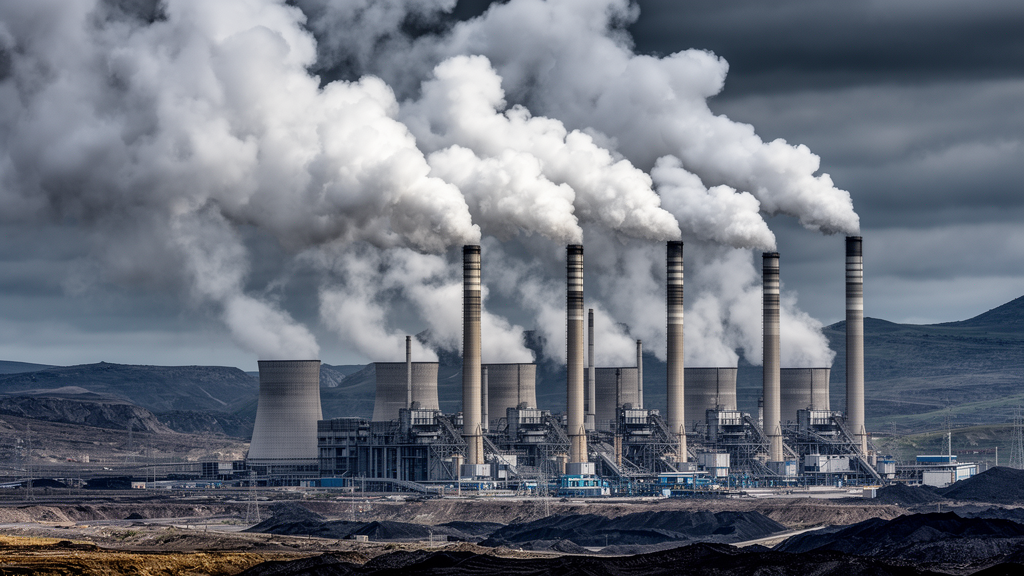
Poland’s carbon dioxide emissions remain driven overwhelmingly by fossil fuel consumption, with a new econometric analysis of national data from 2000 to 2023 finding that coal, oil, and natural gas explain nearly half of the long-run variation in the country’s environmental pollution. The study, which applied a Vector Autoregression framework together with Granger causality tests to Polish time-series data, concludes that electricity consumption and economic growth also significantly raise emissions, while foreign direct investment plays a comparatively minor role. The findings arrive at a pivotal moment, as Poland attempts to reconcile one of the most coal-dependent energy systems in the European Union with the bloc’s ambitious climate neutrality targets for 2050.
The researchers framed their analysis within the emerging concept of Technology Revolution 6.0, a forward-looking label for the convergence of artificial intelligence, automation, the Internet of Things, blockchain, and smart energy systems. Importantly, the authors are careful to note that this framework serves as policy and theoretical context rather than a measured variable. The study does not directly quantify the effects of digitalization or AI adoption through specific indicators. Instead, it examines the traditional determinants of environmental sustainability—electricity consumption, fossil fuel consumption, gross domestic product, foreign direct investment, and trade openness—and interprets the results in terms of their implications for Poland’s ongoing technological transformation.
Poland makes a particularly compelling case study. The country remains among the most fossil-fuel-reliant economies in the European Union, with coal still dominating electricity generation. According to the descriptive statistics compiled from World Bank, International Energy Agency, UNCTAD, and Global Carbon Atlas data, fossil fuels accounted for an average of 82.4 percent of Poland’s total energy consumption between 2000 and 2023, ranging from 68.1 to 95.4 percent. Per capita carbon dioxide emissions averaged 7.5 metric tons over the period, while electricity consumption averaged roughly 3,737 kilowatt-hours per person. These figures underline a structural rigidity: despite global growth in renewables, Poland’s energy mix has changed only gradually.
The empirical core of the study rests on a Vector Autoregression model, chosen precisely because the relationships among energy use, growth, trade, investment, and pollution are multidirectional. Unlike single-equation methods such as ordinary least squares or autoregressive distributed lag models, the VAR framework treats every variable as endogenous, allowing each to respond to its own past values and to the past values of all others. The authors also employed the Johansen cointegration procedure, a maximum likelihood approach for detecting long-run equilibrium relationships among non-stationary time series, and Granger causality tests to establish the direction of predictive influence among the variables.
The results are striking in their clarity on the energy side. In the VAR estimation, lagged fossil fuel consumption carried the largest significant coefficient for predicting subsequent carbon dioxide emissions, followed by electricity consumption and GDP. Granger causality tests reinforced this hierarchy: fossil fuel use Granger-causes emissions at the 1 percent significance level, electricity consumption at the 5 percent level, and GDP and trade openness at the 10 percent level. Foreign direct investment, by contrast, showed no statistically significant causal influence on emissions in this sample. Impulse response functions confirmed that a positive shock to fossil fuel consumption produces a persistent rise in emissions, while shocks to GDP raise emissions with an effect that diminishes over time—a pattern consistent with the early, rising portion of the Environmental Kuznets Curve.
The forecast error variance decomposition quantifies just how dominant fossil fuels are. At a ten-year horizon, shocks to fossil fuel consumption explain roughly 48.2 percent of the forecast error variance in Polish pollution, electricity consumption about 21.7 percent, and GDP 16.3 percent. Trade openness and foreign direct investment contribute only 7.8 and 6.0 percent respectively, and these rankings held under alternative Cholesky orderings used as robustness checks. In practical terms, Poland’s environmental trajectory is dictated far more by what it burns than by who invests in it or what it trades.
The Johansen tests add a structural dimension to the picture. Both the trace statistic and the maximum eigenvalue statistic reject the null hypothesis of no cointegration, identifying two cointegrating vectors at the 5 percent significance level. This means that although the six variables fluctuate independently in the short run, they move together over time and maintain a stable long-run equilibrium relationship. For policymakers, cointegration implies that energy, growth, and pollution in Poland are locked into a shared long-term path—one that cannot be altered without fundamentally restructuring the energy system itself rather than merely adjusting any single factor.
On globalization, the study offers a nuanced reading of long-standing competing hypotheses. The pollution haven hypothesis holds that countries with weaker environmental regulation attract dirtier industries through foreign investment, while the pollution halo hypothesis suggests investment transmits cleaner technologies. The weak, statistically insignificant direct effect of foreign direct investment on Polish emissions may indicate that both mechanisms partly offset each other, with Polish inflows directed substantially toward manufacturing modernization, services, and technologically advanced sectors rather than heavy polluting industry. Trade openness showed an ambiguous, moderate influence: initial shocks raise emissions, consistent with scale effects from expanded production, but the effect fades over time, plausibly reflecting the technique effects of technology transfer within the regulated EU single market.
The study also incorporated Poland’s 2004 accession to the European Union as a policy dummy variable, capturing institutional shifts such as the adoption of EU environmental directives and energy market reforms. This specification helps separate the effects of broader regulatory transformation from the energy and economic drivers themselves. The authors note that the analysis aligns with Poland’s Energy Policy until 2040, which prioritizes reducing coal dependence, expanding renewables, and improving efficiency, and with the European Green Deal’s goal of climate neutrality by 2050. Their findings reinforce these priorities by showing that without decarbonizing the electricity supply, rising power demand from digitalization will translate directly into higher emissions.
The implications reach well beyond Poland’s borders. Several neighboring Central and Eastern European economies—the Czech Republic, Hungary, Slovakia, and Romania—share similar legacies of fossil fuel dependence and face comparable pressure under EU climate policy. The central lesson is that technology alone will not deliver environmental sustainability. Artificial intelligence, smart grids, and digital manufacturing raise electricity demand even as they offer efficiency gains, so their climate benefit depends entirely on the carbon intensity of the grid that powers them. The authors caution, however, that the study relies on only 24 annual observations, uses a parsimonious one-lag VAR specification, and does not directly measure digitalization or AI adoption, so results should be read as evidence of short-run dynamic interactions rather than definitive structural effects. Future work, they suggest, should incorporate explicit technology indicators, sectoral data, and nonlinear or Bayesian methods as Poland’s energy transition unfolds.
Subject of Research: The dynamic relationships among energy consumption, fossil fuel dependence, economic growth, foreign investment, trade openness, and carbon emissions in Poland from 2000 to 2023
Article Title: Energy factors affecting environmental sustainability in Poland: Implications for technology revolution 6.0
Article References: Vu, N. X., Nguyen, T. L. A., Luong, H. G., Pham, X. H., & Nguyen, T. T. T. (2026). Energy factors affecting environmental sustainability in Poland: Implications for technology revolution 6.0. Environmental and Sustainability Indicators, 32, Article 101580. https://doi.org/10.1016/j.indic.2026.101580
Image Credits: AI Generated
DOI: 10.1016/j.indic.2026.101580
Keywords: Poland, carbon dioxide emissions, fossil fuel consumption, electricity consumption, Vector Autoregression, Granger causality, Environmental Kuznets Curve, foreign direct investment, trade openness, European Green Deal, cointegration, energy transition
Cite Scienmag News
Sloane Callahan. (October 24, 2026). Coal Still Drives Poland’s Emissions, Study of 2000–2023 Finds. Scienmag. https://scienmag.com/coal-still-drives-polands-emissions-study-of-2000-2023-finds/
Sloane Callahan. "Coal Still Drives Poland’s Emissions, Study of 2000–2023 Finds." Scienmag, 24 October 2026, https://scienmag.com/coal-still-drives-polands-emissions-study-of-2000-2023-finds/. Accessed 24 October 2026.
Sloane Callahan. "Coal Still Drives Poland’s Emissions, Study of 2000–2023 Finds." Scienmag. October 24, 2026. https://scienmag.com/coal-still-drives-polands-emissions-study-of-2000-2023-finds/


