


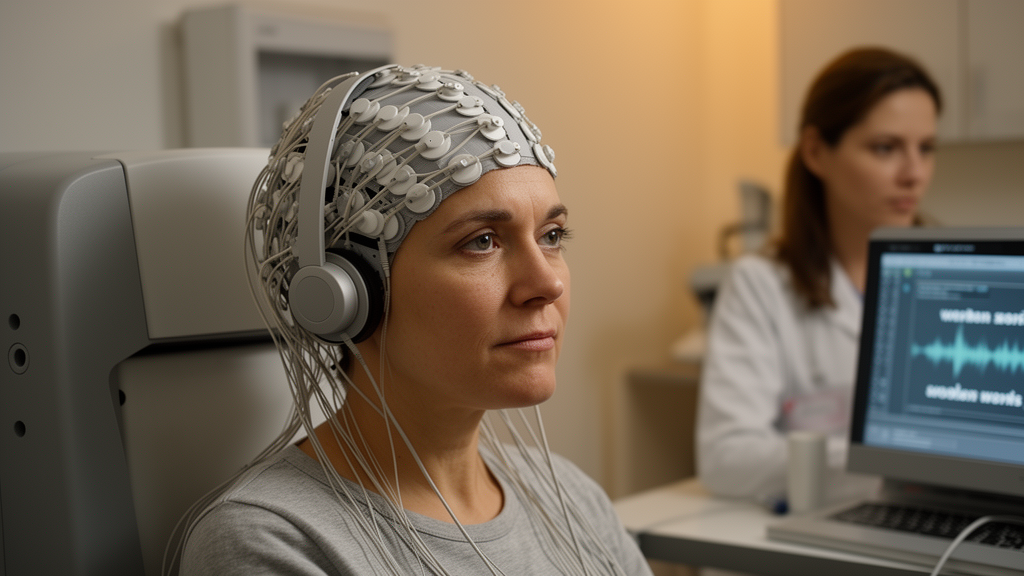
Adults with dyslexia can retune how they categorize ambiguous speech sounds using both lip movements and written text just as effectively as typical readers, according to a functional magnetic resonance imaging (fMRI) study conducted at Maastricht University and published in Frontiers in Human Neuroscience. The behavioral result came as a surprise, because earlier work had suggested that people with dyslexia fail to adjust their phonetic perception when the disambiguating cue is text, while retaining this ability when the cue is seen on a talker’s lips. The new imaging data showed, however, that intact behavior does not mean identical brain processing: the two reader groups reached the same perceptual outcome through partly different cortical routes.
The study recruited 34 adults, 18 with dyslexia and 16 typical readers. Participants were exposed to an ambiguous speech sound, transcribed as /a?a/, which sits perceptually between the categories “aba” and “ada.” On each exposure trial, the ambiguous sound was paired with visual information that disambiguated it. In the text-based condition, the written letter string “aba” or “ada” appeared on screen; in the lipread-based condition, participants watched silent videos of a talker’s mouth articulating the corresponding syllable. After each exposure block, participants completed auditory-only categorization trials in which they judged what they heard without any visual support. Shifts in these auditory judgments toward the visually suggested category served as the measure of phonetic recalibration, a process in which listeners adjust their perception of ambiguous speech sounds based on visual contextual information.
Contrary to the researchers’ expectations based on prior behavioral literature, both groups showed robust recalibration effects in both conditions. Typical readers and adults with dyslexia shifted their auditory-only categorizations toward “aba” or “ada” depending on the visual cue they had just seen, and the magnitude of these text-based and lipread-based effects did not differ significantly between the groups. The hypothesized specific difficulty in forming letter-speech sound associations during this recalibration paradigm was therefore not confirmed at the behavioral level in this adult sample.
The neuroimaging results told a more differentiated story. During exposure to lipread videos paired with the ambiguous speech sound, adults with dyslexia showed increased activation in the fusiform gyrus bilaterally compared with typical readers. Notably, activation in the left fusiform during lipread-based audiovisual exposure correlated with the severity of participants’ phonological processing difficulties, with stronger activation in this region associated with greater phonological impairment. The authors interpret this pattern as suggesting that the relatively heightened fusiform response, together with increased superior temporal activation to lipread audiovisual stimuli, may relate to subtle difficulties in phonological processing of ambiguous speech signals in adults with dyslexia.
A second group difference emerged in the text-based condition. Typical readers exhibited higher activation in right frontal regions than adults with dyslexia while processing written text paired with the ambiguous speech sound. This indicates that even when the behavioral recalibration effect from text cues is intact, the cortical activation supporting the processing of text-based audiovisual stimuli differs between typical readers and adults with dyslexia. The dissociation between preserved behavioral performance and altered activation patterns shows that the two reader groups employed different neural processing strategies in this task, a difference the authors did not anticipate finding most clearly for lipread audiovisual stimuli.
The findings carry implications for how phonetic recalibration is studied in the reading brain. Phonetic recalibration allows listeners to adjust their perception of ambiguous speech sounds based on visual contextual information, and the results suggest that the previously reported absence of text-based recalibration in dyslexia did not appear in this adult sample, at least when measured behaviorally. At the same time, the correlation between left fusiform activation and phonological difficulties during lipread-based exposure indicates that the neural response to processing ambiguous speech is linked to the phonological difficulties that characterize the condition, even when those difficulties do not surface as impaired task performance.
Several cautions temper the conclusions. The sample comprised 34 adults, which limits the statistical power available for detecting between-group differences in both behavior and brain activation, and the discrepancy with previous behavioral findings may reflect differences in participant characteristics, task parameters, or recalibration measures across studies. The fMRI results are correlational: increased fusiform and superior temporal activation in the dyslexia group indicates altered processing during audiovisual exposure, but the data cannot establish whether these activation differences cause the preserved recalibration, compensate for weaker phonological representations, or arise as a byproduct of greater effort. The correlation between left fusiform activation and phonological difficulties, while suggestive, likewise does not demonstrate a causal role for this region in phonological impairment.
Within those limits, the study adds a concrete empirical datum to research on audiovisual speech processing in dyslexia. If adults with dyslexia can use both lips and letters to retune speech categorization in this paradigm, then accounts that locate the difficulty specifically in text-based rapid recalibration did not hold for this group. The divergence between behavioral and neural measures also reinforces a methodological point demonstrated by this study: intact performance on this audiovisual task was not accompanied by typical underlying cortical activation, and the neuroimaging measures revealed group differences that the behavioral measures alone did not.
Subject of Research: Cortical responses to lipread and text-based audiovisual stimuli in adults with and without dyslexia
Article Title: Cortical responses to lipread and text-based audiovisual stimuli in adults with and without dyslexia
Article References: Cao, Y., Gentile, F., Naseri, P., Romanovska, L., & Bonte, M. (2026). Cortical responses to lipread and text-based audiovisual stimuli in adults with and without dyslexia. Frontiers in Human Neuroscience, 20, Article 1806964. https://doi.org/10.3389/fnhum.2026.1806964
Image Credits: AI Generated
DOI: 10.3389/fnhum.2026.1806964
Keywords: Cortical, responses, lipread, text-based, audiovisual, stimuli, adults, without, dyslexia, scientific research
Cite Scienmag News
Cassandra Pierce. (October 24, 2026). Adults with dyslexia recalibrate speech normally but with different brain activity. Scienmag. https://scienmag.com/adults-with-dyslexia-recalibrate-speech-normally-but-with-different-brain-activity/
Cassandra Pierce. "Adults with dyslexia recalibrate speech normally but with different brain activity." Scienmag, 24 October 2026, https://scienmag.com/adults-with-dyslexia-recalibrate-speech-normally-but-with-different-brain-activity/. Accessed 24 October 2026.
Cassandra Pierce. "Adults with dyslexia recalibrate speech normally but with different brain activity." Scienmag. October 24, 2026. https://scienmag.com/adults-with-dyslexia-recalibrate-speech-normally-but-with-different-brain-activity/


