


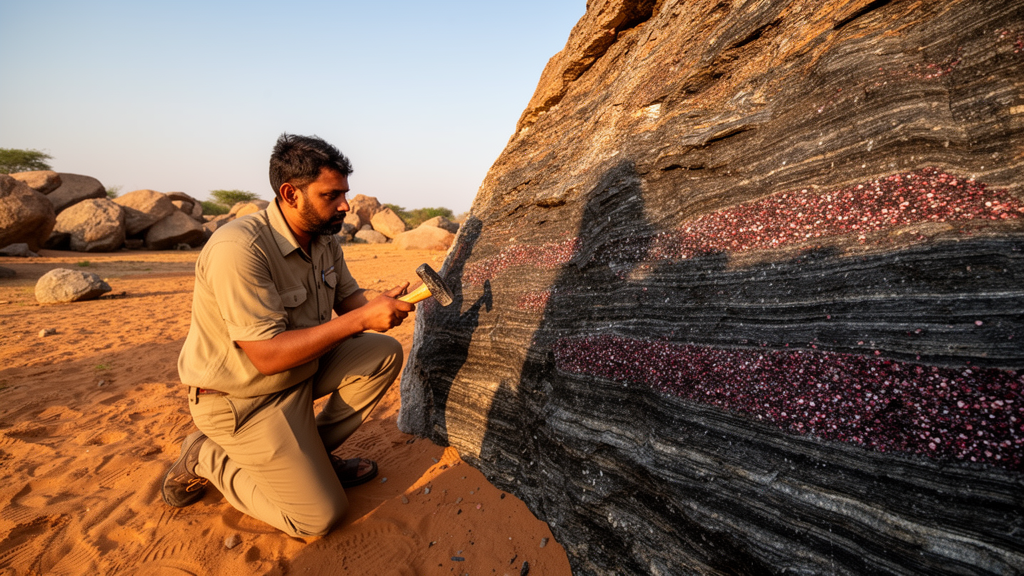
Deep within the Aravalli–Delhi Mobile Belt of northwestern India, a suite of mafic granulites from the Balaram area is providing scientists with an unprecedented window into the chemical and tectonic evolution of Earth’s lower continental crust. A new study published in Discover Geoscience presents comprehensive petrographic, mineral chemical, and whole-rock geochemical data from these rocks, revealing a complex multistage history that spans extensional magmatism, high-grade metamorphism, and later compressional reworking during the Proterozoic evolution of the region.
The mafic granulites, exposed in the Kanpura and Khapa sectors of the Balaram region in Banaskantha district of northern Gujarat, belong to the South Delhi Terrane of the Aravalli–Delhi Mobile Belt. This major Proterozoic orogenic belt extends from north of Delhi to the Gulf of Cambay and comprises predominantly Precambrian rocks. The oldest crustal component in the region is the Archaean Banded Gneissic Complex, which forms the basement to the overlying supracrustal sequences. Subsequent Proterozoic sedimentary basins represented by the Aravalli Supergroup and the Delhi Supergroup developed in response to rifting of the Archaean craton along a passive continental margin.
The research team, led by Manish Kumar and including Divya Prakash, Vagesh Nath Yadav, Rana Firdous, Sonal Shukla, and Manoj Kumar Yadav, employed electron probe microanalysis using a CAMECA SXFive instrument at Banaras Hindu University to determine mineral compositions. Whole-rock geochemical analyses were conducted at Bureau Veritas Commodities Ltd in Canada, using lithium metaborate and lithium tetraborate fusion for major elements and four-acid digestion ultratrace ICP-MS for trace elements. Twelve representative samples were carefully selected for their freshness and lack of alteration to avoid any contamination.
Petrographic examination revealed that the Balaram mafic granulites are two-pyroxene granulites containing orthopyroxene, clinopyroxene, hornblende, and plagioclase, with locally developed garnet and accessory ilmenite, magnetite, and rutile. The rocks commonly exhibit a granoblastic texture characterized by equidimensional and mutually equilibrated grains, indicative of recrystallization under high-grade metamorphic conditions. Orthopyroxene and clinopyroxene occur in mutual contact and represent an important component of the peak granulite-facies assemblage. Garnet occurs locally in association with both pyroxenes, suggesting its formation during high-grade metamorphism near peak conditions, linked to progressive dehydration and recrystallization reactions involving hornblende-bearing precursors.
The mineral chemistry provides compelling evidence for the metamorphic history. Garnet compositions show XMg values ranging from 0.101 to 0.142, with consistently low manganese content between 0.083 and 0.093 atoms per formula unit, suggesting a minor role for the spessartine component. Calcium displays a broader compositional range from 0.086 to 0.100 atoms per formula unit, reflecting variations in the grossular component and possible changes in pressure conditions during garnet growth. Biotite shows relatively Mg-rich compositions with XMg values between 0.406 and 0.448, and appreciable TiO₂ concentrations between 3.37 and 4.61 weight percent, suggesting crystallization under the high-temperature conditions typical of granulite-facies environments.
Orthopyroxene contains 45.24 to 49.24 weight percent SiO₂ and 6.78 to 9.40 weight percent Al₂O₃, with FeO concentrations reaching 19.10 weight percent and XMg values ranging from 0.684 to 0.727. Clinopyroxene contains 48.57 to 53.18 weight percent SiO₂ and 3.24 to 8.16 weight percent Al₂O₃, with FeO concentrations of up to 18.36 weight percent and XMg values between 0.393 and 0.685. Plagioclase shows XCa values between 0.55 and 0.70, with SiO₂ ranging from 51.28 to 54.67 weight percent and CaO from 11.46 to 13.96 weight percent. Ilmenite grains occur as elongated prismatic inclusions within orthopyroxene and plagioclase, with TiO₂ concentrations between 50.82 and 53.05 weight percent and FeO reaching 45.40 weight percent.
The whole-rock geochemical data reveal significant insights into the protolith nature. Total rare earth element contents range from 86.26 to 314.90 parts per million, with enrichment of light rare earth elements over heavy rare earth elements and negative europium anomalies. These patterns suggest crustal involvement in the petrogenesis, plagioclase fractionation, and enrichment inherited from the source rocks. The K₂O/Na₂O ratio ranges between 0.38 and 4.50, indicating a significant quantity of K-feldspar relative to sodic feldspar. In Harker variation diagrams, Al₂O₃, Fe₂O₃, K₂O, Na₂O, CaO, and MnO all show systematic decline with increasing SiO₂, while TiO₂ and MgO show systematic increase.
Primitive mantle-normalized spidergrams display enrichment in large-ion lithophile elements including rubidium, thorium, potassium, and lead, alongside negative anomalies in niobium and titanium. These features collectively indicate significant crustal contamination and a geochemical affinity comparable to continental crust composition. The Rb/Ba versus Rb/Sr diagram suggests derivation from partial melts of clay-poor source rocks, indicating involvement of older crustal basement material. The Al₂O₃/(MgO+FeOt) versus CaO/(MgO+FeOt) plot indicates that the melt source was predominantly metapelitic, with minor contribution from metagreywacke compositions, suggesting the granulite protolith formed by partial melting of crustal sedimentary precursors.
Tectonic discrimination using Ti/Zr and Zr/Y versus Y diagrams, which employ relatively immobile trace elements less affected by granulite-facies metamorphism and retrograde alteration, shows that the analyzed samples plot mainly within the combined mid-ocean ridge basalt and volcanic arc basalt fields. This geochemical distribution suggests the protolith was derived from mafic magma generated under a mixed tectonic influence, reflecting contributions from both mid-ocean ridge and volcanic arc settings. The Sm/Nd versus MgO discriminant diagram indicates that the protolith originated at depths comparable to the middle crust zone, and Ba/Nb versus La/Nb relationships confirm crustal contamination during ascent.
The researchers propose a comprehensive geodynamic model for the evolution of the Aravalli–Delhi Mobile Belt. The initial extensional phase involved rifting and fragmentation of the Banded Gneissic Complex, which likely led to the opening of the Delhi basin. During this stage, the southern Delhi belt may have progressed to oceanic crust generation, whereas the central and northern Delhi belts remained underlain by granitic continental crust. This extensional regime was followed by passive-margin sedimentation along the basin margin. Subsequent basin closure during continental convergence caused subduction, arc magmatism, and emplacement of the gabbro–norite–basic granulite suite, probably derived from melts generated through interaction between the subducted slab and mantle wedge. The ophiolitic mélange-like association in the Balaram area records obduction of oceanic crust during collision, while later thrusting and exhumation of the mafic granulitic crust represent the final collisional tectonic stage. The decompressional history documented in the Balaram granulites, together with evidence from neighbouring regions including the Balaram-Kui-Surpagla-Kengora granulites and the Phulad Shear Zone, supports a subduction-to-collision tectonic model involving crustal thickening, high-grade metamorphism, and subsequent exhumation of deep crustal segments during the late Proterozoic, marking a major reorganization within the Southern Delhi Terrane.
Subject of Research: Geochemical constraints on the multistage metamorphic evolution of mafic granulites from the South Delhi Terrane, Northwestern India
Article Title: Geochemical constraints on the multistage metamorphic evolution of mafic granulites from the South Delhi Terrane, Northwestern India
Article References: Kumar, M., Prakash, D., Yadav, V. N., Firdous, R., Shukla, S., & Yadav, M. K. (2026). Geochemical constraints on the multistage metamorphic evolution of mafic granulites from the South Delhi Terrane, Northwestern India. Discover Geoscience, 4(1), Article 411. https://doi.org/10.1007/s44288-026-00747-4
Image Credits: AI Generated
DOI: 10.1007/s44288-026-00747-4
Keywords: Geochemical, constraints, multistage, metamorphic, evolution, mafic, granulites, South, Delhi, Terrane, Northwestern, India
Cite Scienmag News
Gavin Prescott. (October 24, 2026). Mafic Granulites Record Multistage Metamorphic Evolution in Northwestern India. Scienmag. https://scienmag.com/mafic-granulites-record-multistage-metamorphic-evolution-in-northwestern-india/
Gavin Prescott. "Mafic Granulites Record Multistage Metamorphic Evolution in Northwestern India." Scienmag, 24 October 2026, https://scienmag.com/mafic-granulites-record-multistage-metamorphic-evolution-in-northwestern-india/. Accessed 24 October 2026.
Gavin Prescott. "Mafic Granulites Record Multistage Metamorphic Evolution in Northwestern India." Scienmag. October 24, 2026. https://scienmag.com/mafic-granulites-record-multistage-metamorphic-evolution-in-northwestern-india/


