


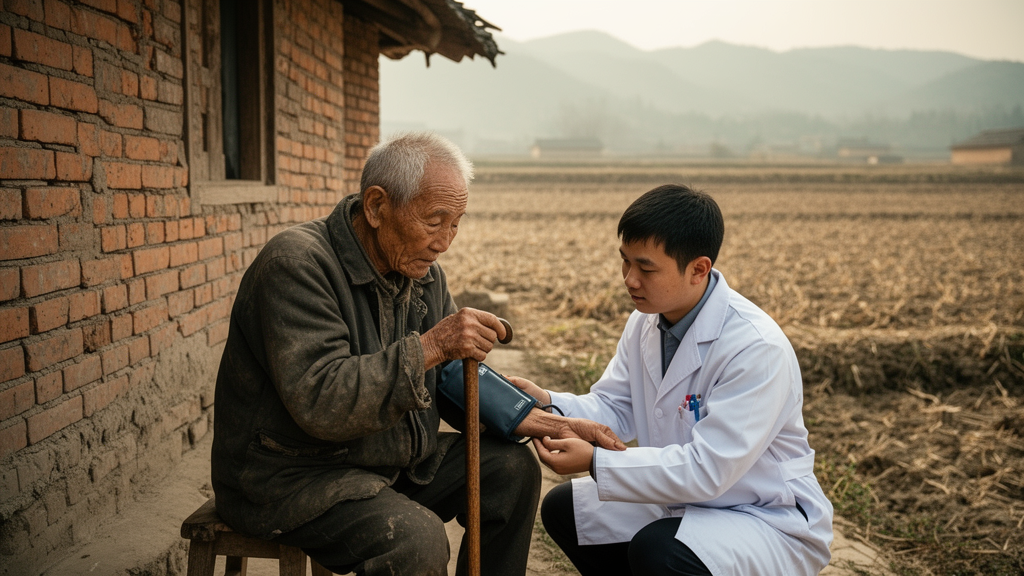
Socioeconomic status is strongly linked to how older adults in rural China rate their own health, how well their minds hold up, and how heavy their depressive symptoms are, according to a study of 1,077 rural residents in Shaanxi Province published in Humanities and Social Sciences Communications. The researchers found that lower socioeconomic status was associated with poorer self-rated health, poorer cognitive function, and more severe depressive symptoms, with the associations reaching statistical significance across all three health dimensions.
The study drew on survey data from both a general population of rural older adults and a vulnerable subgroup of welfare recipients, a group often underrepresented in health research. Health was measured in three ways: self-rated health, cognitive function, and depressive symptoms.
To sharpen comparisons between people of different socioeconomic standing, the team combined multivariable regression with propensity score matching, a statistical technique that improves comparability between socioeconomic groups by balancing observed background characteristics. The reported associations were β = 0.367 for self-rated health, β = 1.927 for cognitive function, and β = −0.471 for depressive symptoms, each with P < 0.001.
Subgroup analysis revealed a striking asymmetry. The link between socioeconomic status and cognitive function was stronger among the vulnerable welfare-recipient population, while the associations for self-rated health and depressive symptoms were larger in the general population. The researchers also found that the association between socioeconomic status and depressive symptoms appeared stronger among older adults living alone (β = −0.587, P < 0.001), with no gender differences detected in the patterns.
Beyond documenting these associations, the study explored potential mediating pathways using an exploratory mediation analysis focused on three candidate mechanisms: physical exercise, nutrition, and living conditions. Living conditions accounted for the largest share of the observed socioeconomic status–health association, explaining between 8.3 and 25.1 percent of it, followed by physical exercise at 3.9 to 9.8 percent and nutrition at 3.2 to 13.2 percent. In other words, the environments in which rural older adults live appear to carry more of the socioeconomic gradient in health than either their diets or their exercise habits, though all three pathways contributed to some degree.
The authors caution that the mediation analysis was exploratory, and the findings describe associations rather than established causal effects. Socioeconomic status is a key determinant of health, but its relationship with health among older adults in rural China—particularly among vulnerable subgroups—remains insufficiently understood, which is precisely the gap the study set out to address. The data cover a single province, and the vulnerable group was defined by welfare receipt, so the results may not generalize to all rural settings in China or to older adults in urban areas.
Even with those limits, the study’s scope across multiple health dimensions and subgroups offers a more granular picture than research that examines single outcomes in general populations. The finding that the socioeconomic gradient in cognitive function is steeper among welfare recipients suggests that the health costs of disadvantage may be concentrated among those with the fewest resources, while the stronger gradient in depressive symptoms among those living alone points to living arrangements as a relevant factor in mental health in later life.
The researchers conclude that efforts to reduce the health costs of poverty in later life may benefit from comprehensive policies that improve living environments, promote healthy behaviors, and prioritize support for vulnerable groups such as welfare recipients and older adults living alone. Because living conditions explained the largest share of the socioeconomic status–health associations in this dataset, interventions targeting housing quality and the home environment could be a particularly promising lever, though the exploratory nature of the pathway analysis means such conclusions await confirmation in future research.
Subject of Research: Socioeconomic status and health outcomes among older adults in rural China
Article Title: Socioeconomic disadvantage and health in later life: associations and potential pathways in rural China
Article References: Gao, Q., Jiang, Y., Zhou, B., Liu, R., & Shi, Y. (2026). Socioeconomic disadvantage and health in later life: associations and potential pathways in rural China. Humanities and Social Sciences Communications. https://doi.org/10.1057/s41599-026-09410-2
Image Credits: AI Generated
DOI: 10.1057/s41599-026-09410-2
Keywords: rural China, socioeconomic status, aging, health disparities, cognitive function, depressive symptoms, welfare recipients, Shaanxi Province, Socioeconomic, disadvantage, health, later
Cite Scienmag News
Glenn Wilkins. (October 24, 2026). Lower socioeconomic status linked to poorer health in rural China’s older adults. Scienmag. https://scienmag.com/lower-socioeconomic-status-linked-to-poorer-health-in-rural-chinas-older-adults/
Glenn Wilkins. "Lower socioeconomic status linked to poorer health in rural China’s older adults." Scienmag, 24 October 2026, https://scienmag.com/lower-socioeconomic-status-linked-to-poorer-health-in-rural-chinas-older-adults/. Accessed 24 October 2026.
Glenn Wilkins. "Lower socioeconomic status linked to poorer health in rural China’s older adults." Scienmag. October 24, 2026. https://scienmag.com/lower-socioeconomic-status-linked-to-poorer-health-in-rural-chinas-older-adults/


