


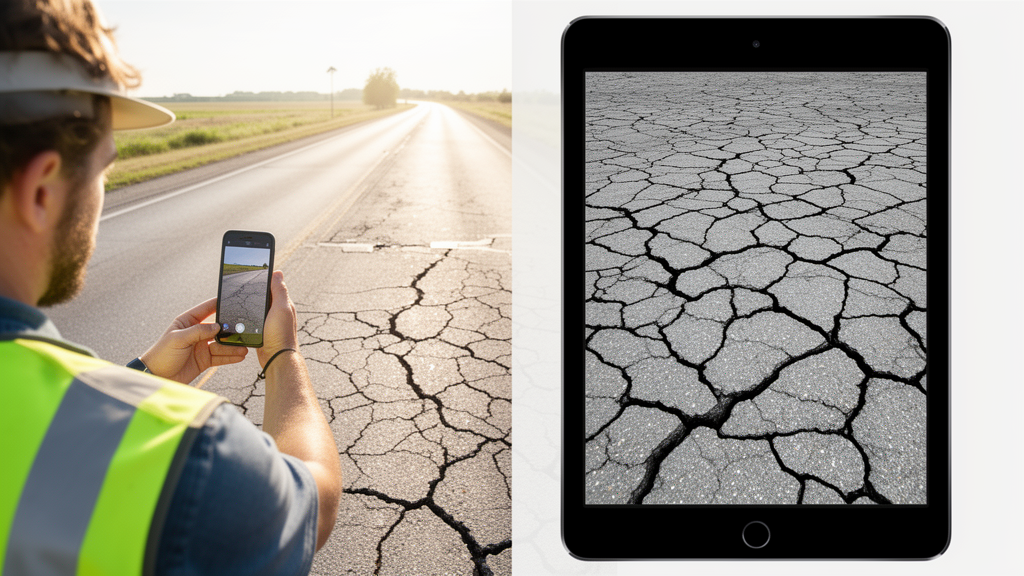
A cracked road no longer requires an expensive survey vehicle to be found. Researchers have assembled a pavement inspection pipeline built from consumer smartphones, a denoising diffusion model, and a modern object detection architecture, and shown that synthetic images generated by artificial intelligence can sharpen crack detection even when the pool of real, labeled photographs is very small. The work, focused on a characteristic deterioration pattern known as alligator cracking, points to a low-cost route for cities that cannot afford conventional pavement condition surveys, and it demonstrates how detection results can be linked back to the locations where they were recorded.
Smartphone-based detection has emerged as a promising alternative, but deep learning detectors need substantial amounts of labeled imagery, and collecting and annotating such data in the field remains a bottleneck. Most earlier generative approaches to expanding pavement datasets, including various GAN and diffusion models, were trained on hundreds to thousands of real images, which reduces the practical value of synthesizing more data. The research team instead asked whether images produced by a generative model could help in a genuinely low-resource setting, where direct training of a detector on the available real data struggles to generalize.
To build the real dataset, the investigators mounted three Samsung smartphones, a Galaxy A72, a Galaxy S20 FE, and a Galaxy S22 Ultra, inside a vehicle with cameras positioned at oblique angles on the front windshield and rear window, using two holders per device to suppress vibration. Data collection took place at an approximately constant speed of 30 kilometers per hour across the urban road network of Tehran, Iran, under both sunny and cloudy conditions to capture distresses under varying illumination. Practical problems trimmed the usable footage: dashboard reflections on the windshield under sunny skies had to be mitigated with a black dash mat, and trailing vehicles that blocked the rear camera's view of the pavement rendered some recordings unusable.
In total, 4 hours and 2 minutes of video were recorded, while a smartphone application logged GPS coordinates and timestamps. Frames were extracted every 250 milliseconds, which at 30 kilometers per hour corresponds to about 2.08 meters of travel, so that consecutive frames shared roughly 26 percent spatial overlap of the pavement ahead. After cropping away the sky-facing upper regions and the adjacent traffic lanes, each image represented approximately 2.8 meters of road surface at a final resolution of 1152 by 360 pixels, and interpolated GPS coordinates were embedded into each image's EXIF metadata.
To prevent any possibility of data leakage, the recordings were divided at the video level into training, validation, and test partitions before frame extraction, so highly similar frames from the same sequence could not straddle subsets. Ultimately, 84 images containing 98 annotated alligator cracking instances were selected, with 64, 20, and 16 percent of the data allocated to training, validation, and testing respectively; the test set contained 13 images with 13 annotated instances. The generative component was a denoising diffusion probabilistic model, or DDPM, based on a UNet2DModel architecture and trained on just 60 alligator crack images drawn from the training partition.
Such models work by progressively corrupting clean images with Gaussian noise through a fixed forward process and then learning a neural network to reverse that corruption step by step. The model was configured with 1,000 diffusion steps, a linear noise schedule, and a mean squared error loss between predicted and actual noise, and it learned to produce 256-by-256 RGB images from pure noise. Recognizable crack patterns first emerged around training epoch 220, and after 400 epochs the team generated 400 synthetic images using eight random seeds, 50 per seed.
A nearest-neighbor filtering procedure, based on feature-space distances between each synthetic image and the real training samples, was then applied to remove images that were either too similar to individual real photographs or too unrepresentative, trimming the pool from 400 to 240 candidates, from which 54 images were randomly selected to double the training set. Quantitative checks suggested the generated images captured the character of real pavement imagery without simply copying it. Using a reduced feature dimension suited to small samples, the synthetic set scored a Fréchet Inception Distance of 2.674 and a Kernel Inception Distance of 0.076, values indicating close alignment with the real image distribution.
Nearest-neighbor analysis using ResNet-50 features showed a mean generated-to-real distance of 0.153, measurably larger than the real-to-real reference distance of 0.107, supporting the use of the synthetic images as complementary training data. The authors caution that because selection and evaluation relied on the same distance metric, the analysis indicates similarity patterns rather than serving as a definitive test for memorization. The detection experiments used YOLOv11m, a medium-sized member of the You Only Look Once family of object detectors, trained on an NVIDIA Tesla T4 GPU with an input size of 640 by 640 pixels, a maximum of 300 epochs, and early stopping with a patience of 100 epochs.
Three dataset configurations were compared: the initial dataset, a version expanded by 100 percent through conventional augmentation of the training subset using horizontal flips, rotations within 15 degrees, and 0.5 percent noise, and a version expanded by 100 percent with the DDPM-generated images. Identical architecture, hyperparameters, built-in training augmentations, and evaluation settings were used throughout, and each configuration was trained with five different random seeds to assess variability. Both augmentation strategies lifted mean detection performance above the initial dataset, but the synthetic images delivered the strongest result.
The baseline model achieved mean precision of 0.820, recall of 0.816, mAP50 of 0.815, and mAP50-95 of 0.579; conventional augmentation raised these to 0.904, 0.829, 0.857, and 0.602 respectively, eliminating some false positives such as pavement markings and a longitudinal crack misread as alligator cracking. The DDPM-augmented model reached mean precision of 0.907, recall of 0.843, mAP50 of 0.865, and mAP50-95 of 0.664. Its advantages over conventional augmentation were modest for precision, recall, and mAP50, with absolute gains of only 0.003, 0.014, and 0.008 respectively.
Because both strategies expanded the training set by the same proportion, the researchers argue the additional benefit cannot be attributed simply to an increase in sample quantity. The clearest separation appeared in mAP50-95, a metric averaged over progressively stricter overlap thresholds between predicted and true bounding boxes. This score rose from 0.579 for the initial dataset to 0.602 with conventional augmentation, then to 0.664 with the synthetic images, a gain of 0.062 over the conventionally augmented model.
The pattern is consistent with improved bounding-box localization under demanding conditions: in a qualitative example, the conventionally augmented model's box excluded part of the upper distressed region while the DDPM-augmented model covered it more completely. The authors also note a limitation of the approach, showing a case in which the DDPM-augmented model produced two overlapping boxes for a single distress instance, a duplication that counts against precision even though the crack is still detected. The team also demonstrated the pipeline outside the city where the training data were collected.
In a case study on roughly one kilometer of Edalat Street in Gorgan, detection outputs were linked to smartphone GPS coordinates and rendered as an interactive Leaflet.js map with point markers sized by detection counts and a heatmap layer showing concentrations of model detections. The investigators stress that these visualizations represent approximate locations of detections rather than direct measurements of actual distress density, since overlapping frames can produce repeated detections of the same physical crack, smartphone GPS carries positional uncertainty, and no independent ground-truth survey was available to validate the mapped positions or quantify cross-city performance. The authors acknowledge further constraints on the findings.
The dataset came from a single city under relatively limited environmental conditions, the experiments used one detection architecture and one distress category, and both augmentation strategies were evaluated at a single 100 percent expansion ratio. Although training across five seeds provided an assessment of training variability, all runs shared the same data partition, and the higher mean performance of the DDPM-augmented model should not be read as evidence of statistical significance. Future work, the team writes, should test the approach with multi-city datasets, additional distress categories such as potholes and linear cracking, alternative detector sizes and synthetic-to-real ratios, and field validation together with spatial de-duplication before the framework can reliably support operational pavement assessment.
Subject of Research: Low-cost alligator crack detection and geospatial mapping using smartphone imagery, data-efficient DDPM synthetic augmentation, and YOLOv11
Article Title: Low-cost pavement distress detection and mapping using smartphone imagery and data-efficient DDPM augmentation with YOLOv11
Article References: Hasanitabaar, F., Golroo, A., & Sedighian-Fard, M. (2026). Low-cost pavement distress detection and mapping using smartphone imagery and data-efficient DDPM augmentation with YOLOv11. Case Studies in Construction Materials, 25, Article e06651. https://doi.org/10.1016/j.cscm.2026.e06651
Image Credits: AI Generated
DOI: 10.1016/j.cscm.2026.e06651
Keywords: pavement distress, alligator cracking, smartphone imagery, DDPM, data augmentation, synthetic images, YOLOv11m, object detection, deep learning, GPS mapping, pavement management, Tehran
Cite Scienmag News
Denise Maddox. (October 24, 2026). AI-Generated Pavement Images Boost Alligator Crack Detection From Scarce Smartphone Photos. Scienmag. https://scienmag.com/ai-generated-pavement-images-boost-alligator-crack-detection-from-scarce-smartphone-photos/
Denise Maddox. "AI-Generated Pavement Images Boost Alligator Crack Detection From Scarce Smartphone Photos." Scienmag, 24 October 2026, https://scienmag.com/ai-generated-pavement-images-boost-alligator-crack-detection-from-scarce-smartphone-photos/. Accessed 24 October 2026.
Denise Maddox. "AI-Generated Pavement Images Boost Alligator Crack Detection From Scarce Smartphone Photos." Scienmag. October 24, 2026. https://scienmag.com/ai-generated-pavement-images-boost-alligator-crack-detection-from-scarce-smartphone-photos/


