


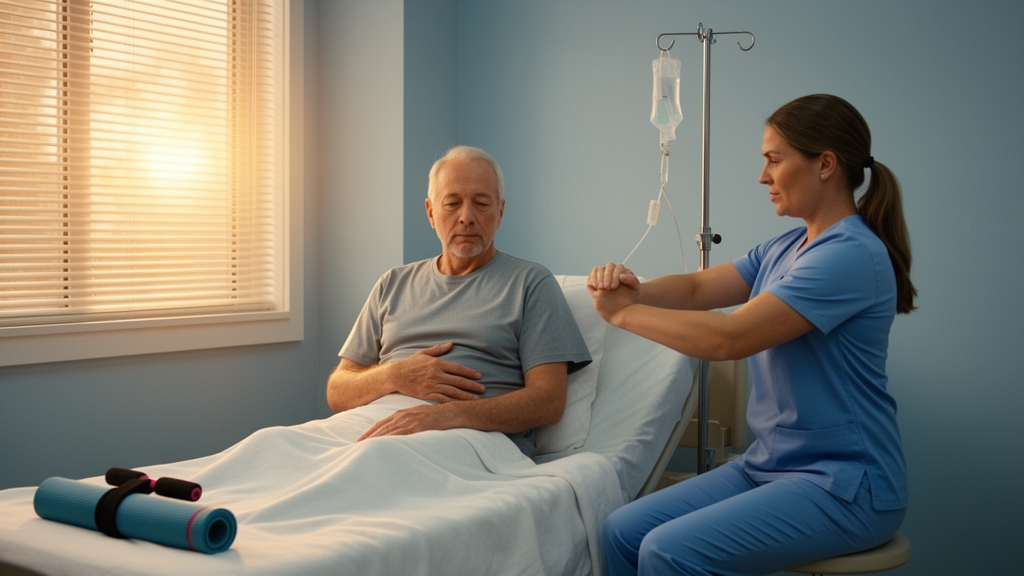
For hundreds of thousands of people with intermediate to advanced hepatocellular carcinoma, transarterial chemoembolization, or TACE, is the backbone of treatment. Interventional radiologists thread a catheter into the arteries feeding the tumor, deliver chemotherapy locally, and embolize the vessels to starve the malignancy of blood. The procedure controls tumor progression effectively, yet it leaves many patients grappling with a symptom that rarely makes it onto a treatment plan: a crushing, persistent exhaustion known as cancer-related fatigue, or CRF. A narrative review published in Supportive Care in Cancer argues that this fatigue is systematically underrecognized in the post-TACE population, and it lays out a detailed roadmap for how screening tools, non-drug interventions, and a nurse-coordinated care model could change that.
The review, led by Shiying Yang and colleagues, systematically searched PubMed, Web of Science, and the Chinese CNKI database for peer-reviewed studies, clinical guidelines, and expert consensus reports published up to April 2026. The authors graded the evidence for each intervention category using the Oxford Centre for Evidence-Based Medicine system. Their central conclusion is stark: despite the high prevalence and profound impact of fatigue after TACE, no fatigue assessment tool developed and validated specifically for this population exists to date. Clinicians currently rely on generic instruments that were never designed with hepatic functional impairment or post-embolization syndrome in mind, and the absence of TACE-specific normative data limits how precisely those scores can be interpreted.
Why is fatigue so prominent after this particular procedure? The pathophysiology, as the review describes it, is a convergence of mechanisms unique to embolization therapy. TACE works by inducing tumor ischemia and necrosis, and that controlled tissue death releases a flood of inflammatory mediators and cytokines, including interleukin-6 and tumor necrosis factor-alpha, triggering a systemic inflammatory response considered central to CRF. The acute injury and inflammation may also disrupt hypothalamic–pituitary–adrenal axis function, alter energy metabolism, and shift neurotransmitter balance, including serotonin signaling, producing exhaustion that is disproportionate to recent activity and not fully relieved by rest. On top of this, the procedure can cause transient hepatic functional impairment, degrading the body’s energy metabolism and toxin clearance, while in patients with portal vein tumor thrombus, even superselective techniques affect portal venous hemodynamics and risk bile duct injury, adding mechanisms distinct from other cancer treatments.
The clinical picture is further complicated by what surrounds the procedure. Post-embolization syndrome, with fever, nausea, vomiting, and abdominal pain, frequently co-occurs with fatigue, and abnormalities in liver function parameters such as elevated transaminases and bilirubin add to the physiological burden, creating what the authors describe as a vicious cycle. Psychological distress is tightly woven in: fatigue severity is positively correlated with depression and anxiety, and in symptom-network research, psychological distress often acts as a core symptom while somatic complaints such as nausea serve as bridge symptoms that amplify the fatigue experience. Patients with lower self-efficacy and inadequate social support tend to report more severe fatigue, and clinical characteristics including prolonged disease course, poorer Child–Pugh classification, and receipt of adjuvant chemotherapy have been identified as independent risk factors.
Combination therapy raises the stakes. TACE is increasingly paired with tyrosine kinase inhibitors such as sorafenib and lenvatinib, or with immune checkpoint inhibitors, and while these combinations improve objective response rates, disease control, and overall survival, they bring higher rates of adverse events, with fatigue among the most common. A meta-analysis comparing sorafenib plus TACE against TACE alone found significantly higher fatigue incidence in the combination group, and randomized comparisons of conventional TACE with drug-eluting bead TACE showed significantly more fatigue in the conventional arm. Fatigue, in other words, burdens quality of life whether the procedure is delivered alone or in combination.
On measurement, the review catalogs the validated instruments currently in play. The Brief Fatigue Inventory, a nine-item tool on a 0 to 10 scale, rapidly captures fatigue severity over the past 24 hours and its interference with daily activities, with internal consistency consistently above Cronbach’s alpha of 0.90 across validation studies and a Chinese version showing alpha values of 0.92 for severity and 0.90 for interference items. The 15-item Cancer Fatigue Scale assesses physical, affective, and cognitive dimensions and has held up across cultural settings, with a UK validation reporting a total alpha of 0.94. The three-item EORTC QLQ-C30 fatigue subscale, a workhorse of clinical trials, shows acceptable internal consistency between 0.67 and 0.84 and, notably, a sensitivity of 86 percent and specificity of 78 percent for identifying clinically significant fatigue. The 20-item Multidimensional Fatigue Inventory measures five dimensions, though a large German validation study of 2,509 people found that confirmatory factor analysis did not support the original five-factor structure, prompting a recommendation to use the total or general fatigue score. For rapid screening, the NCCN guidelines endorse a single-item 0 to 10 numeric rating scale at each visit.
Timing, the authors argue, matters as much as the tool. They propose a structured pathway running from baseline screening at admission through regular postoperative assessment to long-term post-discharge follow-up. Baseline assessment before TACE provides the reference point; the acute window of 24 to 72 hours after the procedure is critical for capturing treatment-induced fatigue responses; and reassessment at one month and before each subsequent cycle tracks cumulative effects. Patients scoring above the clinical threshold, such as a Brief Fatigue Inventory or numeric rating score of 4 or higher, should then undergo multidimensional evaluation of physiological, psychological, nutritional, and functional contributors to guide intervention.
Among the non-pharmacological options, exercise stands out as the best-supported. A landmark meta-analysis by Mustian and colleagues, spanning 113 studies and 11,525 participants, directly compared exercise, psychological, and pharmacological interventions for cancer-related fatigue and found that exercise and psychological approaches significantly outperformed drugs, with exercise showing the largest overall effect size. The ESMO clinical practice guidelines assign exercise their highest recommendation grade as a first-line non-pharmacological treatment. Proposed mechanisms include modulation of fatigue-related inflammatory signaling and improvements in cardiopulmonary fitness, muscle strength, and endurance that counter the bidirectional fatigue-deconditioning loop. The review is careful to note that exercise should not be described as reversing cancer-associated muscle wasting on its own, since anorexia, inadequate intake, tumor- and treatment-related inflammation, and catabolic metabolism also drive that loss. Prescriptions must be individualized: moderate intensity, three to five sessions weekly, 20 to 45 minutes each, with patients who have poor hepatic reserve, such as Child–Pugh class B, starting with low-intensity, short-duration activities like bedside exercises or Tai Chi. Supervised programs outperform unsupervised ones, and mobile health tools, from app reminders to wearable monitoring, are extending reach into the home.
Psychosocial and nutritional strategies round out the multimodal package. Cognitive behavioral therapy helps patients reframe catastrophic cognitions about fatigue, such as the belief that exhaustion means their disease is worsening, while mindfulness-based stress reduction trains non-judgmental awareness of present-moment sensations, and group therapy counters isolation. Nutritional management should begin with regular screening for anorexia, nutrition-impact symptoms, malnutrition, and cachexia, followed by individualized dietary counselling developed with physicians and dietitians to meet energy and protein needs. Oral supplements, omega-3-enriched formulations for selected patients, and branched-chain amino acids in advanced cirrhosis or protein intolerance may all be considered under specialist guidance, though evidence for clinically important outcomes remains limited for some of these. One study in advanced HCC patients undergoing TACE found that a bundled nutritional intervention was associated with improved nutritional status, reduced fatigue, and better quality of life. Traditional Chinese medicine approaches, including acupoint massage at Zusanli and Guanyuan, auricular acupressure, and moxibustion, showed preliminary potential, but the review stresses that direct evidence in post-TACE patients is particularly limited and guideline conclusions on acupuncture-related interventions remain inconsistent, so rigorous randomized trials are needed before these can be endorsed.
The operational glue holding all of this together, the authors propose, is a nurse-led multidisciplinary model in which oncology specialist nurses coordinate physicians, dietitians, psychotherapists, and rehabilitation therapists, maintaining fatigue records from admission through post-discharge follow-up by telephone or messaging platforms. Nurses execute exercise guidance, structured education, and relaxation techniques, and escalate complex cases to the wider team. The review is candid about its limits: high-quality randomized trials validating such a model specifically in post-TACE patients are lacking, and current recommendations are largely extrapolated from broader oncology supportive-care evidence and expert consensus. Priorities for future work include developing and cross-culturally validating TACE-specific fatigue tools, running large multicenter trials comparing intervention combinations, exploring cytokine profiles as objective biomarkers, and applying artificial intelligence to electronic medical records to predict high-risk patients. Until then, the review’s message is that fatigue after TACE deserves the same systematic attention as the tumor itself.
Subject of Research: Cancer-related fatigue assessment and non-pharmacological management in hepatocellular carcinoma patients after transarterial chemoembolization
Article Title: Advances in assessment systems and non-pharmacological intervention strategies for cancer-related fatigue following transarterial chemoembolization in hepatocellular carcinoma: a narrative review
Article References: Yang, S., Yao, X., Ren, Y., Ding, T., Gao, J., & Shentu, L. (2026). Advances in assessment systems and non-pharmacological intervention strategies for cancer-related fatigue following transarterial chemoembolization in hepatocellular carcinoma: a narrative review. Supportive Care in Cancer, 34(11), Article 1148. https://doi.org/10.1007/s00520-026-11380-9
Image Credits: AI Generated
DOI: 10.1007/s00520-026-11380-9
Keywords: cancer-related fatigue, hepatocellular carcinoma, transarterial chemoembolization, exercise intervention, cognitive behavioral therapy, nutritional support, nurse-led care, Brief Fatigue Inventory, inflammation, supportive care, traditional Chinese medicine, narrative review
Cite Scienmag News
Nathaniel Bowman. (October 23, 2026). Fatigue After Liver Cancer Embolization: Review Maps Screening Gaps and Exercise-Led Relief. Scienmag. https://scienmag.com/fatigue-after-liver-cancer-embolization-review-maps-screening-gaps-and-exercise-led-relief/
Nathaniel Bowman. "Fatigue After Liver Cancer Embolization: Review Maps Screening Gaps and Exercise-Led Relief." Scienmag, 23 October 2026, https://scienmag.com/fatigue-after-liver-cancer-embolization-review-maps-screening-gaps-and-exercise-led-relief/. Accessed 23 October 2026.
Nathaniel Bowman. "Fatigue After Liver Cancer Embolization: Review Maps Screening Gaps and Exercise-Led Relief." Scienmag. October 23, 2026. https://scienmag.com/fatigue-after-liver-cancer-embolization-review-maps-screening-gaps-and-exercise-led-relief/


