


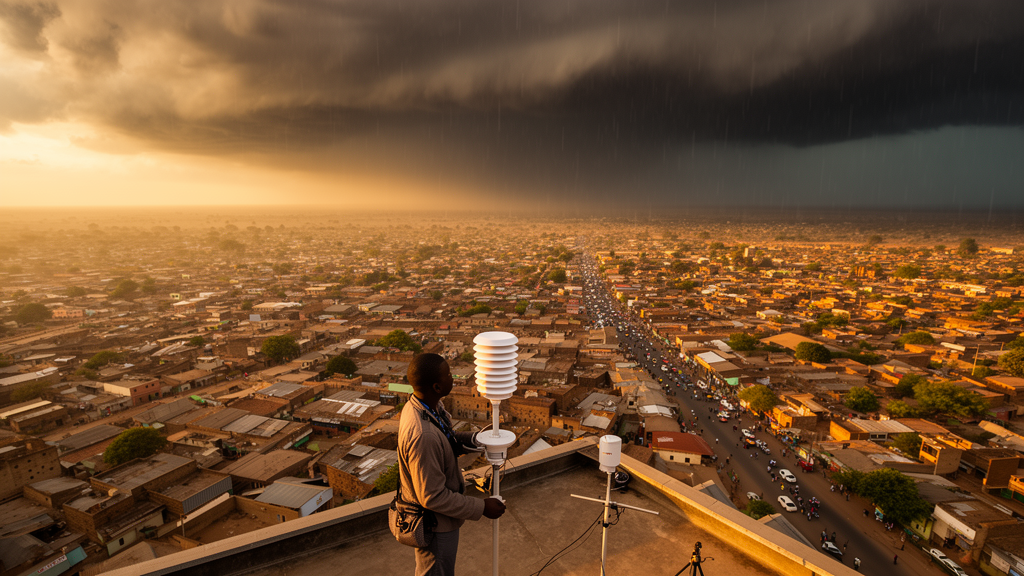
African cities are growing faster than almost anywhere else on Earth, and the climate hazards bearing down on them are intensifying. Yet according to a new review published in the journal Natural Hazards and Earth System Sciences, the scientific literature meant to guide their adaptation is expanding quickly but lopsidedly, leaving many of the continent’s most vulnerable urban populations effectively unstudied. The assessment, led by Koen De Ridder of the Flemish Institute for Technological Research in Belgium together with colleagues in Belgium and Canada, screened 1,832 scientific records published between 2015 and 2025 and distilled them into a final corpus of 272 peer-reviewed articles on climate hazards in African urban settings.
The review, released on 23 October 2026, combined quantitative mapping of the literature with a hazard-by-hazard expert assessment in a semi-systematic design. The team deliberately avoided prescribing hazard-related search terms such as heat, flooding or drought, instead requiring only that variants of the word climate appear alongside urban terms in the title, with geographic coverage spanning Africa and all 54 of its United Nations member countries. That design choice means the corpus captures studies that explicitly connect urban hazards to a climate context, rather than the complete literature on urban hazards, and the authors frame their findings accordingly. Screening was conducted by a single author, with uncertain records conservatively retained to minimise the risk of discarding relevant work, and English-language records across all document types except books were considered.
What emerged is a picture of a knowledge base that is growing fast but unevenly. Annual publication output rose from only a handful of articles in 2015 to more than 40 in 2024, yet the geography of that output is strikingly concentrated. Authors with African affiliations account for 48.1 percent of the sample, but the countries contributing most publications are the United Kingdom and the United States. Among African nations, South Africa, Nigeria, Ethiopia and Ghana lead the record, while Central Africa remains what the authors call a blind spot. Capital cities dominate: of the 112 cities identified, 28 are national capitals, but because capitals tend to appear in many studies, they represent nearly 45 percent of all city references when weighted by frequency.
The size imbalance is perhaps the most consequential finding. Small cities with fewer than 100,000 inhabitants are strongly underrepresented in the literature, while large cities are overrepresented, even though much of Africa’s urban growth is occurring in fast-growing secondary cities. The authors warn that where local evidence is lacking, smaller cities may have to rely on hazard information derived from substantially different urban settings, which may not reflect their actual conditions or adaptation needs. Comparisons across Köppen-Geiger climate zones show that the literature mirrors the distribution of African urban populations reasonably well overall, with the tropical savanna zone dominating both the research record and the population baseline. But cities in highland and Mediterranean climates receive disproportionately high attention, while urban populations in monsoon, tropical forest and hot desert climates are somewhat underrepresented despite their demographic weight. Geographically, coverage clusters near the Gulf of Guinea, along an axis from East to Southern Africa, and in Mediterranean North Africa, with many frequently studied cities located on the coast.
Thematically, flooding and land surface temperature dominate the field, together accounting for nearly half of all publications. Extreme heat and slow-onset events are also well represented, and taken together the two heat-related categories account for well over a hundred articles, confirming heat as one of the most prominently studied urban climate risks. By contrast, sea-level rise, windstorms and urban water stress receive only sparse coverage despite their known relevance to urban vulnerability. The authors caution that this distribution reflects research attention rather than the relative importance of hazards across African cities. Substantive consideration of more than one hazard appears in just 30 papers, or 11 percent of the corpus, and explicit analysis of interactions between hazards, such as the compound flooding studied in Maputo where rainfall coincides with high tides, is considerably rarer still.
Methodologically, Earth Observation has become a central pillar of the field, particularly Landsat imagery used to diagnose land surface temperature and reconstruct historical urban growth. In regions where meteorological stations are sparse, satellite data offer spatially consistent measurements over large areas and multi-decadal periods, and programmes such as the European Space Agency’s Sentinel missions and the Copernicus Climate Change Initiative have greatly expanded data availability. Yet the review finds that the relative share of remote-sensing studies has remained stable at around 40 percent in recent years, and applications remain concentrated on surface temperature diagnostics and land-cover change. The authors conclude that despite major advances in sensors and processing capacity, the broader potential of satellite observation remains underexploited.
High-resolution urban climate modelling is similarly scarce. Global and regional climate models typically operate at resolutions too coarse to capture city-level processes, and many studies interpolate climate data from coarse model output fields, ignoring the local influence of the urban fabric on its own microclimate. The few detailed studies underscore what is being missed: simulations in Lagos reveal substantial spatial differences in heat stress tied to urban morphology, measurements in Kampala and modelling in Johannesburg show strongly varying outdoor heat exposure between neighbourhoods, and work in Niamey coupling the UrbClim model with projected urban expansion found that future heat stress increases both in intensity and spatial extent as the city grows. Keyword co-occurrence analysis also shows that impact-related terms such as mortality, malaria and vector-borne disease sit at the periphery of the research network, suggesting that systematic integration of health, poverty and other vulnerability dimensions remains limited, while artificial intelligence and machine learning techniques are only beginning to enter the field.
The literature is also overwhelmingly retrospective. Urbanisation or urban growth is mentioned in nearly half of the articles, but almost all of these examine past growth; only 10 of the 272 studies look forward to future urban expansion. Roughly 10 percent consider future climate projections, and very few combine future climate scenarios with projected urban growth, demographic change or adaptation pathways. That gap matters because Africa’s urban population is expected to roughly double between 2025 and 2050, from around 700 million to almost 1.5 billion people, and more than half of the continent’s urban residents, some 230 million, already live in informal settlements where homes may overheat, collapse in storms or be swept away in floods. Hazard assessments that account for future climate while disregarding future urban growth may therefore provide an incomplete basis for long-term adaptation decisions.
The hazard-specific reviews reinforce how much urban flood and heat outcomes depend on local conditions rather than climate alone. Studies across the continent show that worsening urban flooding stems from the interaction of changing rainfall, land-use change and drainage performance: expansion into floodplains increases exposure and impervious cover while removing natural surfaces that slowed runoff, and encroachment into drainage rights-of-way concentrates overland flow. Sparse sub-hourly rain gauges, outdated drainage inventories and rare event-based datasets hamper both detection of changing extremes and routine updating of engineering design assumptions. On the coast, sea-level rise acts less as gradual inundation than as a rising baseline that amplifies rainfall, tidal and drainage-related flooding, a risk sharpened in low-lying deltas such as the Nile Delta and by land subsidence linked to urban development. Water stress, meanwhile, emerges from coupled supply and demand pressures, with households turning to private boreholes and vendors in ways that can accelerate groundwater drawdown and impose higher costs on poorer areas. Slow-onset changes accumulate through further pathways, from expanding suitability for malaria and dengue vectors to pressures on food security, soil erosion and landslides, while windstorm research remains confined mainly to individual events and observed impacts, with few cross-city comparisons or projections.
The review’s conclusions point to clear research priorities: broader geographic and climatic representation, greater attention to small and secondary cities and to understudied hazards such as windstorms and water stress, stronger integration of social dimensions like informality, which is mentioned in less than 10 percent of the selected articles, and a decisive shift toward studies that jointly consider future climate and future urban development. Improved high-resolution observations and urban-scale modelling remain essential, with Earth Observation offering a particularly valuable and scalable information source in data-scarce regions. Without such a rebalancing, the authors suggest, the evidence base for adaptation and resilience planning in African cities will continue to be shaped disproportionately by a handful of large, well-studied capitals, while the places growing fastest remain the least understood.
Subject of Research: A semi-systematic review of scientific literature on climate hazards in African cities identifying geographic, thematic and methodological knowledge gaps
Article Title: Review article: Climate hazards in African cities – knowledge gaps and research needs
Article References: De Ridder, K., Alobaidi, M. H., Bonakdari, H., Crols, T., Lanssens, B., Leon-Tavares, J., Naseri, A., Seidou, O., Shaheen, M., Souverijns, N., Uljee, I., & Veldeman, N. (2026). Review article: Climate hazards in African cities – knowledge gaps and research needs. Natural Hazards and Earth System Sciences, 26(10), 5219-5239. https://doi.org/10.5194/nhess-26-5219-2026
Image Credits: AI Generated
DOI: 10.5194/nhess-26-5219-2026
Keywords: African cities, climate hazards, urban flooding, urban heat, land surface temperature, Earth Observation, sea-level rise, water stress, urbanisation, informal settlements, adaptation planning, knowledge gaps
Cite Scienmag News
Sloane Callahan. (October 23, 2026). Africa’s fastest-growing cities remain the least studied for climate hazards. Scienmag. https://scienmag.com/africas-fastest-growing-cities-remain-the-least-studied-for-climate-hazards/
Sloane Callahan. "Africa’s fastest-growing cities remain the least studied for climate hazards." Scienmag, 23 October 2026, https://scienmag.com/africas-fastest-growing-cities-remain-the-least-studied-for-climate-hazards/. Accessed 23 October 2026.
Sloane Callahan. "Africa’s fastest-growing cities remain the least studied for climate hazards." Scienmag. October 23, 2026. https://scienmag.com/africas-fastest-growing-cities-remain-the-least-studied-for-climate-hazards/


