


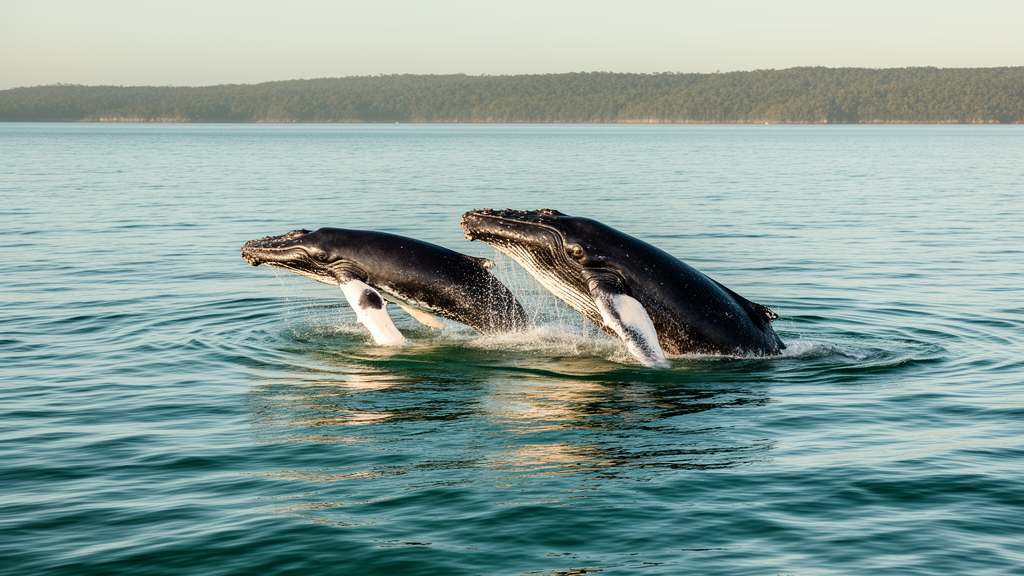
Eastern Australian humpback whales reach nearly their full adult size remarkably quickly, according to a new Griffith University-led study that has produced the first contemporary growth curves for this recovering whale population. The research, published in Marine Mammal Science, found that these whales reach approximately 10.9 metres in length by the age of five and attain 90 per cent of their adult body length by about six to seven years of age. The study was led by Griffith University PhD Candidate Stephanie Stack in collaboration with the Pacific Whale Foundation in Hervey Bay, and its findings suggested that eastern Australian humpback whales grew faster than other humpback whale populations studied elsewhere in the world.
The growth curves were built from an unusually direct kind of evidence. Between 2021 and 2024, researchers collected non-invasive drone photogrammetry measurements from 865 individually identified whales, combining these aerial measurements with long-term photo-identification records to track growth across hundreds of animals ranging from newborn calves to adults more than 40 years old. Because the dataset included calves, juveniles and adults, growth during the important early years of life could be measured directly rather than inferred from older animals. The study found that growth was most rapid during early life before gradually slowing as whales approached their maximum adult size.
“This is faster growth than other humpback whale populations that have been measured,” Ms Stack said. According to the researchers, these are also the first contemporary growth curves developed for eastern Australian humpback whales using measurements from living animals, updating knowledge that has relied heavily on measurements collected during the commercial whaling era in the mid-20th century. “These new growth curves establish a baseline for investigating how whale biology may respond to changing environmental conditions,” she said.
A notable result was that the new measurements aligned with historical estimates of adult body size from Australia, suggesting that humpback whales have maintained similar adult lengths despite decades of population recovery and environmental change. Eastern Australian humpback whales are recognised as one of the world’s most successful whale conservation stories, having recovered dramatically since the end of commercial whaling. The consistency between the contemporary drone-based measurements and the historical size estimates indicates that this rapid growth pattern is not an artefact of outdated data, but a characteristic of the population as it currently exists.
“Understanding how quickly whales grow provides another piece of the puzzle in understanding the biology of this recovering population,” Ms Stack said. “Growth influences many aspects of a whale’s life, including its health, energy requirements and potentially the timing of reproduction.” Because body size is tied to so many biological processes, growth curves of this kind can inform how scientists assess the condition of individuals and the trajectory of the population as a whole.
The new growth curves provide an important benchmark for future monitoring of whale populations and help scientists investigate how humpbacks respond to changing ocean conditions. “As environmental conditions continue to change, having robust biological benchmarks like these will be essential for understanding how whale populations are responding,” Ms Stack said. Her PhD research formed an important contribution to long-term monitoring of Southern Hemisphere humpback whales under the Humpback Whale Sentinel Programme. The study, ‘Contemporary growth curves for individual humpback whales in eastern Australia using aerial photogrammetry’, was published in Marine Mammal Science.
Subject of Research: Contemporary growth curves for eastern Australian humpback whales measured by drone photogrammetry
Article Title: Health & medical environment & energy society & lifestyle technology & space rural & agriculture business & politics more study finds humpback whales growing faster than expected
Article References: Health & medical environment & energy society & lifestyle technology & space rural & agriculture business & politics more study finds humpback whales growing faster than expected. Original publication (Bibliographic details unavailable.)
Image Credits: AI Generated
DOI: Not provided
Keywords: humpback whales, drone photogrammetry, growth curves, marine mammal science, whale conservation, Griffith University, eastern Australia, wildlife monitoring, Health, medical, environment, energy
Cite Scienmag News
Margaret Porter. (October 23, 2026). Eastern Australian Humpback Whales Grow Faster Than Other Measured Populations. Scienmag. https://scienmag.com/eastern-australian-humpback-whales-grow-faster-than-other-measured-populations/
Margaret Porter. "Eastern Australian Humpback Whales Grow Faster Than Other Measured Populations." Scienmag, 23 October 2026, https://scienmag.com/eastern-australian-humpback-whales-grow-faster-than-other-measured-populations/. Accessed 23 October 2026.
Margaret Porter. "Eastern Australian Humpback Whales Grow Faster Than Other Measured Populations." Scienmag. October 23, 2026. https://scienmag.com/eastern-australian-humpback-whales-grow-faster-than-other-measured-populations/


