


In the realm of condensed matter physics, the study of quasi-particles has unravelled a treasure trove of insights into the electronic properties of materials. These quasi-particles, emerging from the interactions of charges within a material, often embody complex behaviors. Among them, excitons—a binding of an electron and a hole—have been extensively investigated, leading to an understanding that they can pair into bi-excitons. However, a groundbreaking paper published in the journal eLight has introduced a revolutionary concept: the quadruplon. This newly identified quasi-particle signifies a considerable advancement in our understanding of multi-body interactions in semiconductor physics.
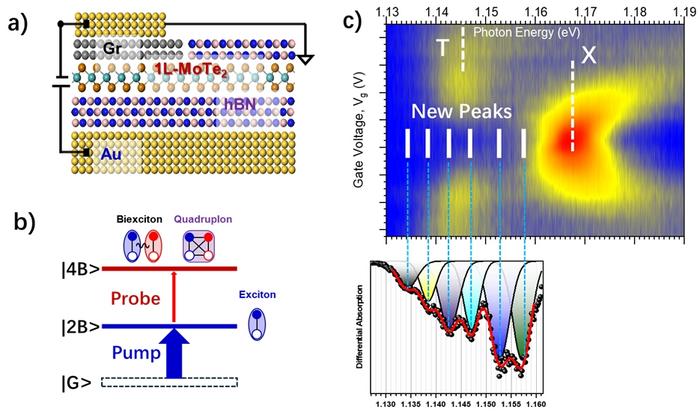
The research, spearheaded by Professor Cun-Zheng Ning from Shenzhen Technology University and Tsinghua University, focuses on molybdenum ditelluride (MoTe2), a two-dimensional material. This study diverges from traditional research in that it explores genuine four-body interactions, which have been largely theoretical until now. Previous studies have mainly corroborated the existence of two-body and three-body entities, such as excitons and trions, but genuine four-body states remained elusive. This investigation provides experimental evidence of the quadruplon by utilizing a thin monolayer of MoTe2 sandwiched between layers of boron nitride.
Within this innovative device setup, researchers meticulously applied varying gate voltages to manipulate the charge distribution in the MoTe2 layer. This approach enabled the team to probe how the spectral properties of the material altered in response to different electrical conditions. The experiment involved a pump-probe technique, where a strong short pulse excited electrons, and a subsequent weak probe pulse examined the resultant absorption characteristics. This technique is particularly insightful as it allows researchers to capture transient phenomena within a material before the quasi-particles decay.
Upon conducting the experiment, the researchers detected an unprecedented six distinct spectral peaks located below the exciton peak. This finding ignited curiosity and skepticism alike, prompting scientists to investigate the origins of these spectral features. Professor Ning was initially concerned about defects in the material, which could mislead the interpretation of the results. However, extensive testing of meticulously prepared samples ruled out defects as a potential culprit, leading to the realization that these peaks were, in fact, indicative of intrinsic properties of the material.
Dr. Jiacheng Tang, the first author of the study and a PhD student in Ning’s group, played a pivotal role in elucidating the nature of these peaks. In a series of systematic experiments, the team varied parameters such as temperature and pump power, confirming the reliable and robust nature of these newly observed spectral features. Initial attempts to explain the peaks through existing theories relying on two-body interactions fell short, necessitating a deeper exploration of Coulomb interactions.
The research team embarked on drafting a theoretical framework that encompassed all possible interactions between two electrons and two holes. Success was met when the new theory accurately represented the key experimental observations. However, opportunities for curiosity remained, as the complexity of four-body interactions raised questions about the specific contributions of each interaction to the spectral features observed. In pursuit of an intuitive understanding, Ning challenged his team to explore an alternative theoretical approach using cluster expansion, a technique that simplifies complex interactions into more manageable components.
Much to their delight, this alternative approach established a correspondence with their initial theoretical framework, effectively reproducing the experimental results. By calculating contributions from specific clusters, the team was able to ascertain which clusters are primarily responsible for the new spectral peaks, thereby elucidating the nature of the quadruplon. The existence of a crucial fourth-order cluster, involving two electrons and two holes, emerged as a standout contributor to the observed phenomena, cementing the classification of this newly identified quasiparticle.
This discovery of the quadruplon represents a progressive leap in condensed matter physics and opens new avenues for further research. The understanding of four-body interactions could enhance our grasp of fundamental physical principles governing different materials. Researchers are eager to extend their investigations into other two-dimensional materials to uncover similar multi-body states. Additionally, the profound quantum nature of the quadruplon’s light emission properties could pave the way for breakthroughs in optoelectronic applications.
As the scientific community processes this innovative finding, it is essential to acknowledge its potential implications in the field of materials science. The quadruplon not only deepens our understanding of complex quasi-particle configurations but also serves as a catalyst for future studies that could unlock new technological advancements. The development of materials exhibiting unique multi-body interactions will undoubtedly have repercussions across various applications, including quantum computing, advanced photonics, and next-generation electronic devices.
In summary, the research led by Professor Cun-Zheng Ning highlights a critical breakthrough in realizing a genuine four-body quasi-particle—the quadruplon—in a semiconductor environment. This discovery not only challenges the existing paradigms in the study of condensed matter but also promises to revolutionize future research directions. With the ability to define and manipulate such sophisticated entities, the quest for novel materials with extraordinary properties is set to continue, heralding a new era of scientific exploration in the field of quantum materials.
Keywords
Quadruplon, Molybdenum Ditelluride, Quasi-particles, Condensed Matter Physics, Two-Dimensional Materials, Excitons, Trions, Multi-body Interactions, Pump-probe Technique, Coulomb Interactions.
Cite Scienmag News
Katie Riggs. (March 27, 2025). Breakthrough: Scientists Uncover Evidence of Novel Four-Body Quasi-Particle in Two-Dimensional Semiconductors. Scienmag. https://scienmag.com/breakthrough-scientists-uncover-evidence-of-novel-four-body-quasi-particle-in-two-dimensional-semiconductors/
Katie Riggs. "Breakthrough: Scientists Uncover Evidence of Novel Four-Body Quasi-Particle in Two-Dimensional Semiconductors." Scienmag, 27 March 2025, https://scienmag.com/breakthrough-scientists-uncover-evidence-of-novel-four-body-quasi-particle-in-two-dimensional-semiconductors/. Accessed 4 September 2026.
Katie Riggs. "Breakthrough: Scientists Uncover Evidence of Novel Four-Body Quasi-Particle in Two-Dimensional Semiconductors." Scienmag. March 27, 2025. https://scienmag.com/breakthrough-scientists-uncover-evidence-of-novel-four-body-quasi-particle-in-two-dimensional-semiconductors/


