


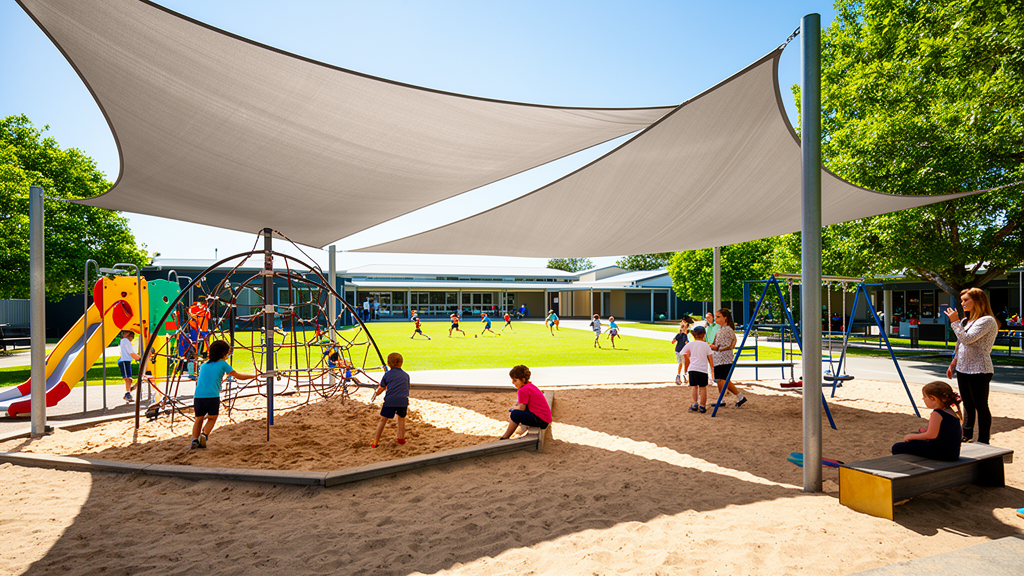
A new design methodology for school playgrounds is showing how children can continue to enjoy their play time while being protected from the harmful effects of the sun. The approach, developed by a team of experts from Lincoln University in New Zealand and Texas A&M University in the United States, offers a structured, evidence-based system that can be used both to design new play areas and to retrofit existing parks exposed to solar radiation. It has already been applied at a school playground in New Zealand, and its authors hope it could serve as a guideline for assessing and improving children’s outdoor recreation areas internationally.
The methodology behind the design is the focus of a research paper published in the peer-reviewed journal Cities and Health. At its core is a concept the researchers call sun protection behaviour design, or SPB-D. Sun protection behaviour is defined as how people protect themselves from ultraviolet radiation, and the SPB-D methodology is aimed at encouraging children to carry out their activities in protected spaces. Rather than relying on children to make conscious, consistent choices about sunscreen use or seeking shade, the approach embeds protection into the physical landscape itself, so that safer behaviour becomes a natural outcome of where and how play spaces are arranged.
The researchers describe three specific design objectives underlying the SPB-D approach. The first is adequate ultraviolet radiation protection. The second is play opportunities for children, so that safety measures do not come at the cost of engaging, functional play environments. The third is microclimatic comfort, meaning the immediate environment is designed to provide adequate temperatures, appropriate wind exposure, and solar protection. Together, these objectives are intended to ensure that children remain protected regardless of where they choose to play within a playground, rather than only in designated shaded corners that may go unused.
Lead author Dr Anupriya Sukumar, from the School of Landscape Architecture at the Lincoln University Faculty of Environment, Society and Design, explains that as the world heats up and playgrounds experience longer periods of sunny conditions, the design of play areas needs to keep pace. She notes that simply increasing the amount of green space is not enough on its own to mitigate solar ultraviolet radiation, which is a major cause of skin cancer and other health conditions. In her view, playground design plays a crucial role in shaping healthy sun protection behaviour among children, and the new design approach is intended to mitigate both immediate and long-term risks of UVR overexposure.
Sukumar draws an analogy with encouraging children to eat healthily. It is difficult to force a child to adopt healthy behaviours, she says, but if the table is already set with the right mix of foods, it becomes more appealing and accessible for them to make healthy choices. The same principle applies to playground design: with the right landscape elements in place, children can be naturally encouraged to seek shade and develop healthy sun protection habits. Co-author Andreas Wesener, also from the School of Landscape Architecture at Lincoln University, adds that through the research the team learned that simply adding shade structures is not enough, and that playgrounds must integrate protection, comfort, and play opportunities to ensure children actually use safer spaces.
The urgency behind the work reflects a significant public health burden. Overexposure to ultraviolet radiation poses a substantial risk, and New Zealand, alongside Australia, has the highest rates of both melanoma and non-melanoma skin cancers globally. Around 100,000 New Zealanders are affected annually. Despite current sun protection measures such as sunscreen policies and shade structures, studies indicate that these approaches often fall short, leaving children inadequately protected. Playground design matters because these spaces account for much of children’s outdoor exposure to ultraviolet radiation, and primary school playgrounds are particularly important, as pupils are vulnerable because of the time they spend outdoors during school hours. Yet shade is often lacking in outdoor activity areas despite research highlighting its importance, and evidence on exactly how these spaces should be designed has been limited.
To apply the SPB-D approach, the researchers worked with an existing school playground in a suburb of Christchurch, New Zealand. The team divided all outdoor spaces used by children into individual activity zones designated for particular activities. These zones were then evaluated against the three SPB-D objectives of ultraviolet protection, play opportunity, and microclimatic comfort. Site elements considered by the researchers included buildings, natural features such as trees, and play equipment such as cricket pitches. The research involved mapping areas of the playground, including those protected against or exposed to wind, those providing shade, and those with high ultraviolet reflectivity, such as areas of open water or stone.
The goal of the evaluation was to identify where and what design improvements were needed in each activity zone, with the final stage being the devising of a design strategy to achieve optimal sun protection over time. As part of the paper, the authors suggest three different design approaches for remedying issues that expose children to excessive ultraviolet radiation. These are to retrofit, to redesign, and to relocate or remove, the last of which refers to zones completely lacking protective factors. In reference to relocate or remove options, the authors say that moving activity zones to a more suitable place or repurposing them for alternative uses may be appropriate. This staged, so-called Three Rs approach allows schools to implement changes over time based on available resources, rather than requiring costly complete overhauls all at once.
Wesener describes the methodology as moving beyond abstract calls for evidence-based practice by offering a pragmatic, transferable approach to enhancing spatial design as a tool for solving real-world health challenges. The team says the new approach will guide best practices and design guidelines to improve playground use, function, and sun protection. While the methodology was developed and tested in New Zealand’s temperate climate, the authors state that it can be adapted for other climate zones and contexts, which underpins their hope that it could act as an international guideline for assessing and improving children’s outdoor recreation areas.
The authors are transparent about the limits of the evidence. The paper does not include data on an increase in children using the redesigned space, or on how much ultraviolet exposure reduction was achieved. The research team acknowledges this as a limitation of the work, suggesting that further testing across diverse settings will strengthen the approach’s validity and reliability. They conclude that while modelling informs this step, field monitoring remains essential for validation. The study is reported as a case study, and its findings should be understood as the demonstration of a design method at a single school site rather than as measured outcomes of reduced exposure or behavioural change. Even so, the researchers argue that the framework gives schools and designers a concrete, staged way to protect children from a radiation hazard that is growing as average temperatures continue to soar internationally and periods of sunny conditions in playgrounds lengthen.
Subject of Research: An evidence-based design methodology for sun-safe school playgrounds in New Zealand
Article Title: Revamped playground design could protect children around the world from dangers of the sun
Article References: Revamped playground design could protect children around the world from dangers of the sun. Original publication (Bibliographic details unavailable.)
Image Credits: AI Generated
DOI: Not provided
Keywords: ultraviolet radiation, playground design, skin cancer, sun protection, New Zealand, children's health, urban design, shade, microclimate, Cities and Health, Christchurch, landscape architecture
Cite Scienmag News
Russell Cooper. (October 23, 2026). Sun-Safe Playground Zoning Tested in New Zealand to Curb Children’s UV Exposure. Scienmag. https://scienmag.com/sun-safe-playground-zoning-tested-in-new-zealand-to-curb-childrens-uv-exposure/
Russell Cooper. "Sun-Safe Playground Zoning Tested in New Zealand to Curb Children’s UV Exposure." Scienmag, 23 October 2026, https://scienmag.com/sun-safe-playground-zoning-tested-in-new-zealand-to-curb-childrens-uv-exposure/. Accessed 23 October 2026.
Russell Cooper. "Sun-Safe Playground Zoning Tested in New Zealand to Curb Children’s UV Exposure." Scienmag. October 23, 2026. https://scienmag.com/sun-safe-playground-zoning-tested-in-new-zealand-to-curb-childrens-uv-exposure/


