


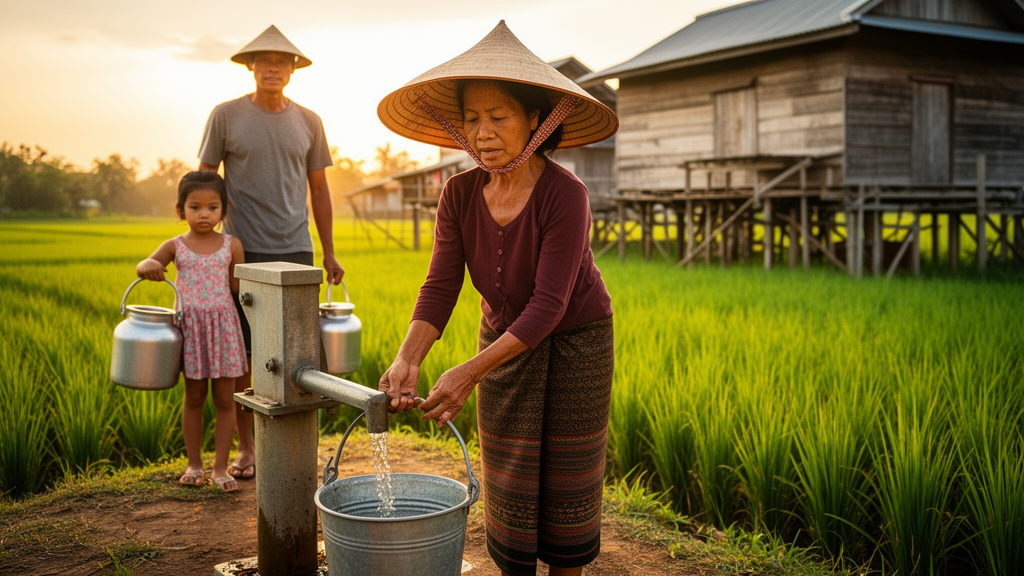
In rural Lao PDR, women and children—particularly daughters—bear the primary responsibility for collecting household water, yet women remain underrepresented in water supply decision-making at every administrative level, from villages to national institutions. That is the central finding of a new study examining the gendered dimensions of water security across the Southeast Asian nation. The research team, led by Souksamone Thongmixay with colleagues including Jo Durham, gathered data through 32 focus group discussions involving 161 community participants, drawing on local authority, men's, women's and elderly groups.
These were complemented by 87 semi-structured interviews with key stakeholders at central, provincial and district levels. Fieldwork spanned eight villages across two provinces and four districts, alongside interviews conducted at the national level, giving the study a multi-scale view of how water access and governance intersect with gender. The findings show a mixed picture.
While the country has made progress in expanding access to safe drinking water and sanitation, many rural communities continue to face water shortages. Climate change and water-related disasters significantly affect water security and livelihoods, with vulnerable communities bearing the heaviest impacts. Because women manage domestic water collection, shortages translate directly into additional labor and time burdens for them and their children.
Despite this critical, hands-on role in securing water for their households, women's voices carry little weight in the forums where water supply decisions are made. The study's design allowed the researchers to compare perspectives across household, community and institutional levels, revealing a consistent pattern: the people who spend the most time securing water have the least influence over how water systems are planned and managed. The authors argue that addressing these gender disparities in both water access and governance is essential to achieving water security in Lao PDR.
Closing the participation gap, they suggest, would align water policy more closely with the people most affected by its failures. Integrating a gender perspective into national water and sanitation programs, the study concludes, is crucial for sustainable development and for building resilience against water-related disasters. The research adds evidence that water security cannot be separated from questions of who collects water—and who decides how it is managed.
Subject of Research: Gendered dimensions of water security access and governance in Lao PDR
Article Title: Access to and control over water security: The perspective of gender equality in Lao PDR
Article References: Thongmixay, S., Sychareun, V., Vongxay, V., Somphet, V., Phimmavong, C., Phommavongsa, P., Khongsab, S., Detchanthachack, K., Thongmala, V., & Durham, J. (2026). Access to and control over water security: The perspective of gender equality in Lao PDR. PLOS Water, 5(10), e0000341. https://doi.org/10.1371/journal.pwat.0000341
Image Credits: AI Generated
DOI: 10.1371/journal.pwat.0000341
Keywords: water security, gender equality, Lao PDR, water governance, sanitation, rural communities, climate change, focus groups, decision-making, disaster resilience, Access, control
Cite Scienmag News
Violet Maxwell. (October 23, 2026). Research report: Access to and control over water security: The perspective of gender equality in Lao PDR. Scienmag. https://scienmag.com/research-report-access-to-and-control-over-water-security-the-perspective-of-gender-equality-in-lao-pdr/
Violet Maxwell. "Research report: Access to and control over water security: The perspective of gender equality in Lao PDR." Scienmag, 23 October 2026, https://scienmag.com/research-report-access-to-and-control-over-water-security-the-perspective-of-gender-equality-in-lao-pdr/. Accessed 23 October 2026.
Violet Maxwell. "Research report: Access to and control over water security: The perspective of gender equality in Lao PDR." Scienmag. October 23, 2026. https://scienmag.com/research-report-access-to-and-control-over-water-security-the-perspective-of-gender-equality-in-lao-pdr/


