


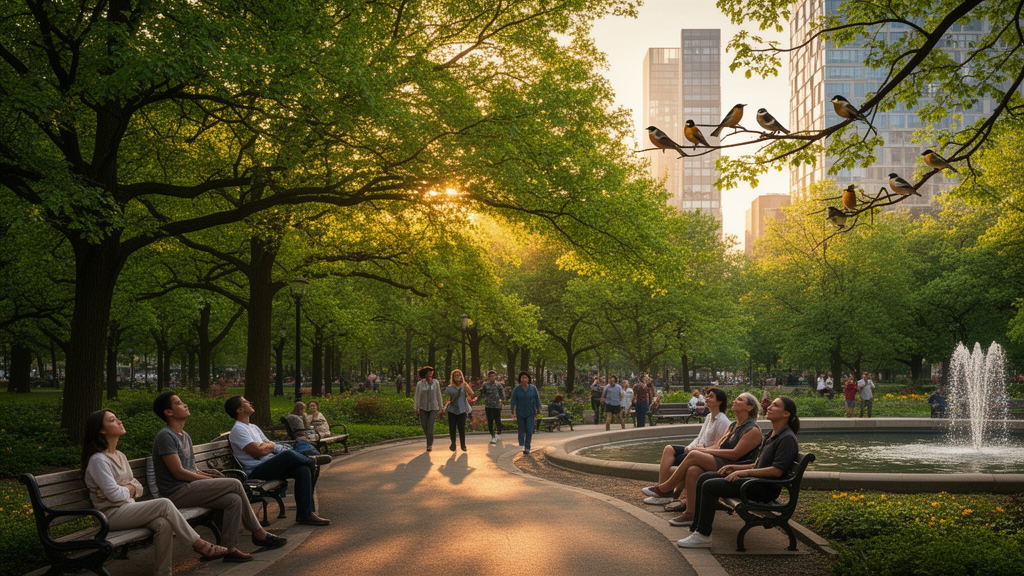
Urban forests are often praised for what can be seen: shaded streets, filtered air, greener skylines. But an editorial published in Frontiers in Forests and Global Change argues that the value of urban green space extends well beyond the visual. Written by Xin-Chen Hong of Fuzhou University, Yingxue Wen of Minjiang University, Guangyu Wang of the University of British Columbia, Xiaoqing Xu of Tongji University and Jinguang Zhang of Nanjing Forestry University, the editorial introduces a Research Topic collecting original studies on the interplay among ecosystem services, natural resource management and the mental health and well-being of urban populations. Its central claim is that sustainable cities require the simultaneous management of ecological integrity, planning integration and human well-being, and that forests and green spaces cannot be reduced to a single metric of value.
The editorial describes urban forests as vital components of city ecosystems, delivering a broad portfolio of ecosystem services that underpin both natural and social sustainability. These services include air purification, water filtration, mitigation of the urban heat island effect and support for biodiversity. The authors point to growing evidence in favour of folding ecosystem-service valuation into urban and regional planning, noting that green infrastructure can also contribute to disaster risk reduction, transboundary water management and adaptive responses to climate change. Yet while these regulating and supporting services are well studied, the editorial highlights a dimension that planning practice still underestimates: the restorative value of green space, which rests on a richer, multi-sensory experience.
That sensory dimension is largely acoustic. The editorial stresses that the soundscape of a green space matters as much as its appearance. A synthesis of urban blue-green space and tranquillity shows how vegetation and water jointly reduce unwanted noise while integrating multi-sensory perception, and a separate study demonstrates that the spatial configuration of park boundaries and their plant structure measurably influence the soundscape experienced inside. How a park is shaped and planted therefore determines not only what visitors see but what they hear, and both channels feed into the restorative experience planners hope to deliver.
At the same time, urbanisation is introducing novel auditory and luminous stressors. The editorial cites evidence that noise exposure is associated with urbanisation and economic activity, exemplified by the link between urban noise and nighttime light observed across major Chinese cities. A newer challenge comes from above: the rise of low-altitude drones introduces overhead noise whose psychoacoustic effects can even be amplified by tall tree canopies. These findings complicate the assumption that vegetation always buffers city dwellers from environmental stress and reinforce the editorial’s call for adaptive design that anticipates emerging stressors rather than merely responding to established ones.
The Research Topic spans scales from global to microscopic. At the macro level, one assessment applies wavelet decomposition and stationarity tests to track forest ecological balance across nine major timber-producing countries, providing a longitudinal account of environmental sustainability. At a finer ecosystem scale, a study of the Poyang Lake wetland quantifies how agricultural activities and environmental factors jointly regulate soil inorganic carbon, clarifying the carbon-service dynamics of forest-adjacent systems under human disturbance. Together, these contributions show how ecological monitoring and biogeochemical analysis can inform the natural side of the sustainability equation.
Several contributions examine the psychological and physiological value of exposure to vegetation. One synthesis articulates the cognitive-neural mechanisms underlying restorative environments and their benefits for mental health. Drawing on urban parks in Kunming, a coupled structural equation modelling, interpretive structural modelling and DEMATEL analysis shows that ecological and colour features directly drive restorative health benefits, while spatial features operate chiefly through perceived restorative experience. The distinction matters for design: what a park contains may matter differently from how it is arranged, and the pathways through which features translate into well-being are not identical.
Indoor nature contact also receives attention. On university campuses, an analysis of perceived green window views reveals distinct psychological pathways, running through perceived stress and positive and negative affect, that relate indoor nature views to freshmen’s adaptation and well-being. This suggests that the benefits of urban greenery are not confined to park visits but extend into buildings, where a view of vegetation can shape emotional states during a demanding life transition. Complementing this, a deep-learning framework now predicts perceived plant diversity in urban green spaces from panoramic imagery, offering scalable, evidence-based tools for biodiversity-aware and restorative design.
Behavioural and governance dimensions round out the collection. A structural-equation analysis of urban forest visitation in an Iranian city maps the psychological pathways through which forest contact cultivates pro-environmental behaviour, extending the topic’s behavioural reach beyond cultural boundaries. From a governance perspective, a dual machine-learning analysis across 30 Chinese provinces demonstrates how digital government development raises forestry total factor productivity, offering insights for integrating ecosystem services into planning and resource governance. At the material level, rosemary-derived extract and hydrosol emerge as promising natural wood-preservation agents that improve dimensional stability while reducing reliance on hazardous chemicals, advancing environmentally responsible resource use within the forestry sector itself.
Read together, the editorial concludes, these studies affirm that the contribution of forests and urban green spaces to sustainable cities cannot be captured by any single measure of value. Work on soundscapes and tranquillity shows that restorative value is multidimensional and sensory, and that emerging stressors, from nighttime light to low-altitude drone noise, demand adaptive rather than static design responses. The authors call for future work to extend these frameworks across more diverse geographical and cultural settings, to integrate the visual and acoustic dimensions of green-space experience, and to translate perceptual and ecological evidence into practical planning and governance guidance. The aim, they argue, is to place human health and ecosystem resilience at the heart of sustainable cities, recognising that the green infrastructure of the future must be heard and felt as well as seen.
Subject of Research: Ecosystem services, soundscapes and human well-being in urban forest sustainability
Article Title: Editorial: Enhancing natural and social sustainability in urban forests
Article References: Hong, X.-C., Wen, Y., Wang, Y., Xu, X., Zhang, J., & Wang, G. (2026). Editorial: Enhancing natural and social sustainability in urban forests. Frontiers in Forests and Global Change, 9, Article 1997919. https://doi.org/10.3389/ffgc.2026.1997919
Image Credits: AI Generated
DOI: 10.3389/ffgc.2026.1997919
Keywords: urban forests, ecosystem services, soundscape, mental health, sustainability, green infrastructure, urban planning, biodiversity, noise pollution, restorative environments, drone noise, forest management
Cite Scienmag News
Glenn Wilkins. (October 23, 2026). Urban Forests Deliver More Than Shade: Soundscapes and Well-Being Emerge as Key to Sustainable Cities. Scienmag. https://scienmag.com/urban-forests-deliver-more-than-shade-soundscapes-and-well-being-emerge-as-key-to-sustainable-cities/
Glenn Wilkins. "Urban Forests Deliver More Than Shade: Soundscapes and Well-Being Emerge as Key to Sustainable Cities." Scienmag, 23 October 2026, https://scienmag.com/urban-forests-deliver-more-than-shade-soundscapes-and-well-being-emerge-as-key-to-sustainable-cities/. Accessed 23 October 2026.
Glenn Wilkins. "Urban Forests Deliver More Than Shade: Soundscapes and Well-Being Emerge as Key to Sustainable Cities." Scienmag. October 23, 2026. https://scienmag.com/urban-forests-deliver-more-than-shade-soundscapes-and-well-being-emerge-as-key-to-sustainable-cities/


