

Friday, October 23, 2026
Science
No Result
View All Result
  • Login
  • HOME
  • SCIENCE NEWS
  • CONTACT US
  • HOME
  • SCIENCE NEWS
  • CONTACT US
No Result
View All Result
Scienmag
No Result
View All Result
Home Science News Biology

Pecan Orchard Survey Reveals Patchy Spread of Native American Truffle DNA

October 23, 2026
in Biology
Alan Morgan
By Alan Morgan Scienmag Editorial Profile - Precision Agriculture
Reading Time: 2 mins read
0
Pecan Orchard Survey Reveals Patchy Spread of Native American Truffle DNA

Pecan Orchard Survey Reveals Patchy Spread of Native American Truffle DNA

65
SHARES
587
VIEWS
Share on FacebookShare on Twitter
ADVERTISEMENT

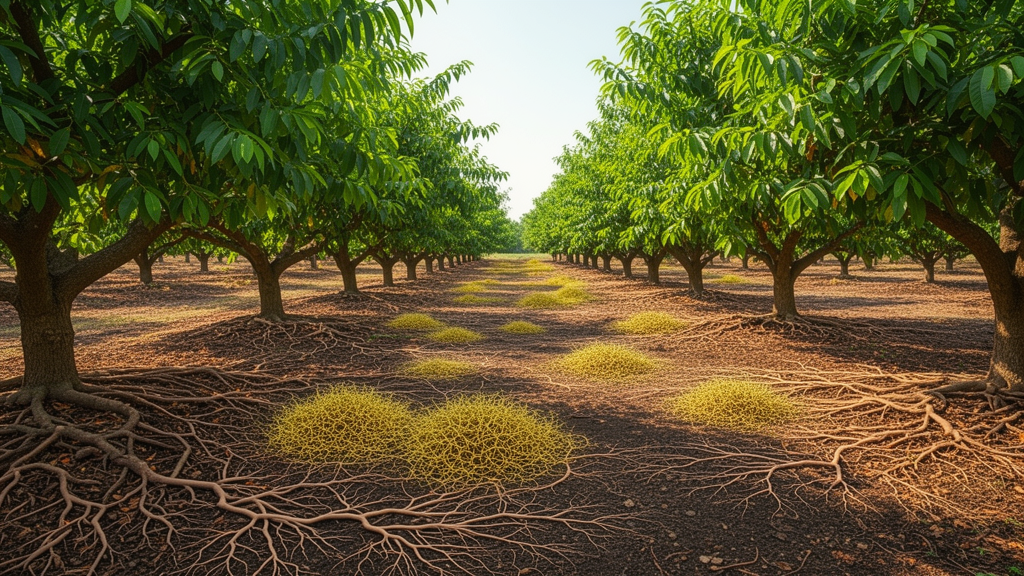
Researchers mapping a cultivated truffle orchard have found strikingly uneven distribution of Tuber lyonii, the pecan truffle, across soil collected beneath trees of different ages. Using species-specific quantitative PCR, the team measured fungal DNA in 60 soil cores drawn from ten trees in each of five orchard sections, including one outlier site, in an effort to understand why truffle abundance varies so dramatically within a single planting. The orchard combined 9-year-old pecan trees in sections A through D with 4-year-old trees in section E, allowing the researchers to test whether orchard age, soil chemistry, and microbial communities were associated with spatial variation in truffle abundance.

Such variability is a persistent obstacle for growers trying to improve productivity of this native North American truffle species. Quantitative PCR results showed the highest T. lyonii DNA abundance in section E, the youngest block, averaging 1.95 × 10⁴ ± 3.91 × 10³ nanograms per gram of soil. The older sections A through D showed lower values, ranging from 3.60 × 10⁻¹ ± 0.18 in section A to 1.14 × 10⁴ ± 4.72 × 10⁴ in section C, with substantial variability among them.

No truffle DNA was detected at the outlier site. To characterize the broader soil environment, the team sequenced ITS and 16S rRNA marker genes, which capture fungal and bacterial communities respectively. Fungal communities across the orchard were dominated by Mortierellomycota, Ascomycota, and Basidiomycota.

Among sequences assigned to the genus Tuber, T. lyonii accounted for 92.2 percent, indicating that this species dominates the detected truffle sequences in the orchard. Bacterial communities were dominated by Proteobacteria (Pseudomonadota), Acidobacteriota, and Actinobacteriota. Beta-diversity analyses, which measure differences in community composition between samples, revealed that microbial communities differed among orchard sections, indicating that each block of trees supports a distinct below-ground assemblage of fungi and bacteria.

Soil physicochemical analyses added a further layer of detail. Soil pH and organic matter content did not differ across the orchard, suggesting these commonly measured factors do not explain the observed patchiness in truffle DNA. The authors interpret these patterns as evidence of spatial heterogeneity in T. lyonii abundance and microbial community composition within the orchard.

Their data suggest that orchard age and localized soil conditions may be associated with the distribution of truffle DNA, though the study design, based on a single orchard and DNA abundance rather than harvested fruit, supports associations rather than proven causal effects. Because the findings come from one cultivated site with a limited number of cores per section, generalizing them to other pecan truffle orchards will require further work. Even so, the study demonstrates how pairing qPCR monitoring of truffle DNA with microbial community profiling and soil chemistry can document the fine-scale spatial structure of a cultivated truffle population.

Subject of Research: Spatial distribution of Tuber lyonii truffle DNA and soil microbial diversity in a cultivated pecan orchard

Article Title: Quantitative Assessment of Tuber lyonii DNA Distribution and Microbial Diversity in a Pecan Orchard

Article References: Udombang, N. S., MensahBonsu, M., Anike, F. N., & Isikhuemhen, O. S. (2026). Quantitative Assessment of Tuber lyonii DNA Distribution and Microbial Diversity in a Pecan Orchard. Microbial Ecology. https://doi.org/10.1007/s00248-026-02898-w

Image Credits: AI Generated

DOI: 10.1007/s00248-026-02898-w

Keywords: Tuber lyonii, pecan truffle, qPCR, soil microbiome, fungal ecology, bacterial communities, cation exchange capacity, orchard age, mycorrhiza, soil chemistry, beta-diversity, Quantitative

Cite Scienmag News

Alan Morgan. (October 23, 2026). Pecan Orchard Survey Reveals Patchy Spread of Native American Truffle DNA. Scienmag. https://scienmag.com/pecan-orchard-survey-reveals-patchy-spread-of-native-american-truffle-dna/

Alan Morgan. "Pecan Orchard Survey Reveals Patchy Spread of Native American Truffle DNA." Scienmag, 23 October 2026, https://scienmag.com/pecan-orchard-survey-reveals-patchy-spread-of-native-american-truffle-dna/. Accessed 23 October 2026.

Alan Morgan. "Pecan Orchard Survey Reveals Patchy Spread of Native American Truffle DNA." Scienmag. October 23, 2026. https://scienmag.com/pecan-orchard-survey-reveals-patchy-spread-of-native-american-truffle-dna/


Tags: bacterial communitiesbeta diversitycation exchange capacityfungal ecologymycorrhizaorchard agepecan truffleqPCRQuantitativesoil chemistrysoil microbiomeTuber lyonii
Share26Tweet16
Previous Post

Vineyard Parable Reread as a Story About Economics, Not Theology

Next Post

Nitrogen Pollution Destabilizes Grassland Productivity Above and Below Ground

Related Posts

Colour-Switching Glow Lets Plants Report Gene Activity Despite Metabolic Noise
Biology

Colour-Switching Glow Lets Plants Report Gene Activity Despite Metabolic Noise

October 23, 2026
Gut microbes and muscle signals may underpin Tuina pain relief, review proposes
Biology

Gut microbes and muscle signals may underpin Tuina pain relief, review proposes

October 23, 2026
Industrial Trash Turns Plastic Waste and Biomass Into Higher-Quality Fuel
Biology

Industrial Trash Turns Plastic Waste and Biomass Into Higher-Quality Fuel

October 23, 2026
Seaweed Polysaccharides Supercharge Plant Growth and Soil Strength in Eroded Red Soil
Biology

Seaweed Polysaccharides Supercharge Plant Growth and Soil Strength in Eroded Red Soil

October 23, 2026
Rat Brainstem Study Traces Acetylcholine Signals That Steady Gaze to a Single Vestibular Source
Biology

Rat Brainstem Study Traces Acetylcholine Signals That Steady Gaze to a Single Vestibular Source

October 23, 2026
Fibroblast Gene Profiling Reveals Inflammatory and Remodeling Signals in PIK3CA Overgrowth Spectrum
Biology

Fibroblast Gene Profiling Reveals Inflammatory and Remodeling Signals in PIK3CA Overgrowth Spectrum

October 23, 2026
Next Post
Nitrogen Pollution Destabilizes Grassland Productivity Above and Below Ground

Nitrogen Pollution Destabilizes Grassland Productivity Above and Below Ground

  • Mothers who receive childcare support from maternal grandparents show more optimized

    Mothers who receive childcare support from maternal grandparents show more parental warmth, finds NTU Singapore study

    27656 shares
    Share 11059 Tweet 6912
  • University of Seville Breaks 120-Year-Old Mystery, Revises a Key Einstein Concept

    1061 shares
    Share 424 Tweet 265
  • Bee body mass, pathogens and local climate influence heat tolerance

    682 shares
    Share 273 Tweet 171
  • Researchers record first-ever images and data of a shark experiencing a boat strike

    546 shares
    Share 218 Tweet 137
  • Groundbreaking Clinical Trial Reveals Lubiprostone Enhances Kidney Function

    531 shares
    Share 212 Tweet 133
Science

Embark on a thrilling journey of discovery with Scienmag.com—your ultimate source for cutting-edge breakthroughs. Immerse yourself in a world where curiosity knows no limits and tomorrow’s possibilities become today’s reality!

RECENT NEWS

  • Pecan Orchard Survey Reveals Patchy Spread of Native American Truffle DNA
  • Vineyard Parable Reread as a Story About Economics, Not Theology
  • Smarter Irrigation Could Cut China’s Crop Water Use by a Quarter While Boosting Yields
  • Most Primary Care Clinicians Miss Out on Medicare’s New $1,292-a-Year Billing Codes

Categories

  • Agriculture
  • Anthropology
  • Archaeology
  • Athmospheric
  • Biology
  • Biotechnology
  • Blog
  • Bussines
  • Cancer
  • Chemistry
  • Climate
  • Earth Science
  • Editorial Policy
  • Marine
  • Mathematics
  • Medicine
  • Pediatry
  • Policy
  • Psychology & Psychiatry
  • Science Education
  • Science News
  • Social Science
  • Space
  • Technology and Engineering

Subscribe to Blog via Email

Enter your email address to subscribe to this blog and receive notifications of new posts by email.

Join 5,151 other subscribers

© 2025 Scienmag - Science Magazine

Welcome Back!

Login to your account below

Forgotten Password?

Retrieve your password

Please enter your username or email address to reset your password.

Log In
No Result
View All Result
  • HOME
  • SCIENCE NEWS
  • CONTACT US

© 2025 Scienmag - Science Magazine

Discover more from Science

Subscribe now to keep reading and get access to the full archive.

Continue reading