


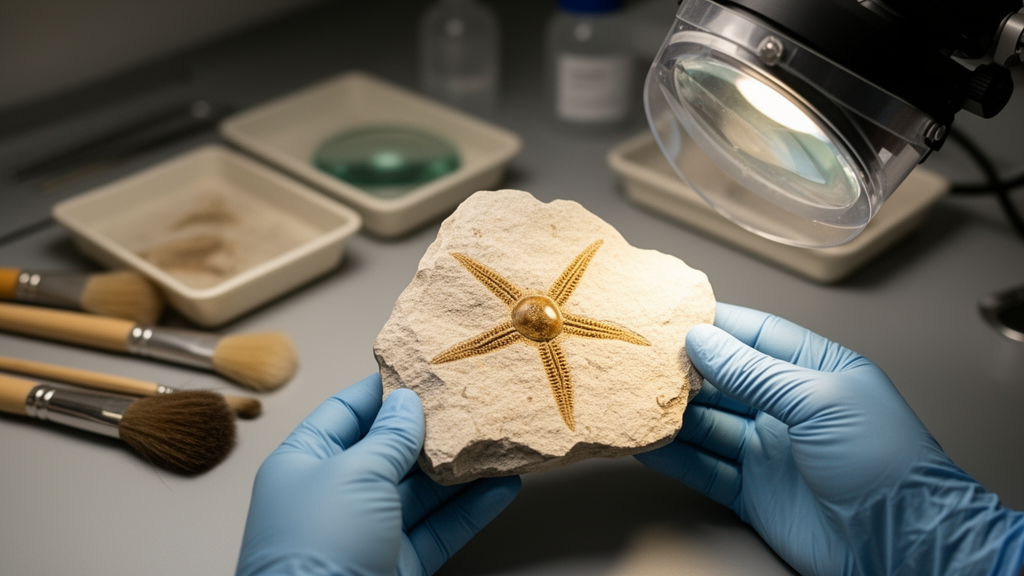
A fossil brittle star so strange that palaeontologists had only ever known it from scattered fragments has finally revealed its full anatomy. Researchers have described an exceptionally preserved, semi-articulated skeleton of Astrosombra rammsteinensis, an enigmatic echinoderm from the upper lower Maastrichtian stage of the Late Cretaceous. The new specimen, recovered from the famous Upper Cretaceous chalk of the Isle of Rügen in north-east Germany, has allowed the team to correct earlier misinterpretations, relocate the genus within the brittle star family tree and paint a vivid picture of its probable lifestyle: not a snowshoe-wearing drifter across soft ooze, but a limpet-like clinger to hard islands of shell and skeleton on the Cretaceous seafloor.
Brittle stars, or ophiuroids, are the most species-rich of the five living classes of echinoderms, the group that also includes sea stars, sea urchins and sea cucumbers. Their basic body plan appears deceptively simple at first glance: a round central disc fringed by five slender, snakelike arms. Yet beneath this apparent monotony lies a surprising breadth of morphological variation, spanning gross features such as arm number and spine length down to microscopic details like the arrangement of tiny mouth papillae. This variability has repeatedly tripped up classifiers, because some variants diverge so radically from the standard blueprint that their peculiarities were long mistaken for defining traits of entire higher-level groups.
The family Hemieuryalidae offers a cautionary example. It was traditionally diagnosed by a combination of characters that seemed unique among non-euryalid brittle stars, notably small body size, reduced disc plating and coiling arms. Molecular and morphological phylogenies have since shown that many supposedly hemieuryalid genera actually belong to other families, meaning those seemingly diagnostic features were independently acquired adaptations to an epizoic lifestyle, clinging to other animals. On a broader level, revised ophiuroid classification has demonstrated that the group is unusually prone to convergent evolution, the process by which unrelated lineages independently evolve similar forms. Astrosombra now stands as one of the most striking examples of this phenomenon in the fossil record of brittle stars.
When Astrosombra was first named in 2019, it rested entirely on dissociated lateral arm plates, isolated skeletal elements that displayed an odd mixture of traits. Their spine articulations resembled those of the family Amphilimnidae, while their wildly modified plate outline echoed Astrophiura, a modern genus so aberrant that its flattened, disk-like body with widely expanded arm bases sets it apart from nearly all other brittle stars. The original authors concluded that Astrosombra was an extinct amphilimnid whose lateral arm plates had expanded dramatically, pushing the animal’s effective body surface well beyond the edge of its disc, much as in Astrophiura. What the fragmented evidence could not settle was the full anatomy, and with it, the genus’s true identity.
The breakthrough came by chance. A collector working the active Promoisel chalk pit, operated by Vereinigte Kreidewerke Dammann GmbH on Rügen’s Jasmund Peninsula, split a block of chalk and broke through the skeleton, producing a ventral and a dorsal half that were promptly reassembled with water-soluble wood glue. The disc and arms were then meticulously freed from the matrix with brush and needle to expose the dorsal surface, while the extremely fragile underside was left unprepared and instead revealed non-destructively through micro-computed tomography. The specimen, now catalogued as MNHNL OPH322 and housed in the National Museum of Natural History Luxembourg, preserves a round disc thirteen millimetres across and, on one arm, at least twenty segments from the base outwards.
The imaging work was exhaustive. MicroCT scanning at the Natural History Museum of Vienna, using a YXLON FF35 CT scanner with an isotropic voxel size of 35.6 micrometres, rendered the delicate ventral skeleton in three dimensions, including oral shields, adoral shields, wing-like oral plates, contiguously arranged ventral arm plates and the tentacle openings through which tube feet protrude. Dorsal details were captured photographically with a Keyence VHX-6000, and individual ossicles pried from the rock were cleaned in an ultrasonic bath, gold-coated and examined under a scanning electron microscope. Together these techniques delivered a level of anatomical detail that isolated plates could never provide, right down to the microscopic stereom, the porous meshwork that makes up echinoderm skeletons.
The new specimen confirmed some earlier inferences and overturned others. The extremely widened arms and the imbricating arrangement of the lateral arm plates, in which each plate leans toward the disc and is overlapped by its successor, were exactly as predicted. But the original plates had been misorientated, with dorsal and ventral sides swapped. Moreover, the structure formerly interpreted as a very wide tentacle notch is now reinterpreted as an articular surface where the preceding lateral arm plate attached. The scans also revealed a previously unknown radial furrow along the inner midline of each lateral arm plate, potentially allowing the tube feet to extend outward to the side, and suggested that the tube feet themselves were relatively large.
These details forced a taxonomic reassessment. The specimen lacks the long disc spines characteristic of Amphilimnidae, the family to which Astrosombra had originally been assigned. Instead, its oral plates are taller than long with an adradial flange expanded into a wing-like structure, and its disc is naked, bearing no trace of spines or granules, only a ring of very large, thick, scalene-triangular radial shields studded with tubercles. Together these features point firmly to the Ophiopsilidae, a family that until now contained only a single living genus. Astrosombra rammsteinensis has therefore been transferred to the Ophiopsilidae, adding a second, extinct genus to a lineage that seemed almost lonely in its modern sparsity.
The palaeoecological implications are equally compelling. The Rügen chalk accumulated in a warm-temperate, open-marine shelf setting at roughly 40 degrees palaeolatitude, in water depths of about 150 to 250 metres, possibly up to 300, below storm wave base within the lower photic zone. The seafloor was soft calcareous ooze generated mainly by coccolithophores, with sedimentation rates of around 35 millimetres per thousand years. Organisms living on such substrates often evolve so-called snowshoe adaptations that reduce the risk of sinking, and at first glance the enormous, flattened arms of Astrosombra look like exactly that. But the authors argue against this interpretation: modern muddy seafloors are commonly inhabited by ophiuroids with no such adaptations, and the same holds for the bulk of the Chalk’s brittle star fauna.
A more persuasive parallel comes from living species of Astrophiura, whose extremely widened arms, flat bodies, large tube feet and fringes of flattened spines enable efficient adhesion to hard substrates. Submersible observations have caught these animals clinging to rocks, shells and even discarded beer bottles, a decidedly limpet-like existence. Astrosombra shares the widened arms, flattened profile, large tentacle pores and large, flat, feather-like marginal spines that suit such a life. The authors therefore propose a similar habit for the fossil, anchored to the patchy secondary hardgrounds, islands of hard substrate formed by bryozoans, molluscs and giant inoceramid shells, that dotted the ooze-dominated Chalk Sea floor. The scarcity of these hard-substrate islands may explain why Astrosombra remains so rare compared with other elements of the Rügen ophiuroid fauna, which number several dozen species. What began as a handful of enigmatic plates has become a fully fleshed portrait of one of the Cretaceous seas’ most improbable animals, a brittle star that abandoned the open ooze to grip the hard places of its world.
Subject of Research: Taxonomic and palaeoecological re-assessment of the aberrant Cretaceous brittle star genus Astrosombra based on an exceptionally preserved specimen from Rügen, Germany
Article Title: Re-assessment of the aberrant brittle star genus Astrosombra ( Echinodermata , Ophiuroidea ), based on an exceptionally preserved specimen from the Upper Cretaceous of Rügen, north-east Germany
Article References: Thuy, B., Schlüter, N., Jagt, J. W. M., Kroh, A., & Winkler, V. (2026). Re-assessment of the aberrant brittle star genus Astrosombra (Echinodermata, Ophiuroidea), based on an exceptionally preserved specimen from the Upper Cretaceous of Rügen, north-east Germany. Fossil Record, 29(2), 777-785. https://doi.org/10.3897/fr.29.202952
Image Credits: AI Generated
DOI: 10.3897/fr.29.202952
Keywords: brittle stars, ophiuroids, Astrosombra, Cretaceous, Maastrichtian, Rügen chalk, convergent evolution, Ophiopsilidae, palaeontology, microCT, echinoderms, secondary hardgrounds
Cite Scienmag News
Gavin Prescott. (October 23, 2026). Limpet-Like Cretaceous Brittle Star Redrawn from a Stunningly Preserved Fossil. Scienmag. https://scienmag.com/limpet-like-cretaceous-brittle-star-redrawn-from-a-stunningly-preserved-fossil/
Gavin Prescott. "Limpet-Like Cretaceous Brittle Star Redrawn from a Stunningly Preserved Fossil." Scienmag, 23 October 2026, https://scienmag.com/limpet-like-cretaceous-brittle-star-redrawn-from-a-stunningly-preserved-fossil/. Accessed 23 October 2026.
Gavin Prescott. "Limpet-Like Cretaceous Brittle Star Redrawn from a Stunningly Preserved Fossil." Scienmag. October 23, 2026. https://scienmag.com/limpet-like-cretaceous-brittle-star-redrawn-from-a-stunningly-preserved-fossil/


