


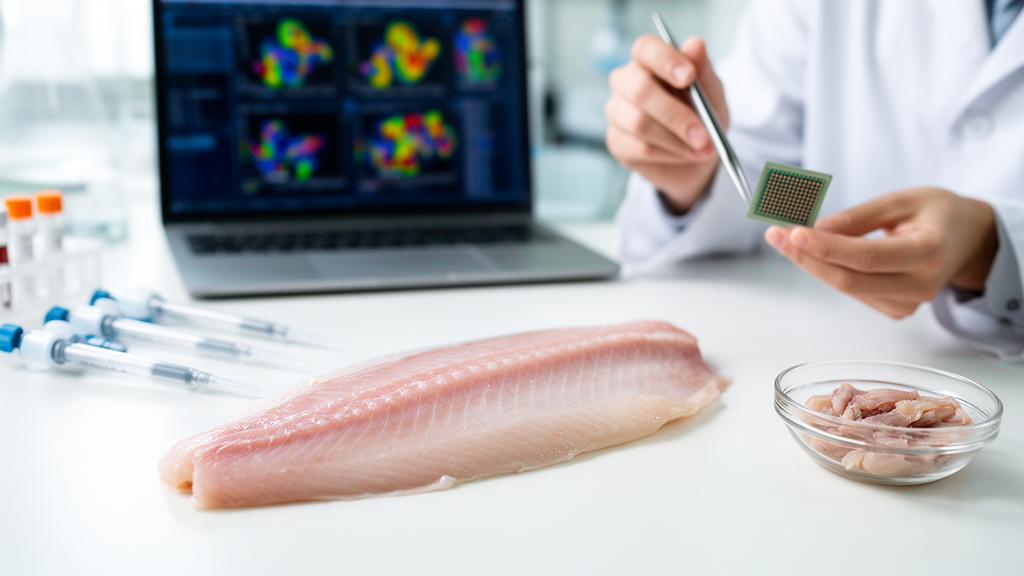
Researchers have built a low-cost genotyping tool that can estimate the nutritional quality of common carp fillets from a fish’s DNA, pairing a custom SNP array with machine learning models to predict traits such as protein content, fat content, moisture, and amino acid composition. The study, conducted on common carp (Cyprinus carpio), one of the world’s most important aquaculture species, addresses a long-standing bottleneck in fish breeding: nutritional quality traits are expensive and destructive to measure, so genetic improvement has lagged far behind traits like growth rate and disease resistance.
The team began by measuring an unusually broad set of fillet characteristics in 387 one-year-old carp drawn from four Chinese strains: Furui carp, Jinbei carp, Songpu mirror carp, and Yuanjiang carp. The fish were reared together in a single pond for a year on a standard commercial diet, ensuring that differences in measured traits reflected genetics as well as environment in a controlled setting. For each individual, the researchers quantified 70 nutritional quality traits in total, including 28 texture indices spanning hardness, springiness, chewiness, cohesiveness, resilience, gumminess, and brittleness across four muscle regions; the contents of moisture, crude protein, and crude fat; intermuscular bone number; 16 fatty acid measures; and 22 amino acid measures.
With whole-genome sequencing data at an average depth of 14× for all 387 fish, the researchers identified roughly 20.95 million high-quality SNPs and ran genome-wide association studies (GWAS) for each of the 70 traits using a mixed linear model that accounted for population structure and kinship. Under a suggestive significance threshold of 1 × 10⁻⁶, the GWAS flagged tens of thousands of candidate variants. Texture traits proved especially complex: chewiness in dorsal muscle alone yielded 30,432 associated SNPs, while cohesiveness was linked to fewer than 2,200 across all tissues, indicating that individual texture components differ greatly in genetic complexity.
One of the most striking findings was spatial heterogeneity in the genetic architecture of fillet texture. Gumminess, springiness, and chewiness had far more associated SNPs in dorsal muscle than in other regions, whereas hardness, brittleness, and resilience showed the strongest associations in gluteal muscle, and cohesiveness in abdominal muscle. Sharing across regions varied widely: only 18 SNPs were common to all four muscle regions for brittleness, while 73.1 percent of resilience-associated SNPs were shared across all regions. The researchers also found extensive overlap between related traits, with 2,768 SNPs simultaneously associated with springiness and resilience and 653 linked to both chewiness and cohesiveness, overlaps that far exceeded random expectations and point to pleiotropic effects or shared biological pathways.
From the GWAS results, the team designed a targeted genotyping array of 20,361 SNPs. Rather than spacing markers uniformly across the genome, the array concentrated on trait-associated variants: 34.09 percent of its SNPs relate to texture properties, 25.38 percent to amino acid profiles, 13.65 percent to fatty acid composition, and smaller fractions to crude protein content, crude fat content, moisture, and intermuscular bone number. The design also included 1,829 strain-discriminating SNPs and roughly 2,000 positive and negative control loci for quality assessment. Most markers fell in regulatory regions, with 42.37 percent in introns and 26.73 percent in intergenic regions, and 708 SNPs sat in coding sequences, of which 328 were missense mutations and seven affected stop codons.
Validation showed the array performs well despite the challenges posed by common carp’s allotetraploid genome. In 26 sequencing libraries from 23 fish, genotyped via probe-based target capture sequencing on the DNBSEQ-T7 platform, 85.88 percent of selected SNPs were successfully captured at 20× sequencing depth. That call rate is lower than figures reported for diploid species such as silver carp and blunt snout bream, likely reflecting the duplicated carp subgenomes, but it substantially exceeds the 74.06 percent call rate of the first common carp SNP array and outperforms rainbow trout arrays. Technical replicates showed genotype concordance between 98.28 and 99.14 percent, and comparison with whole-genome sequencing in 14 individuals produced an average cross-platform concordance of 93.17 percent.
To test whether a trait-biased array could still support population genetics, the researchers genotyped 1,656 carp from two dominant cultured strains, Songpu mirror (953 fish) and HuangHe carp (703 fish), the latter not included in the original design panel. The array cleanly separated the strains: principal component analysis placed the first principal component at 22.61 percent of genetic variation, phylogenetic and ancestry analyses assigned individuals almost completely to their source strains, and the fixation index between strains was 0.18. Songpu mirror carp showed higher nucleotide diversity and heterozygosity than HuangHe carp, a pattern consistent with previous whole-genome sequencing studies and suggesting a larger effective population size or weaker artificial selection in the Songpu line.
The array also helped pinpoint genetic variants behind a real nutritional difference between the strains. When 30 Songpu and 34 HuangHe fish co-cultured in the same pond were compared, only crude protein content differed significantly, being higher in HuangHe carp. A GWAS on strain identity identified 551 strain-differentiated SNPs, and 40 of the 550 crude-protein-associated SNPs on the array fell within this set, a 7.26 percent overlap significantly above the 4.20 percent random expectation from bootstrap resampling. Candidate genes near these variants were enriched in pathways including amino acid metabolism, proteolysis, mitophagy, and autophagy, processes central to protein homeostasis. This cross-strain enrichment, in a strain never used to design the array, suggests the genetic architecture of fillet protein content is at least partly conserved across carp populations.
The predictive power of the array was then benchmarked against eleven genomic selection models, including Random Forest regression, Ridge Regression, LASSO, Bayesian variants, and GBLUP, using four SNP datasets and ten-fold cross-validation on the 387-fish reference cohort. No single model won across the board, but trait-associated SNPs consistently beat random SNPs. With trait-associated markers, average predictive correlations across models reached 0.77 for human essential amino acids, 0.70 for moisture, 0.67 for total polyunsaturated fatty acids, and around 0.39 to 0.40 for crude protein and crude fat. Ridge Regression delivered the single best results for essential amino acids (r = 0.81), crude protein (r = 0.56), and moisture (r = 0.73), while BayesC performed best for total PUFAs (r = 0.73) and crude fat (r = 0.61). Random SNPs, by contrast, yielded correlations below 0.05 for crude fat, protein, and PUFAs under the Random Forest model.
The pattern tracks heritability. Estimated from the full set of 20.95 million SNPs, heritabilities were 0.79 for human essential amino acids, 0.34 for moisture, 0.19 for total PUFAs, and roughly 0.12 for crude fat and crude protein, and predictive accuracy rose in step with these values. The authors note that training population composition, relatedness to validation animals, and phenotyping reliability also shape accuracy, which likely explains the weaker results for fat and protein. Even so, the study demonstrates that concentrating array capacity on trait-associated loci, rather than spreading it evenly across the genome, is a viable and cost-effective strategy for genomic selection of nutritional quality. Because measuring these traits traditionally requires sacrificing the animal, a DNA-based estimate opens the door to selecting superior fish without destroying them. Combined with optimized feeding strategies, the researchers argue, such targeted genotyping and machine learning pipelines could accelerate the breeding of carp strains whose fillets are measurably richer in protein, essential amino acids, and beneficial fatty acids, shifting aquaculture improvement from a yield-first mindset toward the quality traits that increasingly drive consumer choice and market value.
Subject of Research: Targeted SNP genotyping and machine learning for predicting fillet nutritional quality traits in common carp
Article Title: High-throughput targeted genotyping and machine learning modeling to estimate fillet nutritional quality in common carp ( Cyprinus carpio )
Article References: Wang, Q., Zhang, Y., Zhang, D.-K., Zhao, R., Cao, Y.-M., Chen, Y.-J., Wang, K.-K., & Li, J.-T. (2026). High-throughput targeted genotyping and machine learning modeling to estimate fillet nutritional quality in common carp (Cyprinus carpio). Journal of Agriculture and Food Research, Article 103387. https://doi.org/10.1016/j.jafr.2026.103387
Image Credits: AI Generated
DOI: 10.1016/j.jafr.2026.103387
Keywords: common carp, genomic selection, SNP array, GWAS, machine learning, nutritional quality, aquaculture, fillet texture, fatty acids, amino acids, crude protein, targeted genotyping
Cite Scienmag News
Teresa Odom. (October 23, 2026). Targeted SNP Array and Machine Learning Predict Fillet Nutritional Quality in Common Carp. Scienmag. https://scienmag.com/targeted-snp-array-and-machine-learning-predict-fillet-nutritional-quality-in-common-carp/
Teresa Odom. "Targeted SNP Array and Machine Learning Predict Fillet Nutritional Quality in Common Carp." Scienmag, 23 October 2026, https://scienmag.com/targeted-snp-array-and-machine-learning-predict-fillet-nutritional-quality-in-common-carp/. Accessed 23 October 2026.
Teresa Odom. "Targeted SNP Array and Machine Learning Predict Fillet Nutritional Quality in Common Carp." Scienmag. October 23, 2026. https://scienmag.com/targeted-snp-array-and-machine-learning-predict-fillet-nutritional-quality-in-common-carp/


