


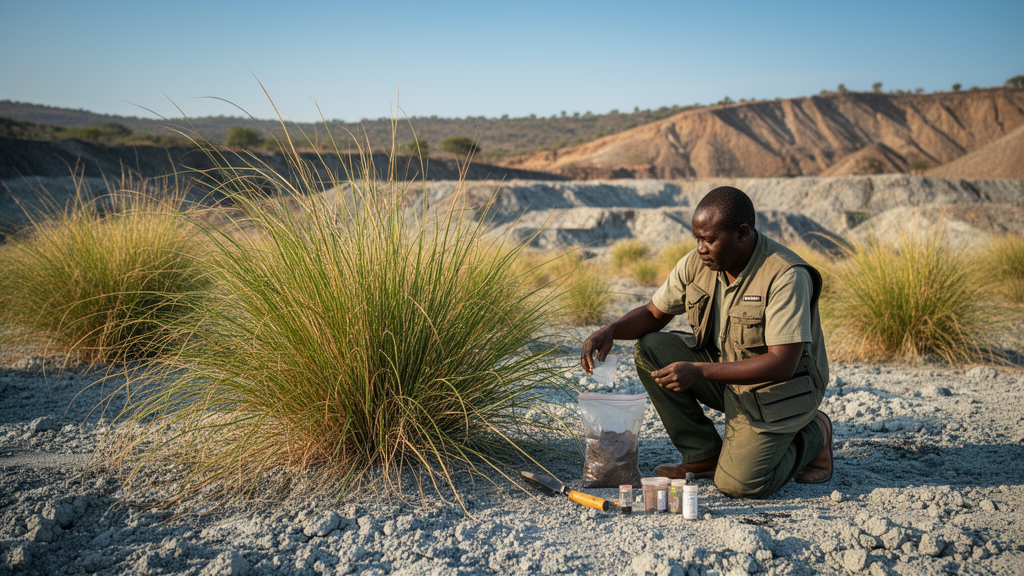
A new review synthesising peer-reviewed research across Sub-Saharan Africa concludes that native grasses could offer a low-cost way to stabilise the region’s vast legacy mine tailings, which rank among the largest and longest-lived sources of heavy-metal pollution worldwide. The review, published in Environmental Geochemistry and Health, followed PRISMA 2020 guidelines and focused on evidence from the Zambian and Katanga Copperbelts, Zimbabwean gold tailings, South African tailings, and selected West and East African sites.
Phytostabilization uses metal-tolerant plants to contain contaminants in place rather than extract them. Vegetation cover limits the wind- and water-driven dispersal of toxic elements, making it an alternative to engineered capping, which is often too expensive for large abandoned tailings facilities. Grasses are widely proposed as pioneer species because of their fibrous roots, rapid canopy closure, stress tolerance, and, in many species, limited translocation of metals from roots to shoots.
Two grasses in particular recur across geographically distinct mining settings in the review: Cynodon dactylon, or buffalo grass, and Chrysopogon zizanioides, better known as vetiver. The regional evidence is interpreted against global literature on these species drawn from arid-to-tropical mining contexts. By contrast, Microchloa altera appears specific to Katanga’s endemic metallophyte flora, highlighting the importance of locally adapted species in the Copperbelt region.
The authors found that establishment success depends strongly on two factors: species selection and substrate amendment. Mycorrhizal fungal associations emerged as a promising but poorly tested enhancement, meaning the role of rhizosphere microbes in improving grass survival and metal containment remains largely unquantified in the region.
The review also identifies a significant gap in the underlying evidence base: the studies it examined rarely report substrate pH, plant survival, or metal bioaccumulation over time. Without multi-year monitoring of these parameters, the long-term stability of grass-based phytostabilization cannot be verified. The authors stress that realising the potential of native grasses will require site-specific amendment trials, rhizosphere microbial studies, and sustained monitoring before the approach can be considered a practical, proven option for the region’s extensive tailings.
Subject of Research: Phytostabilization of heavy metal-contaminated mine tailings using native grasses in Sub-Saharan Africa
Article Title: Phytostabilization potential of native grasses on heavy metal-contaminated mine tailings: a regional review of Sub-Saharan Africa
Article References: Musiige, D., Mundike, J., & Makondo, C. (2026). Phytostabilization potential of native grasses on heavy metal-contaminated mine tailings: a regional review of Sub-Saharan Africa. Environmental Geochemistry and Health, 48(16), Article 654. https://doi.org/10.1007/s10653-026-03556-3
Image Credits: AI Generated
DOI: 10.1007/s10653-026-03556-3
Keywords: phytostabilization, mine tailings, heavy metals, native grasses, Sub-Saharan Africa, Cynodon dactylon, vetiver, metallophytes, mycorrhiza, Copperbelt, soil remediation, potential
Cite Scienmag News
Sloane Callahan. (October 23, 2026). Native Grasses Show Promise for Locking Heavy Metals in African Mine Tailings. Scienmag. https://scienmag.com/native-grasses-show-promise-for-locking-heavy-metals-in-african-mine-tailings/
Sloane Callahan. "Native Grasses Show Promise for Locking Heavy Metals in African Mine Tailings." Scienmag, 23 October 2026, https://scienmag.com/native-grasses-show-promise-for-locking-heavy-metals-in-african-mine-tailings/. Accessed 23 October 2026.
Sloane Callahan. "Native Grasses Show Promise for Locking Heavy Metals in African Mine Tailings." Scienmag. October 23, 2026. https://scienmag.com/native-grasses-show-promise-for-locking-heavy-metals-in-african-mine-tailings/


