


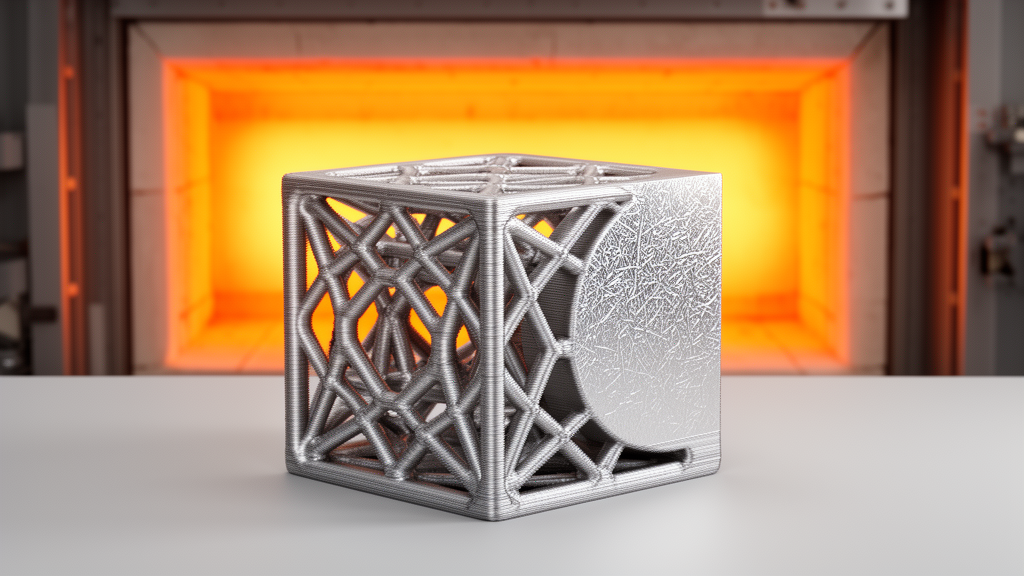
A carefully designed heat treatment can transform the mechanical performance of WE43 magnesium alloy parts built by wire arc directed energy deposition, a 3D-printing process that feeds metal wire through an electric arc to build components layer by layer. In a study published in the Journal of Materials Science, researchers report that a combined solution-and-aging treatment raised the alloy’s ultimate tensile strength from 221.7 megapascals in the as-printed state to 272.7 megapascals, while keeping elongation at 13.9 percent.
The problem the researchers set out to solve concerns the strength–ductility balance of as-deposited WE43. In the as-printed single-pass multi-layer thin-walled samples, continuous fishbone-shaped Mg41Nd5 eutectic phases lined the grain boundaries, and cubic Mg24Y5 particles sat inside the equiaxed grains. This microstructural layout left the material with an elongation of just 9.8 percent.
To address this, the team first applied a T4 solution treatment, holding the alloy at 500 degrees Celsius for one hour. The effect on ductility was striking: elongation jumped from 9.8 to 18.3 percent, while the ultimate tensile strength was well maintained.
The T6 treatment then paired the same solution step with an aging stage at 225 degrees Celsius for 12 hours. During this treatment, fine Mg12(Y,Nd) particles precipitated uniformly throughout the alpha-magnesium matrix, producing numerous dispersed strengthening precipitates.
The numbers show a clear improvement in the strength–ductility combination. Compared with the as-deposited sample’s 221.7 megapascals, the T6-treated alloy reached 272.7 megapascals, with only a slight reduction in elongation to 13.9 percent. The authors describe this as an optimized strength–ductility balance for the alloy in this processing condition.
High-temperature performance was also tested. The team ran tensile tests at 300 degrees Celsius, where the T6-treated alloy achieved an ultimate tensile strength of 167.0 megapascals and elongation of 1.8 percent, compared with 155.1 megapascals and 1.0 percent for the as-deposited alloy. The authors interpret this as indicating improved high-temperature service performance for the heat-treated material.
Microstructural analysis explained the gains. The optimized T6 schedule effectively suppressed grain coarsening during the thermal cycle while simultaneously generating numerous dispersed strengthening precipitates, so the treatment lifted strength without sacrificing the ductility improvements available from solution treatment.
The study focused on single-pass multi-layer thin-walled components, so the findings describe a specific geometry and processing window rather than every possible printed part. Tensile data were reported at room temperature and at 300 degrees Celsius, and the authors frame the treatment as producing an optimized balance for this alloy system rather than a universal solution.
Even so, the results offer a practical post-processing route for wire-arc-deposited magnesium–rare-earth alloys. By showing that a standard heat-treatment sequence can simultaneously lift room-temperature and high-temperature tensile strength while maintaining decent ductility, the study provides what the authors describe as reliable references for engineering exploitation of directed energy deposited Mg–RE alloys.
Subject of Research: Post-heat treatment effects on the microstructure and mechanical properties of wire arc directed energy deposited WE43 magnesium alloy
Article Title: Effect of post-heat treatment on strength–ductility synergy of WE43 magnesium alloy fabricated by wire arc directed energy deposition
Article References: Zhang, H., Shi, R., Wang, L., Cai, B., Wang, K., & Fan, J. (2026). Effect of post-heat treatment on strength–ductility synergy of WE43 magnesium alloy fabricated by wire arc directed energy deposition. Journal of Materials Science. https://doi.org/10.1007/s10853-026-13907-1
Image Credits: AI Generated
DOI: 10.1007/s10853-026-13907-1
Keywords: WE43 magnesium alloy, wire arc directed energy deposition, heat treatment, T6 aging, strength-ductility synergy, precipitation, rare-earth magnesium alloys, tensile properties, high-temperature testing, additive manufacturing, Effect, post-heat
Cite Scienmag News
Denise Maddox. (October 23, 2026). Heat Treatment Boosts Strength and Ductility of 3D-Printed Magnesium Alloy. Scienmag. https://scienmag.com/heat-treatment-boosts-strength-and-ductility-of-3d-printed-magnesium-alloy/
Denise Maddox. "Heat Treatment Boosts Strength and Ductility of 3D-Printed Magnesium Alloy." Scienmag, 23 October 2026, https://scienmag.com/heat-treatment-boosts-strength-and-ductility-of-3d-printed-magnesium-alloy/. Accessed 23 October 2026.
Denise Maddox. "Heat Treatment Boosts Strength and Ductility of 3D-Printed Magnesium Alloy." Scienmag. October 23, 2026. https://scienmag.com/heat-treatment-boosts-strength-and-ductility-of-3d-printed-magnesium-alloy/


