

Friday, October 23, 2026
Science
No Result
View All Result
  • Login
  • HOME
  • SCIENCE NEWS
  • CONTACT US
  • HOME
  • SCIENCE NEWS
  • CONTACT US
No Result
View All Result
Scienmag
No Result
View All Result
Home Science News Technology and Engineering

Plant-based silver-copper oxide nanocomposite senses nitrite and curbs bacteria

October 23, 2026
in Technology and Engineering
Denise Maddox
By Denise Maddox Scienmag Editorial Profile - Mechanical Engineering
Reading Time: 3 mins read
0
Plant-based silver-copper oxide nanocomposite senses nitrite and curbs bacteria

Plant-based silver-copper oxide nanocomposite senses nitrite and curbs bacteria

65
SHARES
587
VIEWS
Share on FacebookShare on Twitter
ADVERTISEMENT

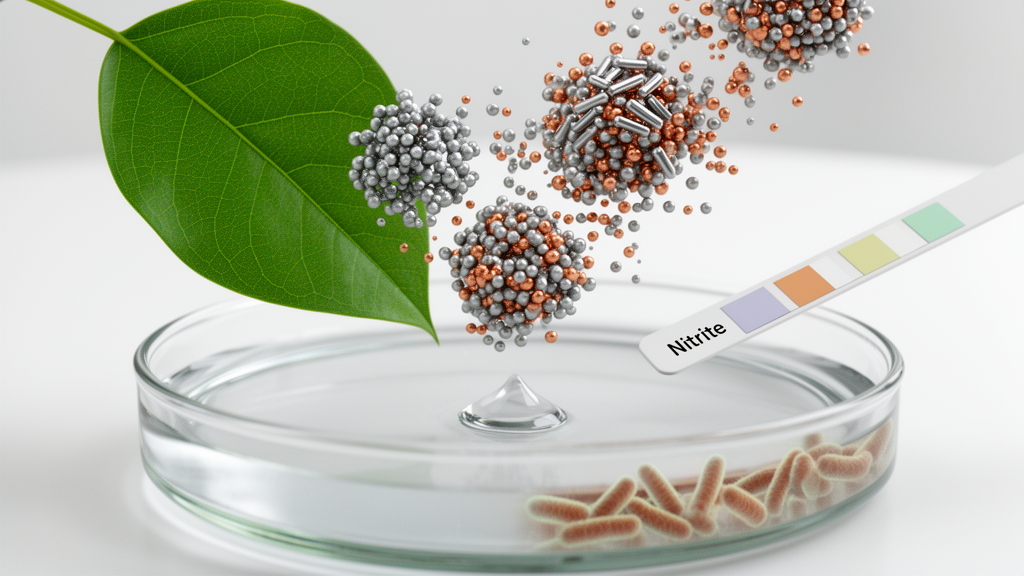
A nanocomposite of silver and copper oxide, synthesised using the plant Caesalpinia bonducella as a green source, has been reported to combine two functions in a single material: electrochemical detection of nitrite at very low concentrations and antibacterial activity against two common bacterial strains. The study, published in the journal Ionics, describes the material’s preparation, its structural characterisation and its measured performance in both roles.

The researchers characterised the Ag/CuO nanocomposite with a suite of analytical techniques, including X-ray diffraction, scanning electron microscopy, atomic force microscopy, Fourier transform infrared spectroscopy and X-ray photoelectron spectroscopy, alongside electrochemical measurements. The antibacterial activity of the nanocomposite was evaluated at different concentrations against Staphylococcus aureus, a Gram-positive bacterium, and Escherichia coli, a Gram-negative one. According to the authors, the bactericidal property of the nanocomposite was comparable to that of a standard, although the available summary does not name the standard agent or report quantitative measures such as minimum inhibitory concentrations. Activity against two bacterial strains in laboratory culture does not by itself establish clinical or environmental effectiveness.

For sensing, the as-synthesised nanoparticles were drop-cast onto a graphite electrode that served as the working electrode in electrochemical experiments. Using cyclic voltammetry, the modified electrode showed a linear response to nitrite across a range from 0.3 nanomolar to 13.5 nanomolar, with a limit of detection of 0.1 nanomolar. Selectivity, often a weak point for electrochemical sensors, held up in these tests: the electrocatalytic activity of the Ag/CuO nanocomposite toward nitrite remained unaffected in the presence of common interfering ions.

The sensor response was also analysed under flow conditions using amperometry, a configuration suited to continuous monitoring. To assess performance beyond clean laboratory solutions, the team evaluated the modified electrode in real-sample analysis by detecting nitrite in water samples with the standard addition method. Recoveries fell between 98.3 and 100.2 percent, with an average relative standard deviation of 2.17 percent, indicating accurate and repeatable measurement in the matrices examined. Stability and reproducibility studies carried out with the devised sensor gave what the authors describe as encouraging results, although the summary does not specify the storage period or the number of repeat cycles behind that assessment.

Several caveats temper the findings. The antibacterial evaluation covered only two bacterial strains at laboratory scale, and the sensing validation involved water samples analysed by standard addition rather than a broader survey of environmental matrices. The linear detection window, spanning roughly 0.3 to 13.5 nanomolar, is narrow in absolute terms, so measurements at higher nitrite concentrations would depend on dilution protocols or an extended calibration range. The reported limit of detection was obtained with cyclic voltammetry, and the amperometric flow measurements are described separately without quantified figures in the available summary. Further studies would be needed to establish long-term electrode lifetime, performance in more complex field samples and any practical deployment of the antibacterial function outside the culture dish.

Subject of Research: Green synthesis of an Ag/CuO nanocomposite for electrochemical nitrite sensing and antibacterial activity

Article Title: Sustainable Ag/CuO nanocomposite with dual functionality for nitrite sensing and antibacterial activity

Article References: S, S. L., Saranya, S., T, S. J. T., & Deepa, P. N. (2026). Sustainable Ag/CuO nanocomposite with dual functionality for nitrite sensing and antibacterial activity. Ionics. https://doi.org/10.1007/s11581-026-07600-1

Image Credits: AI Generated

DOI: 10.1007/s11581-026-07600-1

Keywords: Ag/CuO nanocomposite, green synthesis, Caesalpinia bonducella, nitrite sensor, electrochemistry, cyclic voltammetry, amperometry, antibacterial activity, Staphylococcus aureus, Escherichia coli, graphite electrode, water analysis

Cite Scienmag News

Denise Maddox. (October 23, 2026). Plant-based silver-copper oxide nanocomposite senses nitrite and curbs bacteria. Scienmag. https://scienmag.com/plant-based-silver-copper-oxide-nanocomposite-senses-nitrite-and-curbs-bacteria/


Denise Maddox. "Plant-based silver-copper oxide nanocomposite senses nitrite and curbs bacteria." Scienmag, 23 October 2026, https://scienmag.com/plant-based-silver-copper-oxide-nanocomposite-senses-nitrite-and-curbs-bacteria/. Accessed 23 October 2026.

Denise Maddox. "Plant-based silver-copper oxide nanocomposite senses nitrite and curbs bacteria." Scienmag. October 23, 2026. https://scienmag.com/plant-based-silver-copper-oxide-nanocomposite-senses-nitrite-and-curbs-bacteria/

Tags: Ag/CuO nanocompositeamperometryantibacterial activityantibacterial activity of silver-copper oxide nanomaterialsCaesalpinia bonducellacyclic voltammetryelectrochemical nitrite detection using nanocompositeselectrochemistryEscherichia coliGram-positive and Gram-negative bacterial strain inhibitiongraphite electrodegreen synthesisgreen synthesis of nanomaterials from Caesalpinia bonducellananocomposite applications in food safety and water qualitynanomaterial-based biosensors for environmental monitoringnanostructure characterization techniques for nanocompositesnitrite sensorPlant-based nanocomposite sensorsplant-derived nanomaterialssilver-copper oxide antibacterial nanomaterialsStaphylococcus aureuswater analysis
Share26Tweet16
Previous Post

PELICAN Tool Improves Gene Recall in Bacteriophage Genome Annotation

Next Post

Dual-path neural network predicts airfoil lift and drag from shape images and flow conditions

Related Posts

Dual-path neural network predicts airfoil lift and drag from shape images and flow conditions
Technology and Engineering

Dual-path neural network predicts airfoil lift and drag from shape images and flow conditions

October 23, 2026
Green AI framework aims to make smart cities computationally sustainable
Technology and Engineering

Green AI framework aims to make smart cities computationally sustainable

October 23, 2026
Smart sensors that never forget: three learning paradigms collide in activity recognition
Technology and Engineering

Smart sensors that never forget: three learning paradigms collide in activity recognition

October 23, 2026
Hydrogen-Bond Trick Tames Evaporated Perovskites for Efficient Near-Infrared LEDs
Technology and Engineering

Hydrogen-Bond Trick Tames Evaporated Perovskites for Efficient Near-Infrared LEDs

October 23, 2026
Three New Measures Quantify Dynamical Coherence of Quantum Channels
Technology and Engineering

Three New Measures Quantify Dynamical Coherence of Quantum Channels

October 23, 2026
Survey Maps Two Decades of Intelligent Video Surveillance Systems
Technology and Engineering

Survey Maps Two Decades of Intelligent Video Surveillance Systems

October 23, 2026
Next Post
Dual-path neural network predicts airfoil lift and drag from shape images and flow conditions

Dual-path neural network predicts airfoil lift and drag from shape images and flow conditions

  • Mothers who receive childcare support from maternal grandparents show more optimized

    Mothers who receive childcare support from maternal grandparents show more parental warmth, finds NTU Singapore study

    27656 shares
    Share 11059 Tweet 6912
  • University of Seville Breaks 120-Year-Old Mystery, Revises a Key Einstein Concept

    1061 shares
    Share 424 Tweet 265
  • Bee body mass, pathogens and local climate influence heat tolerance

    682 shares
    Share 273 Tweet 171
  • Researchers record first-ever images and data of a shark experiencing a boat strike

    546 shares
    Share 218 Tweet 137
  • Groundbreaking Clinical Trial Reveals Lubiprostone Enhances Kidney Function

    531 shares
    Share 212 Tweet 133
Science

Embark on a thrilling journey of discovery with Scienmag.com—your ultimate source for cutting-edge breakthroughs. Immerse yourself in a world where curiosity knows no limits and tomorrow’s possibilities become today’s reality!

RECENT NEWS

  • Dual-path neural network predicts airfoil lift and drag from shape images and flow conditions
  • Plant-based silver-copper oxide nanocomposite senses nitrite and curbs bacteria
  • PELICAN Tool Improves Gene Recall in Bacteriophage Genome Annotation
  • Rising Anxiety Symptoms Linked to Higher Hip Fracture Risk in China

Categories

  • Agriculture
  • Anthropology
  • Archaeology
  • Athmospheric
  • Biology
  • Biotechnology
  • Blog
  • Bussines
  • Cancer
  • Chemistry
  • Climate
  • Earth Science
  • Editorial Policy
  • Marine
  • Mathematics
  • Medicine
  • Pediatry
  • Policy
  • Psychology & Psychiatry
  • Science Education
  • Science News
  • Social Science
  • Space
  • Technology and Engineering

Subscribe to Blog via Email

Enter your email address to subscribe to this blog and receive notifications of new posts by email.

Join 5,151 other subscribers

© 2025 Scienmag - Science Magazine

Welcome Back!

Login to your account below

Forgotten Password?

Retrieve your password

Please enter your username or email address to reset your password.

Log In
No Result
View All Result
  • HOME
  • SCIENCE NEWS
  • CONTACT US

© 2025 Scienmag - Science Magazine

Discover more from Science

Subscribe now to keep reading and get access to the full archive.

Continue reading