


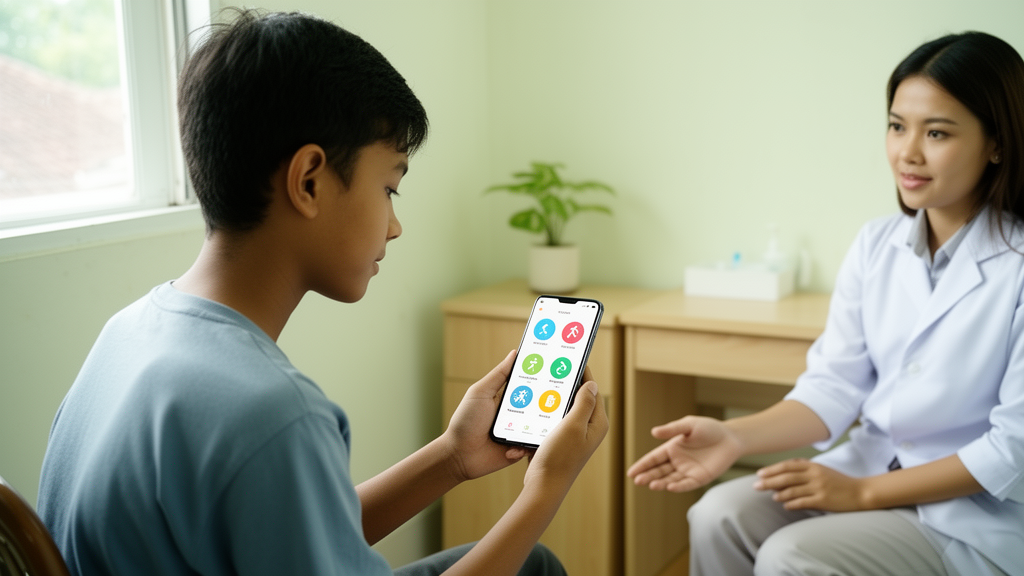
A one-month mentoring program was associated with changes in reported use of the Konco SREGEP adolescent health-promotion application among junior high school students in Malang Regency, while perceived usefulness remained a key factor in the post-test acceptance model. The quantitative study analyzed 92 first-grade students from three Population Alert Schools in East Java, Indonesia, using partial least squares structural equation modeling. In the post-test model, perceived usefulness was positively associated with perceived ease of use, attitude toward using and behavioral intention to use.
Behavioral intention was associated with actual system use, whereas environmental constraints were negatively associated with use. Because the study had no control group and did not objectively record app activity, these results cannot establish that mentoring caused sustained engagement or identify a single “strongest” acceptance factor. Researchers conducted the single-group pre-test–post-test pre-experimental study from February to June 2022.
Participating students had to be in the first grade of junior high school, have access to a cellphone and the internet, have received no prior information about Konco SREGEP, and attend a school that agreed to take part. Students were selected through simple random sampling from three Population Alert Schools, or Sekolah Siaga Kependudukan, in Malang Regency. Ninety-four students were recruited, and 92 completed the study and were included in the final analysis.
The investigators also cited the 10-times rule for partial least squares structural equation modeling, under which the sample should contain at least 10 times the maximum number of structural paths directed toward a single latent construct. They measured the model separately at the pre-test and post-test stages. Konco SREGEP is an Android application developed from 2020 by the Faculty of Public Health at Universitas Airlangga, the East Java provincial government and the Malang Regency government.
The platform was designed around adolescent needs, characteristics and capacities, and it combines education, self-screening, counseling and participation in reporting local problems. Its Sinau Yuk feature provides structured material on 13 subjects: adolescent development, sexuality and gender, adolescent activities, body image and body shaming, nutrition and fertility, teenage pregnancy, stress and coping, life skills, the GenRe program, time management, love management and assertiveness, and preparation for marriage. Each educational module includes pre- and post-tests and video material, and users who complete the material can download a certificate with a barcode.
The Awakmu SEHAT? feature provides self-screening with automatically generated scores, categories and educational information. CurCOLin Aja offers online counseling, including an option to connect with an administrator through WhatsApp. A separate reporting function allows adolescents to submit problems or needs involving friends, family, the surrounding region or school.
The application also includes referral codes, a points system, notifications about the status of reported issues and opportunities to invite other users. The design was therefore intended to extend beyond one-way information delivery by combining education with self-assessment, access to support and adolescent participation. At the time of the research, Malang Regency had 30 Population Alert Schools at the junior high school level, and the local government wanted students to access Konco SREGEP before graduation.
The study instrument assessed adolescent knowledge and skills, curiosity, computer self-efficacy, perceived control, the salience of the behavior, environmental constraints, habit, perceived usefulness, perceived ease of use, attitudes toward using the application, behavioral intention and actual system use. All participants received peer-educator training, installed Konco SREGEP and took part in one month of assistance. Support activities included presentation slides, application-simulation videos, testimonials from young people who had completed the app’s features, weekly engagement activities and daily coordination through a WhatsApp group.
These activities were intended to help students understand the application’s benefits, learn how to access its functions and recognize the importance of adolescent health promotion. The researchers did not collect application logs, login frequency, session duration, cumulative use time or other objective measures of individual activity. Consequently, the intervention cannot show that each student used the app continuously or for a specified number of hours.
Four measurements differed between the pre-test and post-test assessments: knowledge and skills, perceived control, salience of the behavior and actual system use. Attitude and behavioral intention did not change significantly over the same period. The post-test statistical model explained more variation in the principal acceptance outcomes than the pre-test model.
The R-squared value for behavioral intention increased from 0.650 to 0.868, indicating that the modeled factors collectively accounted for 86.8% of its variation after the assistance period. Explanatory power for actual system use rose from 0.204 to 0.398, or 39.8%. These figures describe variation represented by the statistical models; they are not estimates of the causal effect of mentoring.
The actual-use finding also relies on the study’s measured use construct rather than independently verified engagement, and the design did not show whether use continued beyond the assessment. Perceived usefulness was a central post-test pathway in the model, but the study did not establish it as the single strongest determinant of acceptance. Students who regarded the application as useful were more likely to report that it was easy to use, to hold a more favorable attitude toward using it and to state a stronger intention to use it.
Knowledge and skills were also positively associated with perceived usefulness and perceived ease of use, while curiosity was positively associated with perceived usefulness. In the post-test model, knowledge and skills and curiosity together with perceived usefulness accounted for 22.8% of the variation in perceived usefulness, compared with 29.9% at pre-test. Perceived usefulness and knowledge and skills together accounted for 64.1% of the variation in perceived ease of use, while perceived usefulness alone accounted for 82.6% of the variation in attitude toward use.
These are model associations, not proof that changing perceptions would necessarily cause greater engagement. Behavioral and contextual variables contributed distinct relationships to the technology-acceptance pathways. A stronger salience of using Konco SREGEP was associated with behavioral intention, and behavioral intention was positively associated with actual system use.
Environmental constraints were negatively associated with actual use, meaning that reported limitations in the students’ surroundings were linked to lower engagement even when intention was present. At post-test, salience of behavior and perceived usefulness jointly explained 86.8% of the variation in behavioral intention, while environmental constraints and behavioral intention jointly accounted for 39.8% of the variation in actual system use. The model therefore treated acceptance as more than a question of interface convenience: students’ sense of the application’s value, their consideration of the behavior, their stated intentions and their surrounding circumstances all appeared relevant to the statistical explanation of adoption.
The investigators interpreted the results as partial support for integrating the Technology Acceptance Model with the Integrated Behavior Model in an adolescent mobile-health setting. The Technology Acceptance Model focuses on perceived usefulness and perceived ease of use, while the Integrated Behavior Model adds determinants such as intention, the salience of a behavior, perceived control, environmental constraints and habit. The clearest post-test relationships involved perceived usefulness, behavioral intention and actual use, but the study did not find significant changes in attitudes or intentions after one month of assistance.
The authors also suggested that an initially positive attitude toward smartphone-based tools may have left limited room for a measurable shift. This remains an interpretation of the observed results rather than a tested explanation. The findings are geographically specific: they concern first-grade students at three schools in one district, rather than Indonesian adolescents generally, older students or comparable programs elsewhere.
Several limitations constrain what can be concluded. The single-group pre-test–post-test design had no separate control group, so changes cannot be confidently separated from maturation, repeated measurement, school activities or other influences over the study period. The analysis depended on self-reported questionnaire responses, and application use was not tracked objectively.
The sample included only 92 students with cellphone and internet access, which may limit generalization to adolescents with different access patterns, older age groups or other educational settings. Outcomes were assessed after only one month of mentoring, leaving long-term retention unmeasured, while the short geographic and school scope further limits generalizability. Even with those constraints, the study offers a detailed account of how adolescents accepted a locally developed health platform: perceived usefulness was strongly associated with later acceptance measures, behavioral intention was linked to reported use, and practical environmental constraints remained associated with engagement.
The results indicate that usefulness, contextual access and continued support may be important considerations for evaluating digital health tools, while leaving the effectiveness and durability of the mentoring program unresolved.
Subject of Research: Acceptance of the Konco SREGEP adolescent health-promotion app among junior high school students in Malang Regency
Article Title: Acceptance model of adolescent health promotion application (Konco SREGEP) through modifications of technology acceptance model and integrated behavior model
Article References: Muthmainnah, Nurmala, I., Lin, C.-Y., Salim, L. A., Devi, Y. P., Salsabila, A. C., Amalia, A., Bilad, M. R., & Restuti, D. Y. (2026). Acceptance model of adolescent health promotion application (Konco SREGEP) through modifications of technology acceptance model and integrated behavior model. Discover Artificial Intelligence, 6(1), Article 1570. https://doi.org/10.1007/s44163-026-02590-5
Image Credits: AI Generated
DOI: 10.1007/s44163-026-02590-5
Keywords: Konco SREGEP, adolescent health, digital health, technology acceptance, mobile health, PLS-SEM, Malang Regency, student engagement, health promotion apps, Acceptance, model, adolescent
Cite Scienmag News
Denise Maddox. (October 22, 2026). Perceived usefulness linked to acceptance of Malang adolescent health app. Scienmag. https://scienmag.com/perceived-usefulness-linked-to-acceptance-of-malang-adolescent-health-app/
Denise Maddox. "Perceived usefulness linked to acceptance of Malang adolescent health app." Scienmag, 22 October 2026, https://scienmag.com/perceived-usefulness-linked-to-acceptance-of-malang-adolescent-health-app/. Accessed 22 October 2026.
Denise Maddox. "Perceived usefulness linked to acceptance of Malang adolescent health app." Scienmag. October 22, 2026. https://scienmag.com/perceived-usefulness-linked-to-acceptance-of-malang-adolescent-health-app/


