


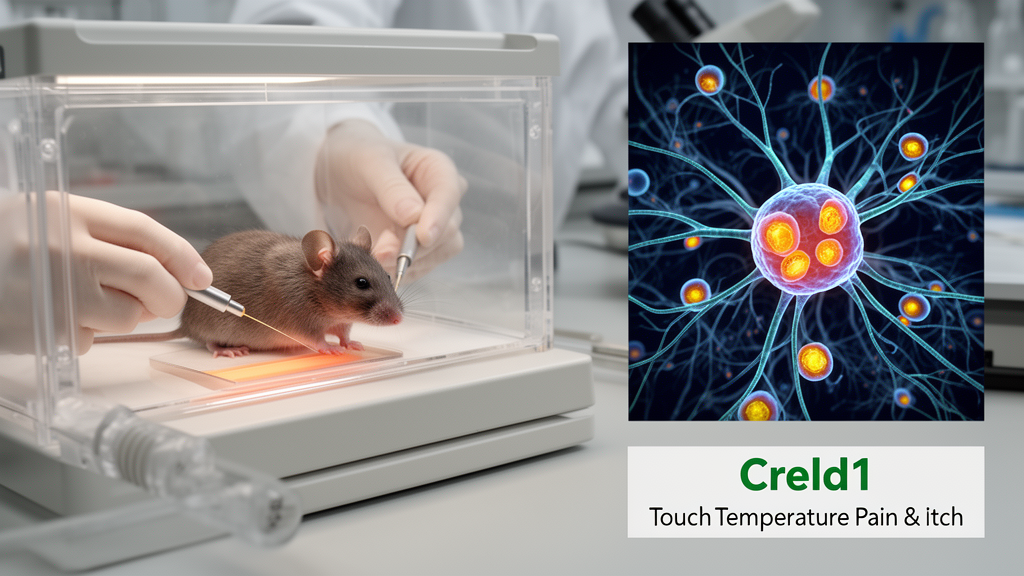
A targeted behavioral-genomics screen in mice has identified Creld1 as a regulator affecting several somatosensory modalities at once. Researchers developed a postnatal CRISPR–Cas9 platform that uses AAV9-mediated delivery of single-guide RNAs to disrupt genes in dorsal root ganglion neurons, which convert physical and chemical stimuli into electrical signals. Tests involving the established somatosensory genes Piezo2, Trpv1 and Scn9a demonstrated the system’s ability to interrogate gene function after birth. A screen of 20 genes then showed that removing Creld1 from dorsal root ganglion neurons impaired behavioral responses to touch, temperature, pain and itch.
Two experimental approaches produced consistent results. In one, single-guide RNA-mediated postnatal knockout reduced Creld1; in the other, tamoxifen-induced Cre-mediated deletion removed the gene specifically in dorsal root ganglion neurons. Both interventions produced deficits across multiple sensory modalities. The experiments support a role for CRELD1 in sensory-neuron function, although they do not establish whether every observed change is independent of broader effects of disrupting the gene during postnatal development. The work was also a screen of a selected set of 20 genes rather than an unbiased genome-wide search, and its results concern mice rather than directly establishing a human sensory disorder or a therapeutic effect.
Cellular and biochemical experiments pointed to an interaction between CRELD1 and voltage-gated sodium channels. CRELD1 acted as an auxiliary regulator of these channels and influenced the excitability of dorsal root ganglion neurons, providing a mechanistic link between a single molecular regulator and the range of behavioral effects observed after gene deletion. The paper reports biochemical and functional characterization of the CRELD1–sodium-channel interaction, including analysis of human CRELD1 in relation to Nav1.7. The researchers reported isoform-dependent regulation of Nav1.7 by human CRELD1, while the principal loss-of-function and overexpression experiments were performed in mice.
The inverse manipulation produced a complementary outcome: overexpressing Creld1 enhanced touch and thermal responses. In combination with the knockout results, this bidirectional observation linked CRELD1 activity with sensory performance under the conditions tested. It does not, by itself, define the full range of conditions in which that relationship operates or determine its long-term consequences. The study therefore presents Creld1 as a cross-modal regulator of somatosensation in the tested mouse model, rather than as the sole or universally dominant controller of sensation.
Beyond its findings about Creld1, the work establishes a method for screening genes in mouse dorsal root ganglion neurons after birth. AAV9 carries the single-guide RNA, while the CRISPR–Cas9 system makes targeted genetic changes in the sensory-neuron population. The authors describe the approach as an efficient postnatal platform for behavioral genomics. Its demonstrated scope is limited but specific: the system was validated with known somatosensory genes, applied to a targeted screen of 20 genes, and used to connect a molecular perturbation in dorsal root ganglion neurons with measurable changes across four behavioral domains. The study’s broader contribution is thus both mechanistic—a proposed regulatory link between CRELD1, voltage-gated sodium channels and neuronal excitability—and methodological, providing a framework for testing postnatal gene function across multiple somatosensory behaviors in mice.
Subject of Research: Creld1 regulation of somatosensory behaviors and neuronal excitability in mice
Article Title: Behavioral genomics identifies Creld1 as a cross-modal regulator of somatosensation
Article References: Jiang, Y., Huang, W., Yao, H., Chen, Y., Bi, C., Ye, T., Wang, S., Yin, H., Cui, Y., & Xiao, B. (2026). Behavioral genomics identifies Creld1 as a cross-modal regulator of somatosensation. Nature Neuroscience. https://doi.org/10.1038/s41593-026-02484-w
Image Credits: AI Generated
DOI: 10.1038/s41593-026-02484-w
Keywords: Creld1, somatosensation, dorsal root ganglion, CRISPR-Cas9, AAV9, behavioral genomics, voltage-gated sodium channels, touch, pain, itch, Behavioral, genomics
Cite Scienmag News
Juliet Wilcox. (October 22, 2026). Mouse study links Creld1 to touch, temperature, pain and itch. Scienmag. https://scienmag.com/mouse-study-links-creld1-to-touch-temperature-pain-and-itch/
Juliet Wilcox. "Mouse study links Creld1 to touch, temperature, pain and itch." Scienmag, 22 October 2026, https://scienmag.com/mouse-study-links-creld1-to-touch-temperature-pain-and-itch/. Accessed 22 October 2026.
Juliet Wilcox. "Mouse study links Creld1 to touch, temperature, pain and itch." Scienmag. October 22, 2026. https://scienmag.com/mouse-study-links-creld1-to-touch-temperature-pain-and-itch/


