

Thursday, October 22, 2026
Science
No Result
View All Result
  • Login
  • HOME
  • SCIENCE NEWS
  • CONTACT US
  • HOME
  • SCIENCE NEWS
  • CONTACT US
No Result
View All Result
Scienmag
No Result
View All Result
Home Science News Science Education

Expert-Derived Framework Maps Virtual Escape Room Design in Health Education

October 22, 2026
in Science Education
Courtney Benton
By Courtney Benton Scienmag Editorial Profile - Science and Technology Policy
Reading Time: 2 mins read
0
Expert-Derived Framework Maps Virtual Escape Room Design in Health Education

Expert-Derived Framework Maps Virtual Escape Room Design in Health Education

65
SHARES
587
VIEWS
Share on FacebookShare on Twitter
ADVERTISEMENT

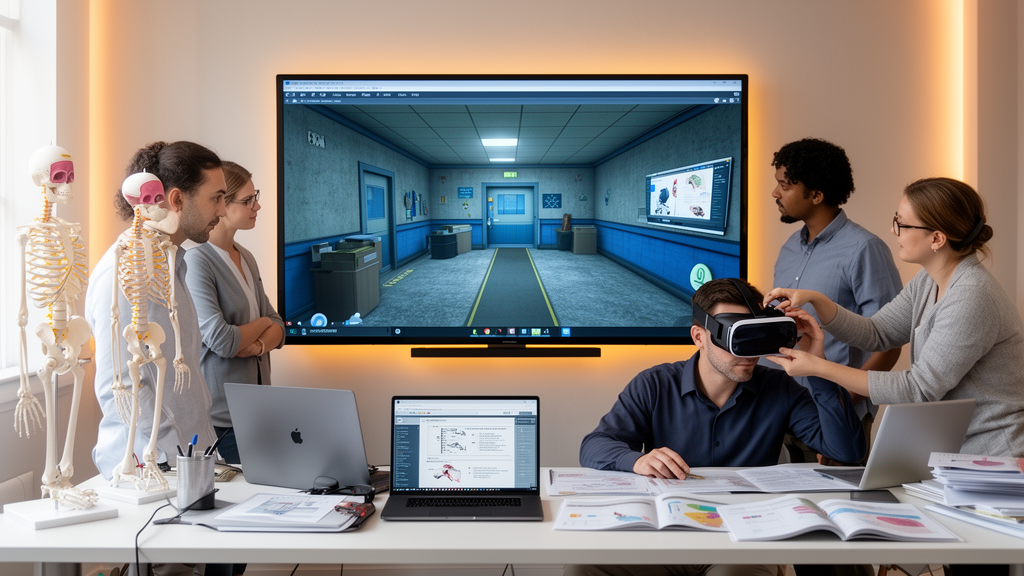
Researchers have developed an integrated, expert-derived framework for designing virtual escape rooms in health sciences education. The sequential exploratory mixed-methods study organized 14 design components within four dimensions: pedagogical, learning experience design, technological and contextual. The result was intended to guide systematic design rather than treat virtual escape rooms as isolated gamification activities. An independent panel of 15 experts subsequently rated the framework’s comprehensiveness and practical applicability favorably, although the researchers said empirical implementation studies and external validations are still needed to assess its feasibility, implementation processes and learning outcomes in authentic educational settings.

The research proceeded in two phases. First, investigators conducted semi-structured interviews with 25 experts in e-learning, educational technology and health sciences education. Participants were selected through purposive and snowball sampling, and conventional qualitative content analysis was used to identify the framework’s core components. A separate panel of 10 experts then structured the extracted components through Interpretive Structural Modeling and DEMATEL. The researchers assessed the content validity and applicability of the resulting framework with another group of 15 experts using a researcher-developed questionnaire. The study therefore combined qualitative interviews, expert-based modeling and questionnaire evaluation; it did not test the framework through a classroom intervention or measure student learning outcomes.

The analysis placed the 14 components into four hierarchical levels. The foundational level consisted of three relatively independent drivers: interpersonal learning objectives, technical infrastructure and contextual adaptation. A mutually dependent core design cluster included individual learning objectives, scenario and puzzle design, group interactions, in-game feedback, motivational mechanisms, digital media and user-interface design. Scalability formed the next level, while assessment and feedback and the educational-game ecosystem were placed at the most dependent level. This structure portrays virtual escape rooms as layered socio-technical instructional systems in which instructional, experiential, technical and contextual elements are interdependent rather than independently selectable features.

Data security and privacy recorded the highest net influence in the expert modeling but had no strong link to any single component, leading the researchers to characterize them as a cross-cutting requirement. The framework also connects learner-facing design elements such as feedback, interaction and assessment with institutional infrastructure, local context and relationships among learners. Its favorability ratings reflect expert judgment rather than observed performance in real educational environments. The authors’ conclusion is therefore bounded: the study provides a theoretically informed, expert-derived structure for designing virtual escape rooms in health sciences education, while the next stage of evidence must come from implementation studies and external validation in authentic settings.

Subject of Research: Expert-derived framework for designing virtual escape rooms in health sciences education

Article Title: Development of an integrated framework for designing virtual escape rooms in health sciences education

Article References: Raoufian, H., Mirmoghtadaie, Z., Zarrabi, H. H., & Toofaninejad, E. (2026). Development of an integrated framework for designing virtual escape rooms in health sciences education. BMC Medical Education. https://doi.org/10.1186/s12909-026-10685-x

Image Credits: AI Generated

DOI: 10.1186/s12909-026-10685-x

Keywords: virtual escape rooms, health sciences education, instructional design, e-learning, educational technology, gamification, mixed-methods study, expert modeling, data privacy, expert validation, Development, integrated

Cite Scienmag News

Courtney Benton. (October 22, 2026). Expert-Derived Framework Maps Virtual Escape Room Design in Health Education. Scienmag. https://scienmag.com/expert-derived-framework-maps-virtual-escape-room-design-in-health-education/


Courtney Benton. "Expert-Derived Framework Maps Virtual Escape Room Design in Health Education." Scienmag, 22 October 2026, https://scienmag.com/expert-derived-framework-maps-virtual-escape-room-design-in-health-education/. Accessed 22 October 2026.

Courtney Benton. "Expert-Derived Framework Maps Virtual Escape Room Design in Health Education." Scienmag. October 22, 2026. https://scienmag.com/expert-derived-framework-maps-virtual-escape-room-design-in-health-education/

Tags: assessment of virtual escape room feasibility and effectivenesscontextual factors in health sciences gamificationData Privacydevelopmente-learningeducational technologyexpert modelingexpert validationexpert-derived educational frameworkgamificationhealth sciences educationinstructional designintegratedinterpretive structural modeling and DEMATEL in instructional designlearning experience design in health educationmixed methods studymixed-methods research in educational technologypedagogical components for virtual escape roomsqualitative content analysis in educational researchsystematic design of virtual gamification activitiestechnological considerations for virtual escape roomsvalidation of educational frameworks by health education expertsvirtual escape room design in health sciences educationvirtual escape rooms
Share26Tweet16
Previous Post

Study identifies correlates of cervical screening uptake in rural Uganda

Next Post

Scoping review maps antimalarial resistance markers across Southeast Asia

Related Posts

Study links online flipped learning to higher nursing knowledge scores
Science Education

Study links online flipped learning to higher nursing knowledge scores

October 22, 2026
Research report: Uniform SCI Publication mandates are associated with unequal clinical training burdens: a quasi-experiment comparing two medical training pathways in China
Science Education

Research report: Uniform SCI Publication mandates are associated with unequal clinical training burdens: a quasi-experiment comparing two medical training pathways in China

October 22, 2026
Cross-sectional survey finds chatbot use widespread among Sudanese medical students
Science Education

Cross-sectional survey finds chatbot use widespread among Sudanese medical students

October 22, 2026
Pre- and post-course study measures student-led high-value care education
Science Education

Pre- and post-course study measures student-led high-value care education

October 22, 2026
Final-Year Medical Students Embrace Possibility of Simulated Patient Death
Science Education

Final-Year Medical Students Embrace Possibility of Simulated Patient Death

October 22, 2026
Modified scale shows acceptable validity among Japanese medical students
Science Education

Modified scale shows acceptable validity among Japanese medical students

October 21, 2026
Next Post
Scoping review maps antimalarial resistance markers across Southeast Asia

Scoping review maps antimalarial resistance markers across Southeast Asia

  • Mothers who receive childcare support from maternal grandparents show more optimized

    Mothers who receive childcare support from maternal grandparents show more parental warmth, finds NTU Singapore study

    27656 shares
    Share 11059 Tweet 6912
  • University of Seville Breaks 120-Year-Old Mystery, Revises a Key Einstein Concept

    1061 shares
    Share 424 Tweet 265
  • Bee body mass, pathogens and local climate influence heat tolerance

    682 shares
    Share 273 Tweet 171
  • Researchers record first-ever images and data of a shark experiencing a boat strike

    546 shares
    Share 218 Tweet 137
  • Groundbreaking Clinical Trial Reveals Lubiprostone Enhances Kidney Function

    531 shares
    Share 212 Tweet 133
Science

Embark on a thrilling journey of discovery with Scienmag.com—your ultimate source for cutting-edge breakthroughs. Immerse yourself in a world where curiosity knows no limits and tomorrow’s possibilities become today’s reality!

RECENT NEWS

  • Scoping review maps antimalarial resistance markers across Southeast Asia
  • Expert-Derived Framework Maps Virtual Escape Room Design in Health Education
  • Study identifies correlates of cervical screening uptake in rural Uganda
  • Brief Instruction Reduced Immediate Self-Reported Lesbian and Gay Prejudice in Trial

Categories

  • Agriculture
  • Anthropology
  • Archaeology
  • Athmospheric
  • Biology
  • Biotechnology
  • Blog
  • Bussines
  • Cancer
  • Chemistry
  • Climate
  • Earth Science
  • Editorial Policy
  • Marine
  • Mathematics
  • Medicine
  • Pediatry
  • Policy
  • Psychology & Psychiatry
  • Science Education
  • Science News
  • Social Science
  • Space
  • Technology and Engineering

Subscribe to Blog via Email

Enter your email address to subscribe to this blog and receive notifications of new posts by email.

Join 5,151 other subscribers

© 2025 Scienmag - Science Magazine

Welcome Back!

Login to your account below

Forgotten Password?

Retrieve your password

Please enter your username or email address to reset your password.

Log In
No Result
View All Result
  • HOME
  • SCIENCE NEWS
  • CONTACT US

© 2025 Scienmag - Science Magazine

Discover more from Science

Subscribe now to keep reading and get access to the full archive.

Continue reading