

Thursday, October 22, 2026
Science
No Result
View All Result
  • Login
  • HOME
  • SCIENCE NEWS
  • CONTACT US
  • HOME
  • SCIENCE NEWS
  • CONTACT US
No Result
View All Result
Scienmag
No Result
View All Result
Home Science News Earth Science

Research report: Circular economy transition through physics informed digital twins for sustainable wastewater management in textile industry

October 22, 2026
in Earth Science
Katie Riggs
By Katie Riggs Scienmag Editorial Profile - Quantum Physics
Reading Time: 2 mins read
0
Research report: Circular economy transition through physics informed digital twins for sustainable wastewater management in textile industry

Research report: Circular economy transition through physics informed digital twins for sustainable wastewater management in textile industry

65
SHARES
587
VIEWS
Share on FacebookShare on Twitter
ADVERTISEMENT

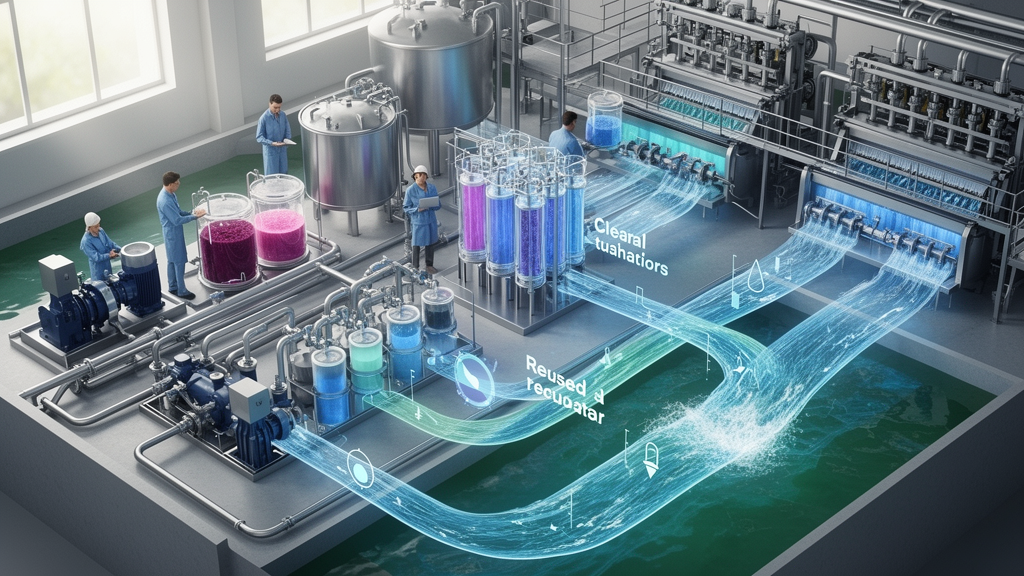
A proposed digital-twin framework combines mechanistic process modeling with Physics-Informed Neural Networks to estimate key biological and hydraulic parameters from limited wastewater measurements. Designed for textile-industry treatment systems with sparse data, the framework uses inverse learning with biochemical oxygen demand (BOD) and chemical oxygen demand (COD) observations to support real-time monitoring, parameter inference and virtual experimentation while maintaining physical consistency and avoiding oscillatory behavior. The study addresses a data problem faced by textile wastewater facilities, particularly in developing regions where monitoring infrastructure and real-time data acquisition are limited.

Conventional treatment models may depend on extensive data or inadequately represent the coupling between biochemical reactions and hydraulic dynamics. The proposed approach instead links a mechanistic representation of treatment processes to a neural network that learns system behavior from sparse observations, allowing physical process information to constrain the machine-learning component. At the center of the framework is an inverse learning strategy.

Rather than requiring a large collection of measurements, it estimates kinetic and hydraulic parameters directly from limited BOD and COD data. These inferred parameters are incorporated into the combined model for monitoring, parameter estimation and virtual tests of how the represented system may respond to changes. The research presents this as a unified modeling method, rather than as a reported full-scale plant intervention or a quantified change in pollutant discharge.

Sensitivity analysis identified aeration intensity, biological reaction kinetics, influent flow rate and biomass yield as the dominant drivers of pollutant-removal efficiency within the model. These results indicate which variables are especially influential in the simulated treatment process and provide a basis for targeted monitoring and operational analysis. The authors position the framework as a tool for circular-economy-oriented industrial water management.

By improving the use of limited data, the model can support adaptive decisions, more efficient treatment and virtual experimentation before operational changes are made. The proposed digital twin is also described as transferable to industrial wastewater systems operating under similar data constraints, although the supplied evidence does not establish performance across different plants or demonstrate field-scale energy savings, pollutant-load reductions or implementation costs. Its main reported advance is therefore a stable, data-efficient modeling structure that combines process physics with neural learning, identifies influential treatment variables and allows monitoring, inference and scenario analysis within one framework.

Subject of Research: Physics-informed digital twins for data-efficient modeling of textile wastewater treatment

Article Title: Circular economy transition through physics informed digital twins for sustainable wastewater management in textile industry

Article References: Rafiq, M., Haider, G., Arshad, M., & Maqbool, S. (2026). Circular economy transition through physics informed digital twins for sustainable wastewater management in textile industry. Discover Sustainability. https://doi.org/10.1007/s43621-026-04232-3

Image Credits: AI Generated

DOI: 10.1007/s43621-026-04232-3

Keywords: textile wastewater, digital twins, Physics-Informed Neural Networks, mechanistic modeling, inverse learning, BOD, COD, aeration, pollutant removal, circular economy, Circular, economy

Cite Scienmag News

Katie Riggs. (October 22, 2026). Research report: Circular economy transition through physics informed digital twins for sustainable wastewater management in textile industry. Scienmag. https://scienmag.com/research-report-circular-economy-transition-through-physics-informed-digital-twins-for-sustainable-wastewater-management-in-textile-industry/


Katie Riggs. "Research report: Circular economy transition through physics informed digital twins for sustainable wastewater management in textile industry." Scienmag, 22 October 2026, https://scienmag.com/research-report-circular-economy-transition-through-physics-informed-digital-twins-for-sustainable-wastewater-management-in-textile-industry/. Accessed 22 October 2026.

Katie Riggs. "Research report: Circular economy transition through physics informed digital twins for sustainable wastewater management in textile industry." Scienmag. October 22, 2026. https://scienmag.com/research-report-circular-economy-transition-through-physics-informed-digital-twins-for-sustainable-wastewater-management-in-textile-industry/

Tags: addressing data scarcity in developing regionsaerationBODcircularCircular economyCODcoupling hydraulic and biochemical system dynamicsdata-efficient modeling in water treatmentdigital twinsdigital twins for wastewater treatmenteconomyinnovative approaches to textile wastewater treatmentinverse learninginverse learning for biological parameter estimationmechanistic modelingmechanistic modeling of biochemical processesphysics-informed neural networksphysics-informed neural networks in environmental engineeringpollutant removalreal-time wastewater monitoringsustainable textile industry practicestextile wastewatervirtual experimentation in wastewater management
Share26Tweet16
Previous Post

Scoping review separates nursing surge capacity from surge capability

Next Post

Research report: Non-criteria antiphospholipid antibodies and pregnancy outcomes in recurrent pregnancy loss patients

Related Posts

Patent mining reveals divergent green-fuel innovation paths for ships
Earth Science

Patent mining reveals divergent green-fuel innovation paths for ships

October 22, 2026
SWOT Satellite Tracks Small Lakes With Twice as Many Observations
Earth Science

SWOT Satellite Tracks Small Lakes With Twice as Many Observations

October 22, 2026
Phased residual framework reveals limits of three-month monsoon rainfall prediction
Earth Science

Phased residual framework reveals limits of three-month monsoon rainfall prediction

October 22, 2026
Storm monitoring quantifies water origins in an urban karst aquifer
Earth Science

Storm monitoring quantifies water origins in an urban karst aquifer

October 22, 2026
One Laser Spot, Two Geological Clocks in Mica and Feldspar
Earth Science

One Laser Spot, Two Geological Clocks in Mica and Feldspar

October 22, 2026
Optimized fast radiative transfer improves FY-3F water-vapor channel simulations
Earth Science

Optimized fast radiative transfer improves FY-3F water-vapor channel simulations

October 22, 2026
Next Post
Research report: Non-criteria antiphospholipid antibodies and pregnancy outcomes in recurrent pregnancy loss patients

Research report: Non-criteria antiphospholipid antibodies and pregnancy outcomes in recurrent pregnancy loss patients

  • Mothers who receive childcare support from maternal grandparents show more optimized

    Mothers who receive childcare support from maternal grandparents show more parental warmth, finds NTU Singapore study

    27656 shares
    Share 11059 Tweet 6912
  • University of Seville Breaks 120-Year-Old Mystery, Revises a Key Einstein Concept

    1061 shares
    Share 424 Tweet 265
  • Bee body mass, pathogens and local climate influence heat tolerance

    682 shares
    Share 273 Tweet 171
  • Researchers record first-ever images and data of a shark experiencing a boat strike

    546 shares
    Share 218 Tweet 137
  • Groundbreaking Clinical Trial Reveals Lubiprostone Enhances Kidney Function

    531 shares
    Share 212 Tweet 133
Science

Embark on a thrilling journey of discovery with Scienmag.com—your ultimate source for cutting-edge breakthroughs. Immerse yourself in a world where curiosity knows no limits and tomorrow’s possibilities become today’s reality!

RECENT NEWS

  • Yak collagen peptides inhibit MMP-1 and extend worm lifespan
  • Lavender oil shows selective muscle-fat shifts, no significant growth gain in lambs
  • Bundles linked with lower neonatal ventilator-associated pneumonia
  • Research report: Non-criteria antiphospholipid antibodies and pregnancy outcomes in recurrent pregnancy loss patients

Categories

  • Agriculture
  • Anthropology
  • Archaeology
  • Athmospheric
  • Biology
  • Biotechnology
  • Blog
  • Bussines
  • Cancer
  • Chemistry
  • Climate
  • Earth Science
  • Editorial Policy
  • Marine
  • Mathematics
  • Medicine
  • Pediatry
  • Policy
  • Psychology & Psychiatry
  • Science Education
  • Science News
  • Social Science
  • Space
  • Technology and Engineering

Subscribe to Blog via Email

Enter your email address to subscribe to this blog and receive notifications of new posts by email.

Join 5,151 other subscribers

© 2025 Scienmag - Science Magazine

Welcome Back!

Login to your account below

Forgotten Password?

Retrieve your password

Please enter your username or email address to reset your password.

Log In
No Result
View All Result
  • HOME
  • SCIENCE NEWS
  • CONTACT US

© 2025 Scienmag - Science Magazine

Discover more from Science

Subscribe now to keep reading and get access to the full archive.

Continue reading