

Thursday, October 22, 2026
Science
No Result
View All Result
  • Login
  • HOME
  • SCIENCE NEWS
  • CONTACT US
  • HOME
  • SCIENCE NEWS
  • CONTACT US
No Result
View All Result
Scienmag
No Result
View All Result
Home Science News Space

Modeled Lunar Free Oscillations Remain Below TianQin Noise Requirement

October 22, 2026
in Space
Iris Watkins
By Iris Watkins Scienmag Editorial Profile - Seismology
Reading Time: 2 mins read
0
Modeled Lunar Free Oscillations Remain Below TianQin Noise Requirement

Modeled Lunar Free Oscillations Remain Below TianQin Noise Requirement

65
SHARES
587
VIEWS
Share on FacebookShare on Twitter
ADVERTISEMENT

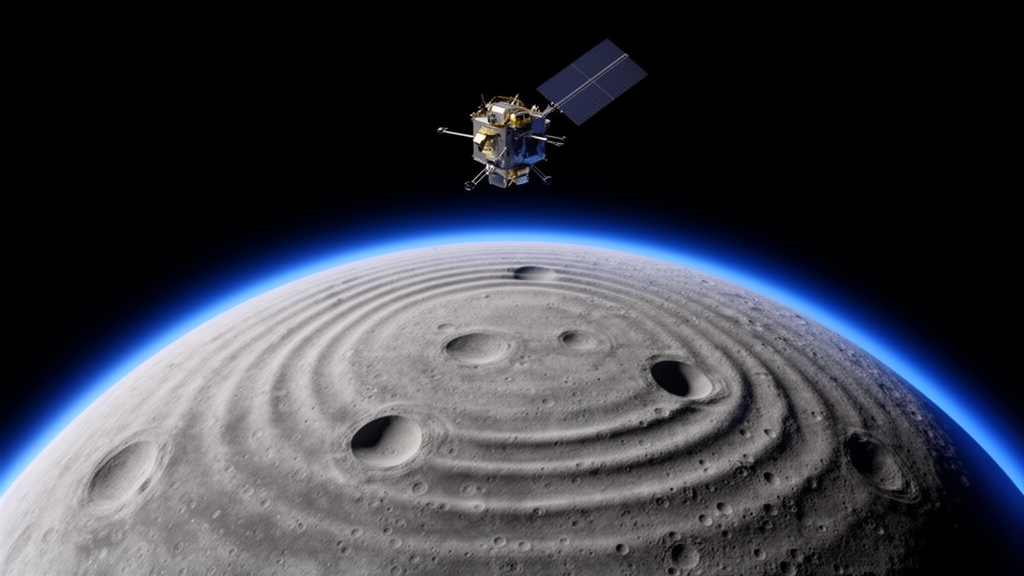
Lunar free oscillations are unlikely to affect the sensitivity of TianQin, a proposed space-based gravitational-wave detector, according to a computational study that incorporated perturbations from the Moon’s normal modes into high-precision orbit simulations. Even under an extreme excitation associated with a moment magnitude 7.0 moonquake, the peak range acceleration noise produced by the modeled oscillations remained at least two orders of magnitude below TianQin’s noise requirement. TianQin is planned as a geocentric mission comprising three satellites in nearly circular, high Earth orbits.

Because the detector would operate in the Earth–Moon environment, the analysis considered whether gravitational perturbations associated with lunar seismic motion could add significantly to that noise. The researchers calculated the perturbations associated with the Moon’s spheroidal normal modes using four seismic velocity models. These lunar seismic models provided the basis for incorporating free-oscillation effects into high-precision simulations of the proposed TianQin constellation.

The study then evaluated the resulting range acceleration noise and compared its peak level with the detector’s noise requirement. In the simulated magnitude 7.0 moonquake scenario, the lunar contribution stayed at least two orders of magnitude below that requirement. The conclusion is bounded to the effects represented by the model: spheroidal normal modes contributing to range acceleration noise within TianQin’s operational frequency band.

It does not establish that every possible perturbation associated with the Moon or the wider Earth–Moon system can be neglected. The research is also a computational assessment of a proposed mission rather than a report based on operating hardware, and its result depends on the normal-mode calculations, the four seismic velocity models and the orbit simulations used in the analysis. Within those limits, the modeled lunar free oscillations are not expected to impair TianQin’s sensitivity in its operational frequency band.

Subject of Research: Modeled effects of lunar free oscillations on TianQin range acceleration noise

Article Title: Effect of lunar free oscillations on TianQin’s range acceleration noise

Article References: Liu, Z., Xu, Y., Liu, K., & Zhang, X. (2026). Effect of lunar free oscillations on TianQin’s range acceleration noise. Astrophysics and Space Science, 371(10), Article 126. https://doi.org/10.1007/s10509-026-04659-0

Image Credits: AI Generated

DOI: 10.1007/s10509-026-04659-0

Keywords: TianQin, lunar free oscillations, gravitational-wave detector, range acceleration noise, lunar seismology, moonquakes, spheroidal normal modes, orbit simulation, Earth–Moon system, Effect, lunar, free

Cite Scienmag News

Iris Watkins. (October 22, 2026). Modeled Lunar Free Oscillations Remain Below TianQin Noise Requirement. Scienmag. https://scienmag.com/modeled-lunar-free-oscillations-remain-below-tianqin-noise-requirement/

Iris Watkins. "Modeled Lunar Free Oscillations Remain Below TianQin Noise Requirement." Scienmag, 22 October 2026, https://scienmag.com/modeled-lunar-free-oscillations-remain-below-tianqin-noise-requirement/. Accessed 22 October 2026.

Iris Watkins. "Modeled Lunar Free Oscillations Remain Below TianQin Noise Requirement." Scienmag. October 22, 2026. https://scienmag.com/modeled-lunar-free-oscillations-remain-below-tianqin-noise-requirement/


Tags: Earth–Moon systemEffecteffects of moonquake-induced seismic activity on space-based detectorsfreegravitational-wave detectorhigh-precision orbit simulations of lunar perturbationsimpact assessment of lunar seismic motion on TianQin noise levelsinfluence of moonquake magnitude 7.0 on gravitational wave detectionlunarlunar free oscillationsLunar free oscillations impact on gravitational-wave detector sensitivitylunar normal modes and gravitational perturbationslunar seismologymoonquakesorbit simulationrange acceleration noiserange acceleration noise comparison with TianQin requirementsseismic velocity models for lunar oscillationsspace-based gravitational wave detectionspheroidal normal modesTianQinTianQin satellite mission noise analysis
Share26Tweet16
Previous Post

QCD sum rules sharpen Bc decay constants and form-factor bounds

Next Post

WeanNet transfers learning through fading neural connections

Related Posts

QCD sum rules sharpen Bc decay constants and form-factor bounds
Space

QCD sum rules sharpen Bc decay constants and form-factor bounds

October 22, 2026
Quasar survey finds statistical evidence of recoiling supermassive black holes
Space

Quasar survey finds statistical evidence of recoiling supermassive black holes

October 22, 2026
Magnetic fields could imprint distinctive extreme-mass-ratio gravitational waves
Space

Magnetic fields could imprint distinctive extreme-mass-ratio gravitational waves

October 22, 2026
Solar-Storm-Like Eruption Observed Near a Supermassive Black Hole
Space

Solar-Storm-Like Eruption Observed Near a Supermassive Black Hole

October 22, 2026
No planar degeneracy for the Landau gauge quark-gluon vertex
Space

No planar degeneracy for the Landau gauge quark-gluon vertex

October 22, 2026
Research report: Discrete Laplacian structure and kernel reduction of the gap equation in odd-dimensional large-N vector models at imaginary chemical potential
Space

Research report: Discrete Laplacian structure and kernel reduction of the gap equation in odd-dimensional large-N vector models at imaginary chemical potential

October 22, 2026
Next Post
WeanNet transfers learning through fading neural connections

WeanNet transfers learning through fading neural connections

  • Mothers who receive childcare support from maternal grandparents show more optimized

    Mothers who receive childcare support from maternal grandparents show more parental warmth, finds NTU Singapore study

    27656 shares
    Share 11059 Tweet 6912
  • University of Seville Breaks 120-Year-Old Mystery, Revises a Key Einstein Concept

    1061 shares
    Share 424 Tweet 265
  • Bee body mass, pathogens and local climate influence heat tolerance

    682 shares
    Share 273 Tweet 171
  • Researchers record first-ever images and data of a shark experiencing a boat strike

    546 shares
    Share 218 Tweet 137
  • Groundbreaking Clinical Trial Reveals Lubiprostone Enhances Kidney Function

    531 shares
    Share 212 Tweet 133
Science

Embark on a thrilling journey of discovery with Scienmag.com—your ultimate source for cutting-edge breakthroughs. Immerse yourself in a world where curiosity knows no limits and tomorrow’s possibilities become today’s reality!

RECENT NEWS

  • Research report: Artificial intelligence literacy and innovative behavior among clinical nurses: the roles of AI self-efficacy and organizational innovation climate
  • WeanNet transfers learning through fading neural connections
  • Modeled Lunar Free Oscillations Remain Below TianQin Noise Requirement
  • QCD sum rules sharpen Bc decay constants and form-factor bounds

Categories

  • Agriculture
  • Anthropology
  • Archaeology
  • Athmospheric
  • Biology
  • Biotechnology
  • Blog
  • Bussines
  • Cancer
  • Chemistry
  • Climate
  • Earth Science
  • Editorial Policy
  • Marine
  • Mathematics
  • Medicine
  • Pediatry
  • Policy
  • Psychology & Psychiatry
  • Science Education
  • Science News
  • Social Science
  • Space
  • Technology and Engineering

Subscribe to Blog via Email

Enter your email address to subscribe to this blog and receive notifications of new posts by email.

Join 5,151 other subscribers

© 2025 Scienmag - Science Magazine

Welcome Back!

Login to your account below

Forgotten Password?

Retrieve your password

Please enter your username or email address to reset your password.

Log In
No Result
View All Result
  • HOME
  • SCIENCE NEWS
  • CONTACT US

© 2025 Scienmag - Science Magazine

Discover more from Science

Subscribe now to keep reading and get access to the full archive.

Continue reading