

Thursday, October 22, 2026
Science
No Result
View All Result
  • Login
  • HOME
  • SCIENCE NEWS
  • CONTACT US
  • HOME
  • SCIENCE NEWS
  • CONTACT US
No Result
View All Result
Scienmag
No Result
View All Result
Home Science News Technology and Engineering

TU Graz develops sensor-linked autonomous on-demand shuttle service

October 22, 2026
in Technology and Engineering
Denise Maddox
By Denise Maddox Scienmag Editorial Profile - Mechanical Engineering
Reading Time: 2 mins read
0
TU Graz develops sensor-linked autonomous on-demand shuttle service

TU Graz develops sensor-linked autonomous on-demand shuttle service

65
SHARES
587
VIEWS
Share on FacebookShare on Twitter
ADVERTISEMENT

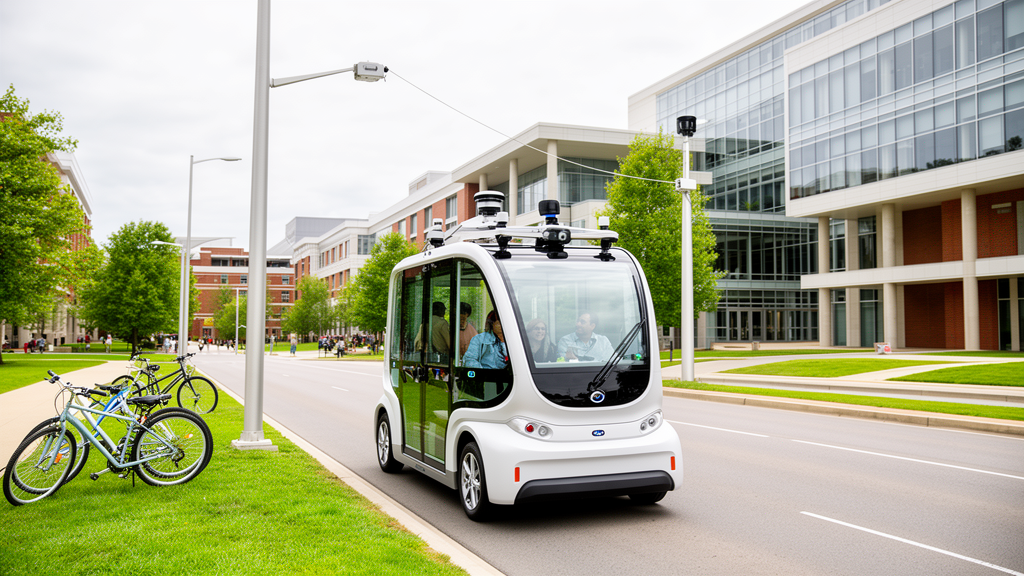
Researchers at Graz University of Technology, working with partners in China, have developed an autonomous, on-demand shuttle service designed to operate without a fixed timetable. The project combines a battery-powered vehicle carrying up to 15 people with sensors and connected road infrastructure to support flexible mobility in real traffic. A test vehicle is already operating on a test route in China, while demonstrators are planned in Austria. The service is intended to bridge the convenience of private cars with the shared capacity of public transport, but the release does not report measured reductions in emissions, travel times or safety incidents.

The shuttle uses lidar, radar and cameras to observe its surroundings and communicate through 5G with smart infrastructure, including cameras placed near difficult or blind sections of road. According to the project team, this collaborative perception can extend the vehicle’s awareness of pedestrians and cyclists beyond what its onboard sensors can detect directly. The approach is intended to support safe autonomous control by giving the shuttle additional information about potentially vulnerable road users. If the network connection fails, the vehicle has an independent safety function that brings it to a controlled stop.

Before deployment, researchers validated the vehicles’ safety concept through computational simulations that recreated real streetscapes, including buildings and infrastructure. The virtual environments were used to examine algorithms for route planning, object detection and the behavior of other road users in both extreme and everyday scenarios. The project team says millions of simulated kilometres were needed because autonomous driving requires extensive testing across a very large number of situations. These simulations are a pre-deployment validation method; they do not by themselves establish the shuttle’s performance under real-world operating conditions.

To increase the flexibility of the service, the Chinese research partners developed a dynamic optimization system for routes and charging processes. Its stated goals are to reduce passenger waiting times and maximize vehicle capacity utilization, with the aim of operating the shuttle efficiently within a wider route network. The system is also intended to support higher-capacity sharing, in which several passengers travel together in one electric vehicle rather than making separate journeys in private cars. The release presents reduced emissions, improved air quality and more efficient use of road space as potential benefits, but it provides no operational data with which to quantify those outcomes.

The project brings together TU Graz, Tongji University, Wenzhou University and the Chinese company Seisys, with funding from the Austrian Research Promotion Agency FFG. Graz University of Technology identifies computational simulation and modeling as the project’s research method, while the vehicle and connected-infrastructure system provide the basis for real-world testing. The announcement describes a technology-development program with a Chinese test route and planned Austrian demonstrators, rather than a completed service evaluation. Its central technical feature is the combination of onboard sensing, cooperative communication with infrastructure and virtual testing across millions of simulated kilometres.

Subject of Research: Development and simulation testing of an autonomous, sensor-linked on-demand public transport shuttle.

Article Title: Personalized public transport: Graz University of Technology develops autonomous mobility service

Article References: Personalized public transport: Graz University of Technology develops autonomous mobility service. Original publication (Bibliographic details unavailable.)

Image Credits: AI Generated

DOI: Not provided

Keywords: autonomous vehicles, on-demand transport, public mobility, lidar sensing, collaborative perception, 5G infrastructure, computational simulation, electric shuttle, TU Graz, Personalized, public, transport

Cite Scienmag News

Denise Maddox. (October 22, 2026). TU Graz develops sensor-linked autonomous on-demand shuttle service. Scienmag. https://scienmag.com/tu-graz-develops-sensor-linked-autonomous-on-demand-shuttle-service/

Denise Maddox. "TU Graz develops sensor-linked autonomous on-demand shuttle service." Scienmag, 22 October 2026, https://scienmag.com/tu-graz-develops-sensor-linked-autonomous-on-demand-shuttle-service/. Accessed 22 October 2026.

Denise Maddox. "TU Graz develops sensor-linked autonomous on-demand shuttle service." Scienmag. October 22, 2026. https://scienmag.com/tu-graz-develops-sensor-linked-autonomous-on-demand-shuttle-service/


Tags: 5G communication for autonomous vehicles5G infrastructureAutonomous shuttle serviceautonomous vehicle safety validationautonomous vehiclesbattery-powered passenger shuttlescollaborative perceptioncollaborative perception in autonomous drivingcomputational simulationconnected road infrastructureelectric shuttlelidar and radar sensor technologylidar sensingon-demand public transportationon-demand transportpersonalizedpublicpublic mobilityreal-time traffic monitoring with sensorssafety systems in autonomous vehiclessensor-linked autonomous vehiclessmart mobility solutionstransportTU Graz
Share26Tweet16
Previous Post

Optimized fast radiative transfer improves FY-3F water-vapor channel simulations

Next Post

Research report: PF chemotherapy combined with a PD-1/CTLA-4 bispecific antibody as first-line treatment in patients with recurrent/metastatic head and neck squamous cell carcinoma: a prospective, single-arm, phase II clinical study

Related Posts

Optimized fast radiative transfer improves FY-3F water-vapor channel simulations
Earth Science

Optimized fast radiative transfer improves FY-3F water-vapor channel simulations

October 22, 2026
Selective orientation correction lowers VIO error without full-state UKF backend cost
Technology and Engineering

Selective orientation correction lowers VIO error without full-state UKF backend cost

October 22, 2026
Lab test finds modified graphite lowers hydrogen permeation but not blistering
Technology and Engineering

Lab test finds modified graphite lowers hydrogen permeation but not blistering

October 22, 2026
Machine learning predicts self-reported anger improvement in teens
Technology and Engineering

Machine learning predicts self-reported anger improvement in teens

October 22, 2026
Pure-culture study links fatty-acid breakdown to methane in one archaeon
Medicine

Pure-culture study links fatty-acid breakdown to methane in one archaeon

October 22, 2026
Expert Interviews Shape Human Insider Threat Framework in Three Sectors
Science News

Expert Interviews Shape Human Insider Threat Framework in Three Sectors

October 22, 2026
Next Post
Research report: PF chemotherapy combined with a PD-1/CTLA-4 bispecific antibody as first-line treatment in patients with recurrent/metastatic head and neck squamous cell carcinoma: a prospective, single-arm, phase II clinical study

Research report: PF chemotherapy combined with a PD-1/CTLA-4 bispecific antibody as first-line treatment in patients with recurrent/metastatic head and neck squamous cell carcinoma: a prospective, single-arm, phase II clinical study

  • Mothers who receive childcare support from maternal grandparents show more optimized

    Mothers who receive childcare support from maternal grandparents show more parental warmth, finds NTU Singapore study

    27656 shares
    Share 11059 Tweet 6912
  • University of Seville Breaks 120-Year-Old Mystery, Revises a Key Einstein Concept

    1061 shares
    Share 424 Tweet 265
  • Bee body mass, pathogens and local climate influence heat tolerance

    682 shares
    Share 273 Tweet 171
  • Researchers record first-ever images and data of a shark experiencing a boat strike

    546 shares
    Share 218 Tweet 137
  • Groundbreaking Clinical Trial Reveals Lubiprostone Enhances Kidney Function

    531 shares
    Share 212 Tweet 133
Science

Embark on a thrilling journey of discovery with Scienmag.com—your ultimate source for cutting-edge breakthroughs. Immerse yourself in a world where curiosity knows no limits and tomorrow’s possibilities become today’s reality!

RECENT NEWS

  • Research report: PF chemotherapy combined with a PD-1/CTLA-4 bispecific antibody as first-line treatment in patients with recurrent/metastatic head and neck squamous cell carcinoma: a prospective, single-arm, phase II clinical study
  • TU Graz develops sensor-linked autonomous on-demand shuttle service
  • Optimized fast radiative transfer improves FY-3F water-vapor channel simulations
  • Urban Habitat Mosaics Structure Invasive Termite Gene Flow Without Genetic Erosion

Categories

  • Agriculture
  • Anthropology
  • Archaeology
  • Athmospheric
  • Biology
  • Biotechnology
  • Blog
  • Bussines
  • Cancer
  • Chemistry
  • Climate
  • Earth Science
  • Editorial Policy
  • Marine
  • Mathematics
  • Medicine
  • Pediatry
  • Policy
  • Psychology & Psychiatry
  • Science Education
  • Science News
  • Social Science
  • Space
  • Technology and Engineering

Subscribe to Blog via Email

Enter your email address to subscribe to this blog and receive notifications of new posts by email.

Join 5,151 other subscribers

© 2025 Scienmag - Science Magazine

Welcome Back!

Login to your account below

Forgotten Password?

Retrieve your password

Please enter your username or email address to reset your password.

Log In
No Result
View All Result
  • HOME
  • SCIENCE NEWS
  • CONTACT US

© 2025 Scienmag - Science Magazine

Discover more from Science

Subscribe now to keep reading and get access to the full archive.

Continue reading