


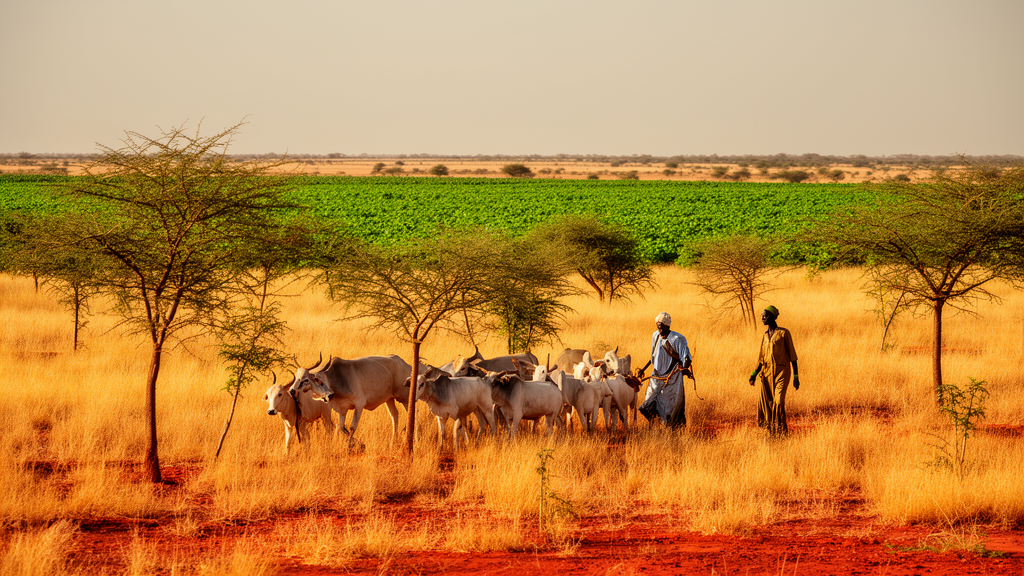
A qualitative study of Fulani pastoralists in northern Senegal found that environmental pressures, development projects and changing expectations are prompting herders to rethink how they raise cattle, move with their herds and earn a living. Researchers working in Widou Thiengoly and Koyli Alpha found that some herders are reducing herd sizes, crossbreeding local Gobra zebu cows with Guzerat bulls imported from Brazil and seeking employment beyond livestock farming. These changes are not simply responses to project prescriptions: they combine local knowledge of a declining bush with economic calculations, environmental constraints and the cultural importance of cattle.
The study, based on 14 field stays conducted between June 2023 and September 2025, used focus groups, semistructured interviews, photo-elicitation and ethnographic observation to examine relationships among pastoralists, animals and the surrounding environment. Eight focus groups involved men and women who identified as pastoralists, while 17 individual interviews explored herd management, breed preferences, local vegetation and ideas of modern livestock farming. An additional interview at the Dahra Djoloff Zootechnical Research Center helped triangulate information about the introduction of Brazilian Guzerat cattle and crossbreeding through artificial insemination. The findings describe strategies and perceptions among a bounded set of communities; they do not establish a population-wide trend across Senegal’s Sahel.
Both villages lie in the sylvopastoral zone between the River Senegal and the Ferlo Valley, where Fulani herders keep cattle, sheep, goats and equines alongside smaller communities of Wolof farmers and Moor camel herders. Before pastoral boreholes were installed from the 1950s onward, people occupied the area mainly during the rainy season and moved livestock toward the Senegal River during the dry months. Permanent water, new settlements and changes in land administration altered transhumance routes, while livestock numbers rose roughly threefold between 1945 and 1975. Severe droughts in the 1970s and 1980s, reduced rainfall, habitat loss and limits on herd mobility then contributed to sharp losses and lasting changes in the landscape.
Pastoralists described the bush, known in Pulaar as ladde, as “empty,” “finished” or “broken.” Their accounts identified declining rainfall, shrinking pasture, disappearing trees and wildlife, expanding villages and fenced development plots as interconnected pressures. Historically, communities also used reciprocal arrangements such as lending cattle to relatives in need, while rules called hurum protected crops during the growing season and reserved pasture near camps. Researchers reported that increased settlement and the privatization of formerly communal spaces weakened these practices. A herder’s observation that “the bush has become crowded” captures a local understanding in which human, animal and infrastructural expansion have narrowed the spaces available for grazing, movement and wildlife habitat.
The Great Green Wall and related programs occupy a contradictory position in these accounts. Many residents welcomed projects that provide fodder plots, employment, nurseries, conservation areas and other resources, especially herders unable to move their animals during the dry season. Yet some enclosure-sized restoration plots, reaching as many as 600 hectares in the study area, were criticized for closing areas formerly used collectively for grazing, travel and gathering. Municipal decisions about plot locations could also advantage some settlements over others. The researchers therefore characterized local engagement as neither passive acceptance nor blanket resistance. Pastoralists pragmatically adopted particular technologies and opportunities while navigating the restrictions and unequal access associated with a dense landscape of projects.
Water and forage shortages were especially acute during the hot dry seasons, when herders supplemented cili pods and baobab bark with purchased feed. Grass, crop residues and fodder increasingly entered markets, while cutting tree branches remained constrained both by restrictions from authorities and by local beliefs concerning inhabited trees. A potentially harmful grass known locally as Demba Yaba prompted some herders to move cattle during the rainy season to avoid exposure. Pastoralists reported digestive problems and deaths among cattle after ingestion, although the article notes that no study had yet published evidence for the proposed mechanism. Their accounts nevertheless showed how the plant had become a major practical concern and an uncertain target for intervention.
Against this background, some herders proposed keeping fewer animals. Large herds were described as exhausting to maintain during drought, when borehole fees, feed purchases and water constraints increased. Reducing numbers could improve the possibility of feeding the remaining animals, but it also risked economic and symbolic losses because cattle represented both productive assets and central elements of Fulani identity. Some respondents resisted the idea because of demand for meat, particularly during Eid al-Adha. Others expected to compensate for smaller herds with animals of higher market value. The resulting idea of “modern livestock farming” was therefore locally reworked: it combined reduced herd size, fodder plots, limited transhumance, wage income and continued ownership of cattle rather than simply matching the productivity aims of government policy.
Guzerat bulls from Brazil now form one part of this strategy. They can command higher prices than local Pulfuli, or Gobra, bulls, and are valued for perceived improvements in meat and milk production, but their introduction also creates risks. Direct mating between a purebred Guzerat bull and a Gobra cow may produce difficult calving because of the calf’s size, a concern also recognized by the research center. Guzerat cattle reportedly require more forage than the more resilient local animals, while the purchase price creates greater exposure if an animal falls ill or dies. Consequently, herders differed in their responses: some sought purebred Guzerat, others castrated local bulls, and some favored crossbreeding to retain hardiness while seeking greater weight and value. A minority interviewed respondents wanted to preserve the Pulfuli, while pastoralists unable to be interviewed may have held other preferences.
Livelihood diversification was equally important. Some herders sold selected animals to purchase feed for the rest, invested in children’s education, took work in development projects or entered commerce, and used wages to support livestock production. A salaried livelihood could make continued herding possible even for households unable to maintain large, mobile herds. Transhumance remained close to many herders’ hearts, but it was also described as physically demanding and dangerous because animals could become lost and people had to endure heat, dust, hunger and fatigue. Women, who remained closely involved with animals, were especially prominent in discussing the burdens of this work. These accounts complicate the policy opposition between “traditional” mobility and “modern” settlement by showing that pastoralists themselves were evaluating which combination of movement, work, education and herd management could support the next generation.
The researchers interpret breed change as a reconfiguration of the established human-cattle-environment relationship rather than a purely technical event. Their multispecies approach drew on interviews, photographs, sounds, seasonal observations and local language to examine how people perceive animals, trees, grasses and soils as active parts of a shared environment. This differs from framing biodiversity loss only as the disappearance of ecosystem components or pastoralists only as victims of degradation. The study’s central argument is that herders actively combine environmental knowledge, market opportunities, project-based resources, family aspirations and symbolic values. The findings are qualitative and geographically focused, so they do not measure productivity gains, changes in herd numbers at regional scale or the effect of crossbreeding on income. They do show that, around the Great Green Wall, adaptation can involve fewer but more valuable animals, new breeds, paid work and selective use of projects rather than the wholesale abandonment of pastoralism.
Subject of Research: Qualitative research into how Fulani pastoralists in northern Senegal are changing cattle breeding, herd management and livelihoods in response to environmental pressures and the Great Green Wall.
Article Title: Between Gobra and Guzerat: a reinvention of human-cattle-environment relationships in the Great Green Wall (northern Senegal)
Article References: Laloi, C., Diallo, A. H., Ferrié, J.-N., & Duboz, P. (2026). Between Gobra and Guzerat: a reinvention of human-cattle-environment relationships in the Great Green Wall (northern Senegal). Pastoralism: Research, Policy and Practice, 16, Article 16069. https://doi.org/10.3389/past.2026.16069
Image Credits: AI Generated
Keywords: Great Green Wall, Senegal, Sahel, pastoralism, Gobra cattle, Guzerat cattle, livestock breeding, environmental change, rural livelihoods, Fulani herders, Between, Gobra
Cite Scienmag News
William Thompson. (October 22, 2026). Senegal herders reinvent cattle breeding around the Great Green Wall. Scienmag. https://scienmag.com/senegal-herders-reinvent-cattle-breeding-around-the-great-green-wall/
William Thompson. "Senegal herders reinvent cattle breeding around the Great Green Wall." Scienmag, 22 October 2026, https://scienmag.com/senegal-herders-reinvent-cattle-breeding-around-the-great-green-wall/. Accessed 22 October 2026.
William Thompson. "Senegal herders reinvent cattle breeding around the Great Green Wall." Scienmag. October 22, 2026. https://scienmag.com/senegal-herders-reinvent-cattle-breeding-around-the-great-green-wall/


