


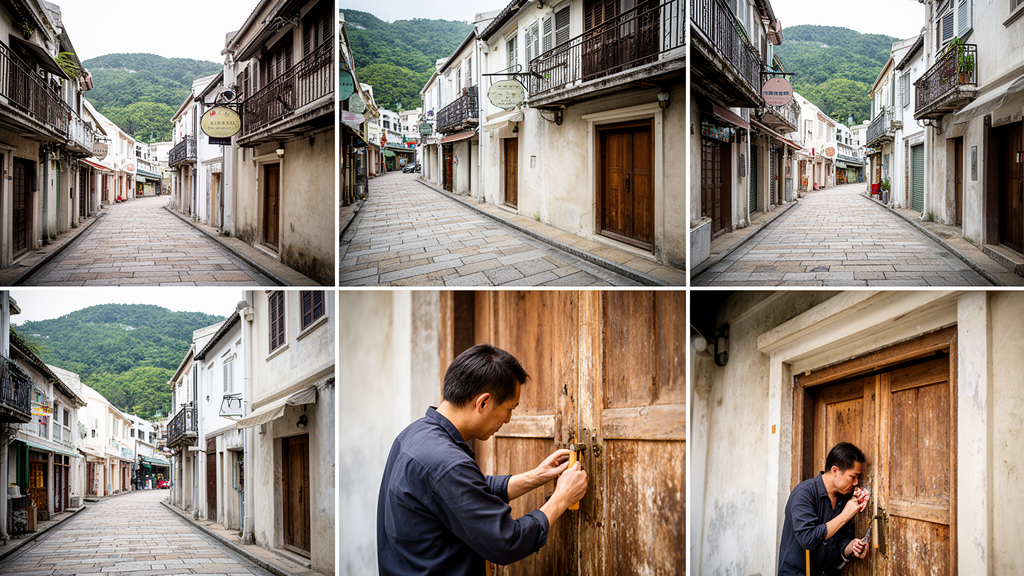
In a controlled experiment using six Hong Kong tourist streetscapes, researchers found that complete scenes produced measurably different short-term responses in perceived restorativeness, visual attention, brain activity and autonomic function. Oil Street Art Space, known as Oi!, ranked highest among the six tested scenes for perceived restorativeness and natural-area attention, while Western Market ranked lowest on those measures. The study examined only six selected visual configurations around Victoria Harbour, so its results do not establish that one streetscape type is generally superior across Hong Kong tourism areas.
The analysis covered 22.312 square kilometres on both sides of Victoria Harbour, including parts of Hong Kong Island and Kowloon, rather than the entire city. The researchers assembled 66 tourism-related sites from official databases: 48 declared monuments, 11 museums and seven major attractions. For each site, they retained four quality-checked streetscape views, producing 264 images, and combined those observations with five geographic information system indicators describing the surrounding 250 metres.
The resulting 66-by-11 matrix contained measures of building coverage, built volume, mean building height, road density and distance from the statutory harbour boundary, alongside image-based proxies for green, blue and sky colours, natural-colour saliency, luminance entropy and technical image quality. All indicators were standardised before principal component analysis, which retained five components explaining 80.14% of the variance. The researchers used K-means clustering to structure the 66 sites before examining any human-response data.
Six groups were retained because the experiment had capacity for six scenes, not because six clusters proved to be a uniquely optimal natural typology. Group sizes were highly uneven, ranging from one site to 21, and a four-cluster solution had a slightly higher silhouette coefficient than the six-cluster solution, 0.254 compared with 0.226, although the six-cluster solution performed better on the Davies-Bouldin index. The six locations were therefore treated as sampling strata or archetypal positions rather than universal categories of Hong Kong streets.
They were Oil Street Art Space, the Hong Kong Science Museum, Western Market, St John’s Cathedral, the Old Wan Chai Post Office and the Hong Kong Museum of Art, each matched one-to-one to a cluster centroid. A laboratory procedure then tested how adults responded to these static, two-dimensional scenes. Forty-eight adults registered and provided informed consent, while 46 contributed at least one focal-scene exposure, yielding 108 participant-scene records with an incomplete repeated-measures structure.
Ten participants contributed one focal exposure, 14 contributed two, 18 contributed three and four contributed four. Each trial proceeded through baseline measurements, a 90-second mild stress induction, a 60-second scene exposure, 20 seconds for subjective ratings, a 45-second sustained-attention task and a 30-second inter-trial break. Eye tracking, electroencephalography, electrodermal activity and heart-rate variability were recorded during scene viewing.
The primary subjective measure, perceived restorativeness, averaged ratings of being away, fascination, coherence or extent and compatibility on a seven-point scale. Physiological outcomes were defined as the change from the stress phase to the scene phase, allowing each location to be evaluated against the same experimental starting condition. The clearest subjective and attentional contrasts involved Oil Street Art Space and Western Market.
Oil Street received the highest perceived-restorativeness score, 5.69 out of 7, with a 95% confidence interval of 5.55 to 5.84, compared with 4.17 for Western Market, whose interval was 4.00 to 4.33. The 1.52-point separation amounted to about 22% of the available scale. Oil Street also attracted the largest share of eye-tracking fixations to natural areas of interest: 51.4% of fixations fell on vegetation, water or sky, compared with 31.2% in Western Market, a difference of 20.2 percentage points.
These descriptive endpoints moved in the same direction, but the researchers did not attribute the pattern to any isolated element. The photographs differed in architecture, colour, heritage character, signage, enclosure and spatial organization, all of which varied together within each complete scene. Brain and autonomic measures supplied partial support for the same high-to-low pattern, although their interpretation required greater caution.
From the stress phase to the scene phase, EEG alpha-minus-theta power increased under all six conditions, but the amount of change differed significantly among scenes. Oil Street had the largest increase, at 2.68 log-power units, while Western Market had the smallest, at 1.93. Heart-rate variability measured by RMSSD also differed by scene, with Oil Street showing the largest increase of 11.37 milliseconds.
Mean skin conductance change, an indicator of sympathetic arousal rather than emotional valence, showed a corrected significant scene effect. Yet all three physiological endpoints were sensitive to presentation order. When the analysis was restricted to each participant’s earliest focal exposure, differences in EEG and HRV remained detectable, but the skin-conductance effect did not.
Available-case analyses, which used valid records from each modality, and complete-case analyses based on 99 trials with all seven primary outcomes produced broadly consistent physiological conclusions. Not every outcome followed the same ranking, revealing why the investigators did not combine the measurements into a single restoration score. Sustained-attention accuracy did not differ significantly among the scenes, with adjusted omnibus statistics of χ²(5) = 5.64, p = 0.342 and q = 0.342, even though descriptive accuracy ranged from 78.9% at the Hong Kong Science Museum to 87.5% at Oil Street.
Correct-response reaction time did differ, with Oil Street producing the fastest responses at 528.8 milliseconds and the Hong Kong Museum of Art the slowest at 579.3 milliseconds. Gaze entropy also failed to track perceived restorativeness: the Museum of Art produced the broadest distribution of gaze, at 3.39, while the Science Museum produced the most concentrated, at 2.95. More dispersed visual search therefore did not automatically mean greater restorativeness, and rapid reactions did not translate into higher accuracy.
The findings separate subjective appraisal, attentional targets, exploratory viewing and cognitive performance rather than assuming that they operate as interchangeable measures of restoration. The statistical evidence was strongest for subjective and visual-attention differences. Participant-level models accounted for repeated observations and included presentation order, while seven primary outcomes were tested with Benjamini-Hochberg false-discovery-rate correction.
The overall effects were significant for perceived restorativeness, natural-area fixation share, gaze entropy, EEG change, skin-conductance change and HRV change, but not for sustained-attention accuracy. Sensitivity tests found no scene-by-order interaction for perceived restorativeness, natural-area fixation, gaze entropy or accuracy. In the earliest-exposure analysis, scene differences remained for perceived restorativeness, natural-area fixation, gaze entropy, EEG and HRV, while they were absent for skin conductance and cognitive accuracy.
The incomplete design still limits certainty: participants contributed between one and four focal scenes, exposures were unevenly distributed across scenes and positions, and only 99 trials contained complete records for all seven primary outcomes. Seven HRV records were excluded after modality-specific quality control, leaving 101 valid HRV exposures from 45 people. The urban sampling method also carries important measurement limits.
Colour thresholds may classify painted signs or other objects as green or blue, and a strong correlation between the blue and sky proxies, with a Spearman coefficient of 0.762, suggests that these measures partly overlap. A high blue value therefore cannot automatically be interpreted as visible water, just as a green-colour share is not a validated measure of vegetation. Saliency measures estimate where low-level features may draw attention rather than where participants actually look, and averaging values across four directions may conceal local extremes.
Accordingly, the experiment supports contrasts among fixed visual configurations over 60 seconds; it does not establish that a visual scene will have the same effect while visitors are walking, waiting or navigating an attraction. The study’s proposed application is to evaluate streets and small public spaces around attractions as part of the visitor experience rather than dismiss them as circulation routes. By linking the 66 objectively sampled sites to six controlled scenes and their response profiles, the authors propose an archetype-calibrated method for identifying locations with potentially greater restorative value and areas that may warrant closer examination.
The framework could eventually support route networks and prioritisation of interventions, but it is not yet a validated planning tool. Establishing actionable effects would require many more prospectively selected scenes, validated semantic image measures, models that include both participant and scene variation, and field studies recording sequential exposure, sound, thermal conditions, crowding and walking behaviour. Within the six configurations tested, Oil Street Art Space emerged as the leading scene for perceived restorativeness and natural-area fixation, but the broader evidence points to differences between complete scene configurations rather than a proven effect of greenery, openness, visual order or any single environmental feature.
Subject of Research: Short-term restorative responses to six high-density Hong Kong tourist streetscapes
Article Title: Restorative streetscapes in high-density urban tourism: environmental archetypes, visual attention, and psychophysiological responses
Article References: Wang, X., Zhao, Y., Xu, X., Li, X., & Cheng, J. (2026). Restorative streetscapes in high-density urban tourism: environmental archetypes, visual attention, and psychophysiological responses. Frontiers in Public Health, 14, Article 1981997. https://doi.org/10.3389/fpubh.2026.1981997
Image Credits: AI Generated
DOI: 10.3389/fpubh.2026.1981997
Keywords: Hong Kong tourism, urban streetscapes, perceived restorativeness, visual attention, EEG, heart-rate variability, environmental psychology, multimodal measurement, Restorative, streetscapes, high-density, urban
Cite Scienmag News
Ophelia Keating. (October 22, 2026). Oil Street led six tested Hong Kong tourist scenes in short-term restoration. Scienmag. https://scienmag.com/oil-street-led-six-tested-hong-kong-tourist-scenes-in-short-term-restoration/
Ophelia Keating. "Oil Street led six tested Hong Kong tourist scenes in short-term restoration." Scienmag, 22 October 2026, https://scienmag.com/oil-street-led-six-tested-hong-kong-tourist-scenes-in-short-term-restoration/. Accessed 22 October 2026.
Ophelia Keating. "Oil Street led six tested Hong Kong tourist scenes in short-term restoration." Scienmag. October 22, 2026. https://scienmag.com/oil-street-led-six-tested-hong-kong-tourist-scenes-in-short-term-restoration/


