


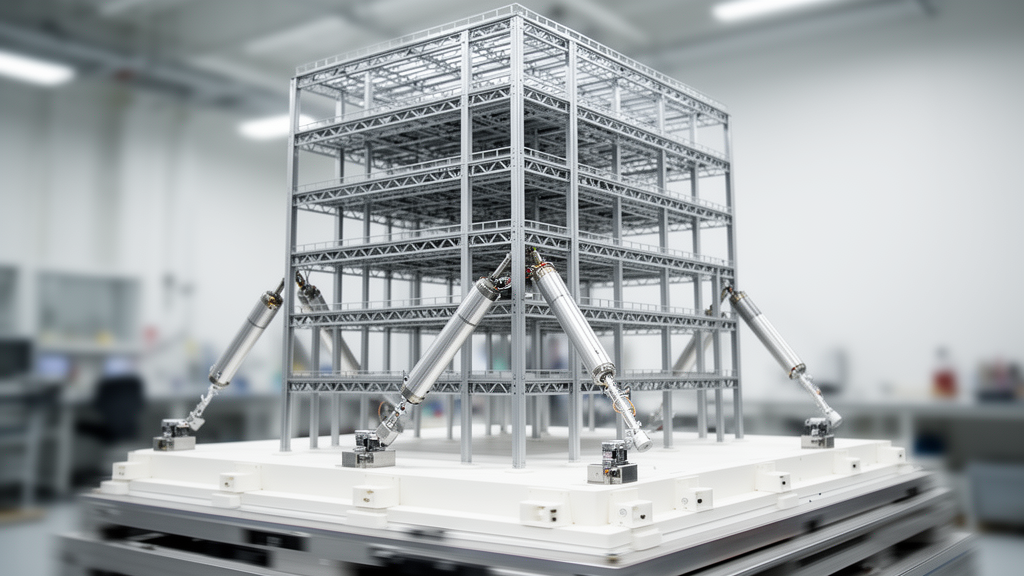
A revised mathematical and computational study finds that fractional damping does not automatically reduce earthquake demand in nonlinear buildings. After fractional and conventional viscous models were placed on the same physical footing by matching their equivalent damping in the first and third vibration modes, the large differences reported in an earlier version largely disappeared. Across 12 independent synthetic, nonstationary motions, mean roof displacement varied only from 4.285 to 4.355 centimetres among three fractional orders and the viscous comparator, while paired 95% confidence intervals contained zero. The result applies to a deliberately simplified model with monotone cubic hardening and synthetic excitation, not to real buildings under recorded earthquakes.
The research developed a nonlinear seismic-response framework for single- and multiple-degree-of-freedom building models using Caputo fractional damping. Its memory term describes hereditary, frequency-dependent dissipation, while the restoring law is restricted to convex, monotone cubic hardening. That restriction gives the restoring force a well-defined potential and makes rigorous statements about existence, uniqueness, continuation, and energy possible. It also marks an important boundary: the framework does not reproduce pinching, stiffness or strength degradation, hysteretic internal variables, or residual drift, so its mathematical guarantees cannot automatically be transferred to more realistic building models.
The authors separated two questions that are often conflated in fractional structural analysis. The continuous model has a mechanical energy identity in which accumulated hereditary work is nonnegative, allowing a forcing bound and continuation of solutions over finite time under a coercive potential. The numerical method then has its own discrete energy property. It combines midpoint L1 product integration for the Caputo kernel, average-acceleration Newmark kinematics, and a discrete gradient of the nonlinear potential. Under the stated assumptions, every nonlinear time step has exactly one solution, and the resulting scheme satisfies a cumulative discrete energy balance without introducing positive net numerical energy over any prefix of the time grid.
The discrete proof relies on a positive quadratic form associated with the midpoint L1 history weights. The method’s Jacobian is positive definite, making the nonlinear residual strongly monotone and coercive. In an unforced free-vibration test of a three-story system, the maximum relative defect in the energy balance was at the level of floating-point roundoff. This numerical check was consistent with the theorem, although the authors stress that it verifies the implementation rather than replacing the analytical argument. The direct treatment of the memory history also makes every contribution auditable, an advantage for verification but one that may become costly for long records or high-dimensional models.
Convergence tests reveal a sharp distinction between smooth and singular early-time behaviour. For a smooth manufactured solution, the maximum displacement error decreased from about 5.60 times 10 to the power of minus 3 on the coarsest grid to 1.39 times 10 to the power of minus 5 on the finest grid. The measured rate fell from approximately 1.86 to 1.60 as the grid was refined, approaching the expected fractional consistency regime rather than a uniform second-order limit. A separate solution with a weak initial layer reduced the uniform-grid convergence rate to about 0.40, showing that the smooth-solution convergence theorem cannot simply be applied to every fractional initial-value problem.
Concentrating resolution near the singular start recovered much of the lost accuracy. A deliberately graded mesh reduced the error in the weakly singular test by more than two orders of magnitude on the finest grid and produced finite-grid slopes between 1.54 and 1.57. The researchers interpret those slopes as pre-asymptotic behaviour arising from competition among midpoint, Newmark, and first-cell errors, not as proof of an asymptotic order above the method’s smooth consistency ceiling. The experiment demonstrates the practical value of mesh grading while retaining the mathematical limits of the convergence result.
The damping comparison was redesigned after the authors recognised that varying the fractional order while keeping one numerical coefficient fixed is not an equal-damping test. Fractional coefficients and orders have dimensional and frequency-dependent interpretations, so an apparently large response change could reflect unequal dissipation rather than a distinct seismic effect. The revised study instead calculated scalar fractional modal damping from the complex dynamic stiffness and calibrated each fractional matrix, together with a classical Rayleigh comparator, to 4% damping in the first and third modes. The second mode was not fitted directly; its equivalent damping emerged at approximately 3.4% to 3.6%.
This physical normalization largely removed the earlier apparent advantage of increasing fractional order. In a representative three-story response scaled to 0.35 g, peak roof displacement ranged from 3.998 to 4.245 centimetres across the fractional and viscous models, compared with much larger separation in the earlier fixed-coefficient comparison. More importantly, the 12-motion ensemble showed only small between-model differences relative to the record-to-record standard deviations. Paired confidence intervals relative to the viscous model included zero for roof displacement, interstory drift ratio, and peak floor acceleration. The evidence therefore supports changes in phase and frequency dependence under a chosen calibration, not a universal improvement in seismic performance from a larger fractional order.
Synthetic inverse identification showed a similar split between controlled numerical recoverability and real-world limitations. The researchers generated 600 single-degree-of-freedom parameter pairs and trained Extra Trees, Random Forest, and standardized Ridge regressors using five-fold shuffled cross-validation. Each input combined 40 displacement samples with seven global descriptors. Under clean, within-family conditions, all methods recovered the known fractional parameters accurately, and the simple Ridge baseline outperformed Extra Trees in mean absolute error, root mean square error, and squared coefficient of determination for both targets. That result indicates that the synthetic feature relationship contains a comparatively simple low-dimensional signature rather than demonstrating that a sophisticated artificial-intelligence system is required.
Stress tests weakened the inverse estimates substantially. With 1% Gaussian noise, mean absolute errors rose to 0.0285 for fractional order and 0.0604 for the fractional coefficient; at 10% noise, they reached 0.0643 and 0.1613. Perturbing structural stiffness and nonlinear properties produced errors of 0.1003 and 0.1955, while training on one synthetic excitation and testing on another produced the largest failures, 0.1105 and 0.4645. These results establish numerical identifiability only within a controlled model family, not reliable parameter recovery from actual buildings. Timings also showed a modest overhead for the fractional solver at small problem sizes, while leaving scalability to longer histories and larger structural models unresolved.
Subject of Research: Numerical analysis of fractional damping, nonlinear seismic response, and synthetic parameter identification in building models
Article Title: Fractional seismic simulation and synthetic inverse identification of nonlinear building models: discrete energy balance, convergence, and equivalent-damping calibration
Article References: Salas, A. H., Acosta M, C. D., & Solórzano, E. (2026). Fractional seismic simulation and synthetic inverse identification of nonlinear building models: discrete energy balance, convergence, and equivalent-damping calibration. Frontiers in Built Environment, 12, Article 1956502. https://doi.org/10.3389/fbuil.2026.1956502
Image Credits: AI Generated
DOI: 10.3389/fbuil.2026.1956502
Keywords: fractional damping, nonlinear seismic response, Caputo derivative, discrete energy balance, equivalent damping, synthetic motion, inverse identification, structural dynamics, convergence analysis, numerical identifiability, Fractional, seismic
Cite Scienmag News
Violet Maxwell. (October 22, 2026). Fractional damping study finds no universal seismic performance advantage. Scienmag. https://scienmag.com/fractional-damping-study-finds-no-universal-seismic-performance-advantage/
Violet Maxwell. "Fractional damping study finds no universal seismic performance advantage." Scienmag, 22 October 2026, https://scienmag.com/fractional-damping-study-finds-no-universal-seismic-performance-advantage/. Accessed 22 October 2026.
Violet Maxwell. "Fractional damping study finds no universal seismic performance advantage." Scienmag. October 22, 2026. https://scienmag.com/fractional-damping-study-finds-no-universal-seismic-performance-advantage/


