

Thursday, October 22, 2026
Science
No Result
View All Result
  • Login
  • HOME
  • SCIENCE NEWS
  • CONTACT US
  • HOME
  • SCIENCE NEWS
  • CONTACT US
No Result
View All Result
Scienmag
No Result
View All Result
Home Science News Psychology & Psychiatry

Trial Protocol Tests Music-Reinforced Gaze Training With Pediatric CBT

October 22, 2026
in Psychology & Psychiatry
Harold Sullivan
By Harold Sullivan Scienmag Editorial Profile - Maternal and Child Health
Reading Time: 3 mins read
0
Trial Protocol Tests Music-Reinforced Gaze Training With Pediatric CBT

Trial Protocol Tests Music-Reinforced Gaze Training With Pediatric CBT

65
SHARES
587
VIEWS
Share on FacebookShare on Twitter
ADVERTISEMENT

A preregistered, double-blind randomized controlled trial will test whether Gaze-Contingent Music Reward Therapy (GCMRT) can improve outcomes when added to cognitive behavioral therapy (CBT) for children and adolescents with anxiety disorders. The protocol plans to enroll 120 patients aged 8–17 who meet DSM-5-TR criteria for an anxiety disorder and will compare active GCMRT with a control form of GCMRT. Both groups will receive CBT, with the difference between groups in clinician-rated anxiety reduction from before to after treatment serving as a primary measure of effectiveness.

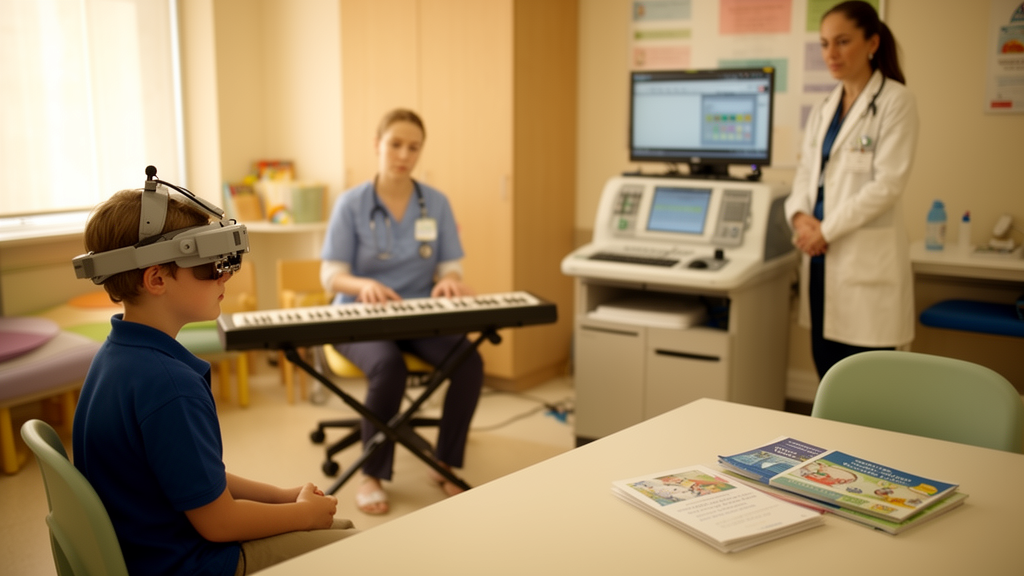
Because this is a study protocol rather than a completed trial, it reports no findings showing that GCMRT is safe, effective or superior to the control intervention. GCMRT is an eye-tracking-based treatment intended to modify threat-related attention bias. During the computer-based exercise, participants view matrices of faces with negative and non-negative valence while a system monitors their eye movements.

In the active condition, participant-selected music plays only when the participant looks at non-negative faces, creating a positive-reinforcement training regimen that links the reward to gaze direction. In the control condition, the same type of participant-selected music plays continuously rather than in response to gaze. The researchers describe recent studies as promising for GCMRT as an augmentative treatment for CBT, but note that this approach has not yet been robustly tested in pediatric samples with anxiety disorders.

The trial will assess changes in behavioral and neural indices of threat-related attention bias alongside anxiety outcomes. Behaviorally, the investigators will calculate prolonged eye-gaze dwell time on negative-valence faces relative to non-negative faces, using the change in that measure across treatment to indicate a shift in attention bias. Before and after treatment, participants will also undergo functional magnetic resonance imaging, or fMRI, while resting and while completing a dot-probe task with threatening face cues.

The protocol specifies a neural-efficiency approach for assessing brain-based implicit threat responses. Healthy youth will serve as a baseline comparison for the patients’ brain-based threat response, allowing the analysis to distinguish treatment-linked changes from patterns observed in a nonclinical comparison group. Linear mixed-effects models will be used to compare trajectories between groups in behavioral attention bias, neural threat-response indices and anxiety symptoms over the course of treatment.

The protocol identifies two broad objectives: determining whether GCMRT is an efficacious adjunct to CBT for pediatric anxiety disorders and advancing understanding of the neural mechanisms that may underlie its effects. The trial is registered as NCT06595953, with registration dated September 19, 2024; the source reports that data acquisition began on December 4, 2024. Until the trial is completed and analyzed, the evidence supports a planned test of GCMRT as an addition to CBT, not a conclusion that the intervention improves pediatric anxiety.

Subject of Research: A randomized trial protocol testing gaze-contingent music reward therapy as an adjunct to cognitive behavioral therapy for pediatric anxiety.

Article Title: Active versus control Gaze-Contingent Music Reward Therapy (GCMRT) augmentation of cognitive behavioral therapy in the treatment of pediatric anxiety: protocol for a double-blind randomized controlled trial

Article References: Byrne, M. E., Korom, M., Haller, S. P., Massac, L. A., Chen, E., Ross, A., Lewis, K. M., Berman, E., Silverman, W. K., Lazarov, A., Bar-Haim, Y., & Pine, D. S. (2026). Active versus control Gaze-Contingent Music Reward Therapy (GCMRT) augmentation of cognitive behavioral therapy in the treatment of pediatric anxiety: protocol for a double-blind randomized controlled trial. BMC Psychiatry. https://doi.org/10.1186/s12888-026-08631-8

Image Credits: AI Generated

DOI: 10.1186/s12888-026-08631-8

Keywords: pediatric anxiety, gaze-contingent therapy, music reward, eye tracking, cognitive behavioral therapy, randomized trial, attention bias, functional MRI, threat processing, clinical research, Active, versus

Cite Scienmag News

Harold Sullivan. (October 22, 2026). Trial Protocol Tests Music-Reinforced Gaze Training With Pediatric CBT. Scienmag. https://scienmag.com/trial-protocol-tests-music-reinforced-gaze-training-with-pediatric-cbt/

Harold Sullivan. "Trial Protocol Tests Music-Reinforced Gaze Training With Pediatric CBT." Scienmag, 22 October 2026, https://scienmag.com/trial-protocol-tests-music-reinforced-gaze-training-with-pediatric-cbt/. Accessed 22 October 2026.

Harold Sullivan. "Trial Protocol Tests Music-Reinforced Gaze Training With Pediatric CBT." Scienmag. October 22, 2026. https://scienmag.com/trial-protocol-tests-music-reinforced-gaze-training-with-pediatric-cbt/


Tags: ActiveAnxiety Disorder Treatment Protocolsattention biasChild and Adolescent Anxiety InterventionsClinical Researchcognitive behavioral therapycognitive behavioral therapy for childrenComputer-Based Gaze TrainingDouble-Blind Clinical Trial Designeye trackingEye-Tracking Attention Bias Modificationfunctional MRIGaze-Contingent Music Reward TherapyGaze-Contingent Reinforcement Methodsgaze-contingent therapymusic rewardMusic-Enhanced Attention Bias ModificationMusic-Reinforced Gaze Trainingpediatric anxietyPediatric Anxiety Disorder TreatmentRandomized Controlled Trial in Anxietyrandomized trialthreat processingversus
Share26Tweet16
Previous Post

Liposomal DNA formulation shifts immune responses in schistosomiasis mouse study

Next Post

Excess ASNS links neuronal stress to Angelman syndrome features in mice

Related Posts

Randomized trial links group relaxation exercises to better PTSD symptoms and sleep
Psychology & Psychiatry

Randomized trial links group relaxation exercises to better PTSD symptoms and sleep

October 22, 2026
How testosterone administration affects social rank perceptions: A double-blind, placebo-controlled study
Psychology & Psychiatry

How testosterone administration affects social rank perceptions: A double-blind, placebo-controlled study

October 22, 2026
Webcams Track Reading Effects, but Noisy Eyes Limit Precision
Psychology & Psychiatry

Webcams Track Reading Effects, but Noisy Eyes Limit Precision

October 22, 2026
Social media use associated with orthorexia symptoms, review finds
Psychology & Psychiatry

Social media use associated with orthorexia symptoms, review finds

October 22, 2026
Simulation exposes failure risks in publication-bias tests
Psychology & Psychiatry

Simulation exposes failure risks in publication-bias tests

October 22, 2026
Qualitative study maps provider-reported barriers to Asian American addiction care
Psychology & Psychiatry

Qualitative study maps provider-reported barriers to Asian American addiction care

October 21, 2026
Next Post
Excess ASNS links neuronal stress to Angelman syndrome features in mice

Excess ASNS links neuronal stress to Angelman syndrome features in mice

  • Mothers who receive childcare support from maternal grandparents show more optimized

    Mothers who receive childcare support from maternal grandparents show more parental warmth, finds NTU Singapore study

    27656 shares
    Share 11059 Tweet 6912
  • University of Seville Breaks 120-Year-Old Mystery, Revises a Key Einstein Concept

    1061 shares
    Share 424 Tweet 265
  • Bee body mass, pathogens and local climate influence heat tolerance

    682 shares
    Share 273 Tweet 171
  • Researchers record first-ever images and data of a shark experiencing a boat strike

    546 shares
    Share 218 Tweet 137
  • Groundbreaking Clinical Trial Reveals Lubiprostone Enhances Kidney Function

    531 shares
    Share 212 Tweet 133
Science

Embark on a thrilling journey of discovery with Scienmag.com—your ultimate source for cutting-edge breakthroughs. Immerse yourself in a world where curiosity knows no limits and tomorrow’s possibilities become today’s reality!

RECENT NEWS

  • Excess ASNS links neuronal stress to Angelman syndrome features in mice
  • Trial Protocol Tests Music-Reinforced Gaze Training With Pediatric CBT
  • Liposomal DNA formulation shifts immune responses in schistosomiasis mouse study
  • Juvenile manta rays stay coastal as adults migrate beyond protected reserves

Categories

  • Agriculture
  • Anthropology
  • Archaeology
  • Athmospheric
  • Biology
  • Biotechnology
  • Blog
  • Bussines
  • Cancer
  • Chemistry
  • Climate
  • Earth Science
  • Editorial Policy
  • Marine
  • Mathematics
  • Medicine
  • Pediatry
  • Policy
  • Psychology & Psychiatry
  • Science Education
  • Science News
  • Social Science
  • Space
  • Technology and Engineering

Subscribe to Blog via Email

Enter your email address to subscribe to this blog and receive notifications of new posts by email.

Join 5,151 other subscribers

© 2025 Scienmag - Science Magazine

Welcome Back!

Login to your account below

Forgotten Password?

Retrieve your password

Please enter your username or email address to reset your password.

Log In
No Result
View All Result
  • HOME
  • SCIENCE NEWS
  • CONTACT US

© 2025 Scienmag - Science Magazine

Discover more from Science

Subscribe now to keep reading and get access to the full archive.

Continue reading