


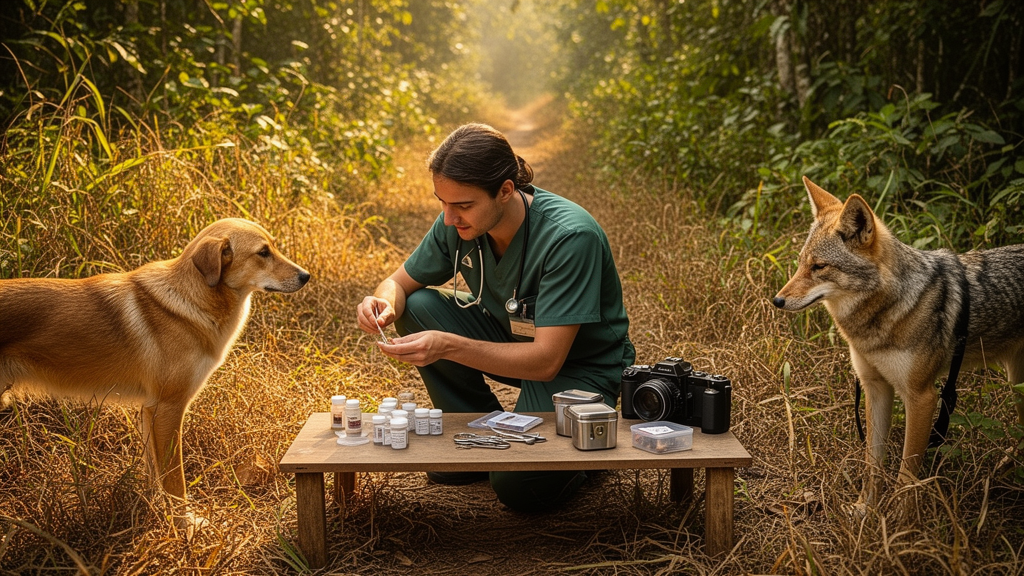
Coyotes and domestic dogs in Costa Rica share gastrointestinal helminth communities across human-modified landscapes, according to an observational study that combined fecal microscopy, DNA metabarcoding, genetic analysis and dietary metabarcoding. Researchers analyzed 31 individual coyotes and 149 domestic dogs and found that the hookworm Ancylostoma caninum was the most prevalent nematode in both hosts, occurring in 38.7% of coyotes and 25.7% of dogs. Molecular screening also detected Toxocara canis and Spirocerca lupi DNA in dogs. The combination of shared parasite detections and genetic patterns supported recent exchange of A. caninum among wild and domestic canids living in sympatric areas.
The study sampled canids across protected, fragmented and urban landscapes in Costa Rica as part of a wildlife–domestic interface investigation. Host identity was confirmed using mitochondrial cytochrome b restriction fragment length polymorphism and 12S metabarcoding, while single-nucleotide-polymorphism genotyping distinguished individual coyotes. Parasite communities were characterized by microscopy and deep amplicon sequencing of the nematode mitochondrial cytochrome c oxidase 1 gene, or cox1. This approach identified seven helminth groups through metabarcoding, whereas microscopy detected four parasite species or groups and generally yielded lower infection frequencies. The molecular and microscopic results therefore differed not only in the number of parasite groups detected but also in measured occurrence, illustrating how the two methods captured complementary portions of the helminth community.
Phylogenetic and haplotype analyses were then performed on the dominant parasite, A. caninum. The researchers found high genetic diversity but no structure associated with either host species or location. The authors interpreted this pattern as evidence of recent parasite exchange among sympatric canids rather than long-term separation of host- or location-specific populations. The result links the broad parasite distributions observed in coyotes and dogs with a shared genetic pool, although it does not identify the precise routes, individual source animals or direction of any particular transmission event. Within the scope of the sampled Costa Rican landscapes, the findings nevertheless demonstrate substantial overlap between the parasite communities infecting wild and domestic canids.
Parasite infection was more frequent in modified environments. Relative to protected areas, infection risk was associated with fragmented landscapes at an odds ratio of 16.000, with a 95% confidence interval of 1.381–185.405, and with peri-urban landscapes at an odds ratio of 8.000, with a 95% confidence interval of 1.061–60.324. Both intervals were wide, indicating considerable statistical uncertainty around the point estimates. These observations came from a geographically focused observational study and therefore support an association between landscape setting and infection rather than establishing that fragmentation or peri-urban development caused the differences. The analysis nevertheless identifies human-modified settings as important settings for parasite surveillance at the interface shared by wildlife, domestic animals and people.
Dietary metabarcoding offered a further line of ecological evidence. Vertebrate 12S metabarcoding showed that coyotes frequently consumed domesticated animals and small mammals, suggesting potential exposure to parasite paratenic or intermediate hosts present in the environment. The researchers also applied a reservoir-capacity model to estimate the potential contribution of coyotes to parasite transmission. Together, the shared infections, absence of host- or location-specific genetic structure and dietary findings led the authors to identify coyotes as possible reservoirs of zoonotic hookworms in this tropical One Health system. The evidence supports this reservoir role as a model-based and ecological interpretation, not as a demonstration that coyotes directly infected dogs or people. By documenting parasite circulation among canids in Costa Rica, the study shows why wild canids, domestic dogs and the landscapes they occupy may need to be considered together when monitoring zoonotic parasites. Its conclusions remain bounded by the sampled regions, host populations and methods, including the limited precision of the habitat estimates and the use of dietary exposure to infer possible sources of infection.
Subject of Research: Wildlife–domestic parasite transmission and dietary exposure in Costa Rican coyotes and dogs
Article Title: Nematode metabarcoding and dietary analysis uncover parasite sharing between wild and domestic canids in a tropical One Health system
Article References: Robleto-Quesada, J., Solano-Barquero, A., Romero-Zúñiga, J. J., Lloyd, K., Montalvo, V., Sáenz-Bolaños, C., Cruz, J. C., Vargas Soto, J. S., Molina-Mora, J. A., Eriksson, C. E., Allen, J., Montenegro, V. M., Levi, T., & Rojas, A. (2026). Nematode metabarcoding and dietary analysis uncover parasite sharing between wild and domestic canids in a tropical One Health system. Parasites & Vectors. https://doi.org/10.1186/s13071-026-07728-z
Image Credits: AI Generated
DOI: 10.1186/s13071-026-07728-z
Keywords: Costa Rica, coyotes, domestic dogs, nematode metabarcoding, Ancylostoma caninum, parasite transmission, habitat fragmentation, dietary metabarcoding, One Health, wildlife–domestic interface, Nematode, metabarcoding
Cite Scienmag News
Drew Townsend. (October 22, 2026). Costa Rican observational study finds shared parasites in coyotes and dogs. Scienmag. https://scienmag.com/costa-rican-observational-study-finds-shared-parasites-in-coyotes-and-dogs/
Drew Townsend. "Costa Rican observational study finds shared parasites in coyotes and dogs." Scienmag, 22 October 2026, https://scienmag.com/costa-rican-observational-study-finds-shared-parasites-in-coyotes-and-dogs/. Accessed 22 October 2026.
Drew Townsend. "Costa Rican observational study finds shared parasites in coyotes and dogs." Scienmag. October 22, 2026. https://scienmag.com/costa-rican-observational-study-finds-shared-parasites-in-coyotes-and-dogs/


